
Advertising account security: how to survive in 2026
Russia and other countries are tightening laws on advertising and personal data. This directly affects the work with advertising accounts and requires a more careful approach to launching campaigns.
The ban of an advertising account is not just a temporary problem. It is a loss of funds, time spent on farming, launching ads, all of which leads to one result: a decrease or complete loss of profit.
Today, it is important not only to choose a profitable combination of offer + creative, but also to ensure proper technical preparation. This refers to the use of an anti-detection browser, working with proxies, and imitating natural user behavior.
Let’s take a look at the basic principles of account security and ways to reduce the risk of bans.
Ways to avoid getting your advertising account banned
1. Proper use of IP and proxy
Each account requires a clean IP. It is best to use mobile or residential proxies from trusted providers.
The IP address should not belong to data centers such as AWS, DigitalOcean, OVH, and other hosting providers, as these addresses often raise suspicion among anti-fraud systems. The geo proxy must match the target audience and the selected geo, otherwise there will be a discrepancy between the account’s behavior and its technical data. The provider (ISP) should look like a regular internet operator, not a server network. It is important to make sure that the IP address is not in spam databases, otherwise the risk of blocking the advertising account will skyrocket.
If there are many proxies, it is better to perform the check automatically. Automation helps to quickly weed out unsuitable IPs.
One last thing: when using mobile proxies, it is worth monitoring address changes — for example, each time the browser is restarted.
2. Configuring the MoreLogin browser fingerprint
In addition to IP, anti-fraud analyzes device parameters. Therefore, you need to configure the anti-detection browser correctly.
The MoreLogin anti-detection browser allows you to flexibly configure parameters and manage the digital fingerprint of the device.
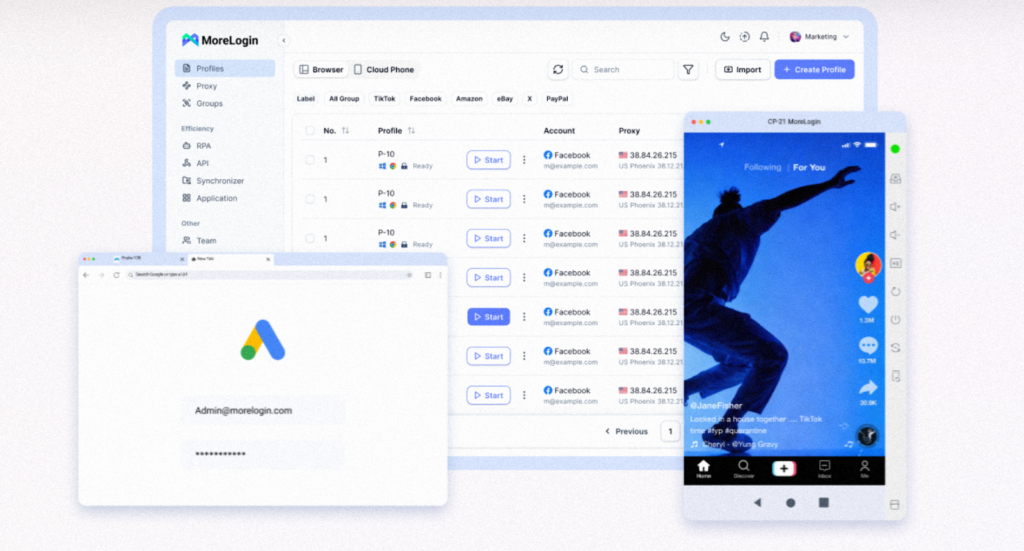
The operating system and browser should look logical, for example, Windows with Chrome for desktop or Android with mobile Chrome for mobile traffic. The video card in the browser fingerprint must match the selected system and not look outdated for the device. The User-Agent must match the screen resolution so that there are no contradictions between the device type and its parameters. The time zone and interface language must be set strictly according to the geo of the proxy used. Avoid things like too many plugins or a complete lack of them, as this may look suspicious to anti-fraud systems and increase the risk of account blocking.
After configuration, the profile must be checked using special services. They will show:
- whether the real IP is visible through WebRTC;
- whether Canvas is masked;
- whether DNS and geolocation match.
It is important to update the fingerprint every 1–2 weeks so that it does not become “exposed.”
3. Behavioral factors: don’t look like a bot
Even the perfect proxy won’t help if your behavior looks like automation.
To keep your account from looking like a bot, you need to imitate normal human user behavior. For example, pause between actions so that clicks and transitions don’t happen at regular intervals. Scroll through pages smoothly. Do not log into your account at the same time every day, as repetitive activity is easily detected. Also, browse your feed, react to posts, respond to messages, and be socially active.
Platforms analyze all information: click speed, video viewing time, account login schedule. Your behavior should be natural.
4. Account isolation
Do not use the same IP address for different accounts, as this creates a direct link between them. Also, do not use the same cookies — they can become a marker that anti-fraud systems use to combine profiles into a single network. It is also prohibited to log into multiple accounts from the same browser profile or environment, as such overlaps usually significantly increase the risk of mass blocking.
Before launching an ad campaign, delete unnecessary cookies and history. The main goal is to ensure that accounts cannot be linked to each other.
Some people use cookie robots for their profile. The main thing is that the websites you visit match the geo-location of your account.
5. Separating stages: farming and launching ads
First, the profile is warmed up: social activity, activity history, behavior is formed. Only after that does the work with advertising begin.
It is best to farm the account in one environment and launch advertising in another, more “clean” working profile without unnecessary traces. This will complicate the work of anti-fraud and help reduce the risk of blocking and mass bans.
Briefly about account farming
Nowadays, new empty accounts are quickly banned, so it is difficult to work in traffic arbitration without good warming up.
The idea is simple: create an account history. Fill out the profile, add photos, subscriptions, likes, comments, video views, correspondence, etc. The profile appears to be active and does not look like a bot.
For farming, use the MoreLogin anti-detection browser and high-quality mobile or residential proxies. Together, this helps isolate accounts and reduce the risk of blocking.
Usually, the process looks like this: registration with unique data, basic profile completion, several days of normal activity without advertising, and only then – a careful launch of the advertising account. Sometimes, “white” advertising with a small budget is launched first to increase trust.
Farming is a mandatory step in working with advertising accounts. The more natural the profile looks and the more carefully the process is built, the lower the risk of blocking and the more stable the result.
Choosing GEO and traffic volumes
The choice of country for launching advertising affects moderation and risks. In traffic arbitrage, it is customary to divide countries into Tier-1, Tier-2, and Tier-3.
Tier-1 (USA, Canada, UK, Europe, Australia) is a solvent audience with a high average check. But this comes with very strict rules and frequent checks. To work in these countries, you need the most trusted advertising accounts, high-quality proxies, and a careful launch strategy.
Tier-2 and Tier-3 (Latin America, Eastern Europe, Asia, Africa) are more often chosen for testing. Here, competition is low, clicks are cheaper, and moderation is less strict. But revenue per user is usually lower, and conversion is lower than in Tier-1.
The optimal approach is not to work with only one GEO. It is better to spread the risk: keep some accounts in Tier-1 for expensive offers, and some in Tier-2/3 for volume and testing. Such a portfolio of countries helps to maintain stability: if rules are tightened or the number of bans increases in one region, traffic can be redistributed to other areas.
Conclusion
Technical security is not a minor issue, but the foundation of stable operation. Everything is important here: the correct IP, the correct browser fingerprint, natural behavior, clear account farming, and careful ad launch. Any minor detail can affect the lifespan of an advertising account.
There is no such thing as a completely “unbreakable” account. But if you build your defenses wisely, you can significantly reduce the risk of bans and extend the life of your accounts.