
How Artificial Intelligence Is Changing Proxy Requirements
AI has quietly made the shift from controlled experiments to everyday digital work. With the increased autonomy of these systems, they became more and more data-hungry, and thus the infrastructure supporting them had to evolve, even at a pace that teams за did not always anticipate.
Introduction
Over the past few years, artificial intelligence and machine learning have become the center of various business activities such as data gathering, product experimenting, market checking, and online operations.
Instead of performing randomly, these systems deliver continuous, organized, and large-scale traffic.
At the same time, platforms have poured resources into understanding user behavior. They no longer evaluate isolated requests, but entire interaction patterns: timing, consistency, origin, and historical context. As a result, infrastructure that once worked reliably now raises flags simply by behaving “too efficiently.”
This shift has pushed proxy usage into a new phase — one where stability, reputation, and predictability matter more than raw throughput.
How AI Is Used Today
Contemporary Al applications have gone a long way beyond automation experiments. Marketing departments more and more rely on Al technology to run their campaigns and adjust their messages nearly in real time.
Meanwhile, analysts use automated models to collect and analyze large amounts of publicly available data.
Spying agents use Al to track the changing offers, the modifications of content, and the signals of competition.
In parallel, autonomous bots take on extensive validation work, including availability checks, consistency testing, and controlled experiments across multiple environments. Although these processes are not malicious by design, their sustained and systematic nature makes them difficult to mask as human-like behavior.
The common thread is duration. AI systems operate continuously, and that continuity places new pressure on the networks they rely on.
Why Legacy Proxy Approaches No Longer Work
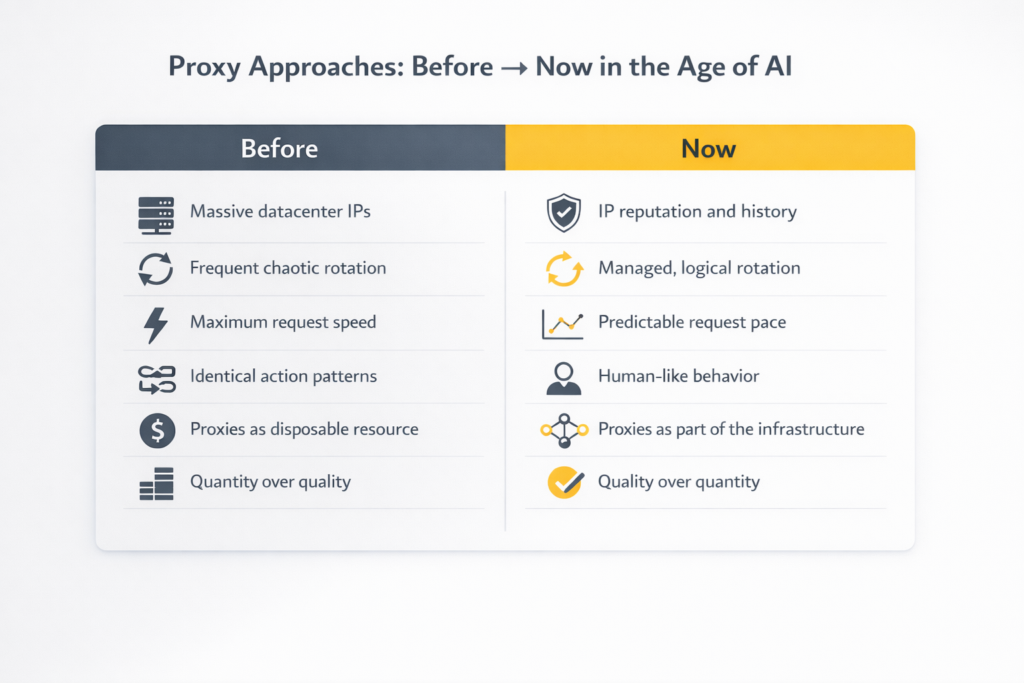
Earlier proxy strategies emerged in a very different environment. Platforms were less sensitive to behavioral nuance, and detection mechanisms relied heavily on static rules. Under those conditions, datacenter proxies optimized for cost and speed were often sufficient. High request volume mattered more than how that volume was distributed over time.
That context has changed gradually but fundamentally. With the accumulation of data, platforms moved away from judging isolated requests and toward modeling long-term behavioral patterns. Processes that once passed as efficient automation now stand out as overly uniform when observed over extended periods.
Uniform IP pools, identical session structures, and repetitive request timing no longer blend into background noise. Rather, they establish stable patterns that can be easily classified at scale. Signals from high-frequency automation are not hidden. On the contrary, they are strengthened.
AI-driven traffic rarely fails because it is fast. It fails because its consistency lacks the natural variability that characterizes real-world usage when viewed over extended periods.
How AI Has Transformed Anti-Fraud and Detection
Anti-fraud systems have evolved alongside AI itself. Rule-based filters, once designed to catch obvious anomalies, have been replaced by machine learning models trained on extensive behavioral datasets.
These systems do not rely on single indicators. They evaluate how activity unfolds over time: the spacing between actions, session continuity, recurrence patterns, IP reputation history, and contextual alignment with local usage cycles. The focus is not on whether a request is valid in isolation, but on whether a sequence of actions deviates from expected norms.
In this framework, infrastructure becomes part of the behavioral profile. Network characteristics, session stability, and historical usage patterns all contribute signals that models learn to interpret.
This is why highly optimized infrastructure can underperform. Systems designed for maximum throughput often produce activity that is internally consistent but externally implausible. Slower, less aggressive setups frequently appear more credible simply because they generate richer behavioral variance.
How Proxy Requirements Have Changed in the AI Era
As detection has grown more contextual, the role of proxies has changed accordingly. They are no longer evaluated as interchangeable routing tools, but as persistent signals within larger behavioral models.
IP Reputation and Behavioral History
IP history and reputation now influence outcomes well before any request is processed. Addresses with long, organic usage histories tend to be interpreted as lower risk, while newly recycled IPs lack the contextual depth that modern systems expect. Reputation is no longer a static score, but a trajectory shaped by how an address behaves over time.
Behavioral Coherence
Human-like behavior has also been redefined. It is not achieved through randomness, but through coherence. Real users are consistent within sessions and across days, yet never perfectly repetitive. AI systems that fail to replicate this balance often reveal themselves through overly regular timing or rigid session structures.
Session Stability and Continuity
Stability and predictability have become essential because many AI workflows are inherently long-running. Frequent disconnects, abrupt IP changes, or broken sessions introduce anomalies that stand out more than steady operation ever would. In practice, instability is interpreted as risk.
Session-Aware Rotation
Rotation strategies reflect the shift. Constant IP changes fragment behavior and disrupt continuity. Deliberate, session-aware rotation preserves context while limiting long-term exposure, producing patterns that are easier to reconcile with natural usage.
In practice, this means designing sessions around behavioral continuity rather than IP longevity. Over-rotating breaks temporal coherence and creates fragmented interaction trails, while holding an address unnaturally long can amplify pattern consistency. Detection models respond less to change itself than to mismatched rhythm when infrastructure timing diverges from how real users appear to enter, act, pause, and return.
Alignment with GEO, language and time zones
Finally, alignment with geography, language, and time zones reinforces plausibility. Infrastructure that reflects local context supports behavioral expectations at every layer, from access timing to interaction frequency.
It is within this analytical environment that residential and ISP-based proxies have moved from niche solutions to practical infrastructure components for AI-driven systems.
Matching Proxy Types to AI Workloads
As requirements have clarified, the proxy landscape has narrowed.

Residential and ISP-based proxies have become the preferred option for long-running AI processes precisely because they support continuity. Their historical context, network stability, and predictable behavior align more closely with how modern detection models interpret legitimacy.
The advantage is not realism in isolation, but durability under observation. Long-running inference, monitoring, or model-driven collection pipelines expose infrastructure to repeated evaluation cycles, where cumulative behavior matters more than individual requests. In such environments, proxies without history degrade faster, regardless of raw performance.
Datacenter proxies still serve a purpose, particularly for short-lived tasks or isolated operations where reputation accumulation is minimal. In these cases, speed and availability remain useful, and long-term behavioral coherence is less critical.
The key distinction is not performance, but duration. AI systems that operate persistently benefit from infrastructure designed to behave consistently over time. This is why proxy selection increasingly favors suitability over scale: a smaller pool that produces coherent signals often outperforms a larger one that introduces conflicting behavioral cues.
How These Patterns Show Up in Real Life
One of the most critical elements in Al-powered marketing is a stable network situation to be able to assess the performance of a campaign without any hidden factors.
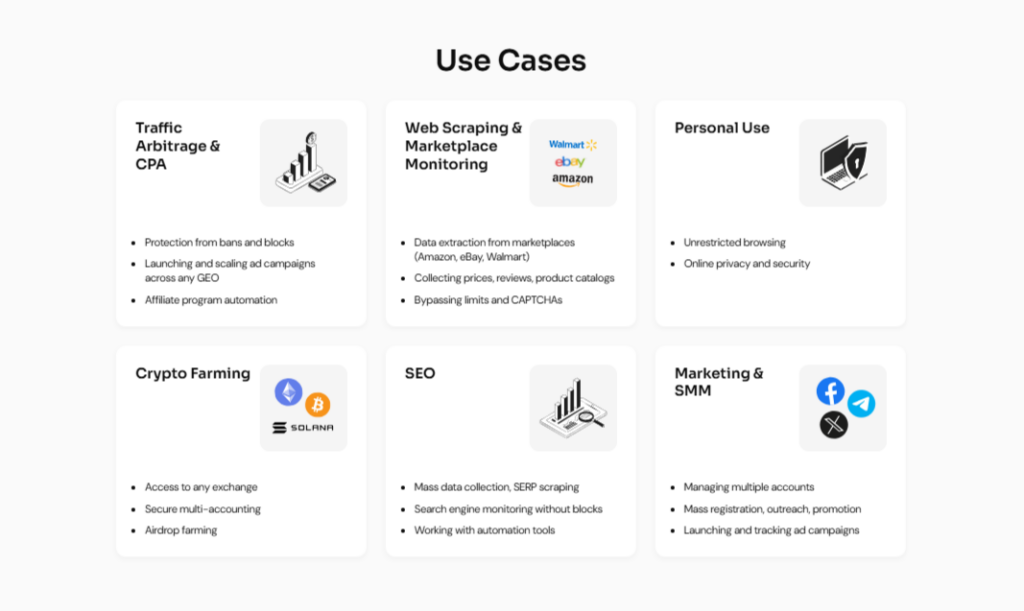
Data collection workflows face similar risks. Inconsistent sessions or unstable routing can introduce gaps and bias into datasets, affecting downstream analysis. For automation frameworks managing multiple identities, continuity is critical; abrupt changes create correlations that detection systems readily identify.
Even hypothesis testing depends on infrastructure stability. When network behavior fluctuates, it becomes difficult to distinguish genuine outcomes from artifacts introduced by the environment itself. In this sense, proxy infrastructure shapes not only access, but the reliability of conclusions drawn from AI-driven experiments.
Proxy as Managed Infrastructure for AI-Driven Systems
In response to the constant, long-running activity AI systems now produce, some providers have updated their infrastructure accordingly. Mango Proxy positions proxies as a managed layer rather than a temporary resource, offering ISP, residential, and server-based proxies built to handle persistent workloads.
With access to huge IP pools covering more than 200 locations and tens of millions of addresses, this setup supports an operational approach that aligns with modern AI: continuous operation across multiple environments, where maintaining session integrity and preserving behavioral history outweigh short-lived connections.
Conclusion
Artificial intelligence has impacted every level of digital infrastructure by raising the standards. Proxies today are being evaluated not only based on their speed or availability, but also on how naturally they can fit into overall behavioral models.
With the increase in sensitivity of platforms, the focus of infrastructure decisions is changing from operations to strategy.