
Why 2Captcha remains a best captcha solver for automation
In 2026, automating web scraping, price monitoring, multi-accounting, and other tasks directly depends on the stability and detection-resistance of processes under strict platform protection. To keep these pipelines stable, many teams integrate a dedicated CAPTCHA-solving layer like 2Captcha or SolveCaptcha to handle challenges without breaking the session flow. CAPTCHA is no longer just an image with object selection — it’s a comprehensive heuristic analysis. Today, anti-bot systems (e.g., Cloudflare, DataDome) evaluate not only the correctness of the answer but also the “network fingerprint,” behavioral factors, and overall user trust score. In these conditions, CAPTCHA becomes not just an obstacle but a single point of failure for the entire session: one suspicious signal — and the pipeline stops, data is lost, and business processes are disrupted. For developers and marketers, this means constant adjustments, time loss, and risks to scaling.
The CAPTCHA problem in automation
CAPTCHA is the main cause of failures in automation. The key issues specialists face:
- Rapid evolution of protection: Anti-bots update more frequently than developers can adapt code — from classic puzzles to invisible reCAPTCHA v3 Enterprise and Cloudflare Turnstile, which evaluate user score in the background.
- Unpredictability of formats: A script runs stably for hours, but a new challenge (slider, audio, or enterprise token) breaks the entire flow.
- Detection by indirect signs: Even a correct solution doesn’t help if the traffic looks suspicious — by IP, timing, or fingerprint.
- Scaling under threat: Without a reliable challenge-solving mechanism, processes can’t handle volumes and frequent changes.
Without an external solver, pipelines remain fragile and dependent on outdated scenarios.
What is a CAPTCHA solver
A CAPTCHA solver is a service that takes a challenge from a site (grid image, slider, audio puzzle, enterprise-level token) and returns the correct solution. It allows automation to continue working regardless of protection changes: the challenge is sent to the solver, the solution is returned and applied in the current browser session or request. This is critical for stable data collection, monitoring, and other tasks where CAPTCHA appears unexpectedly.
What is 2Captcha
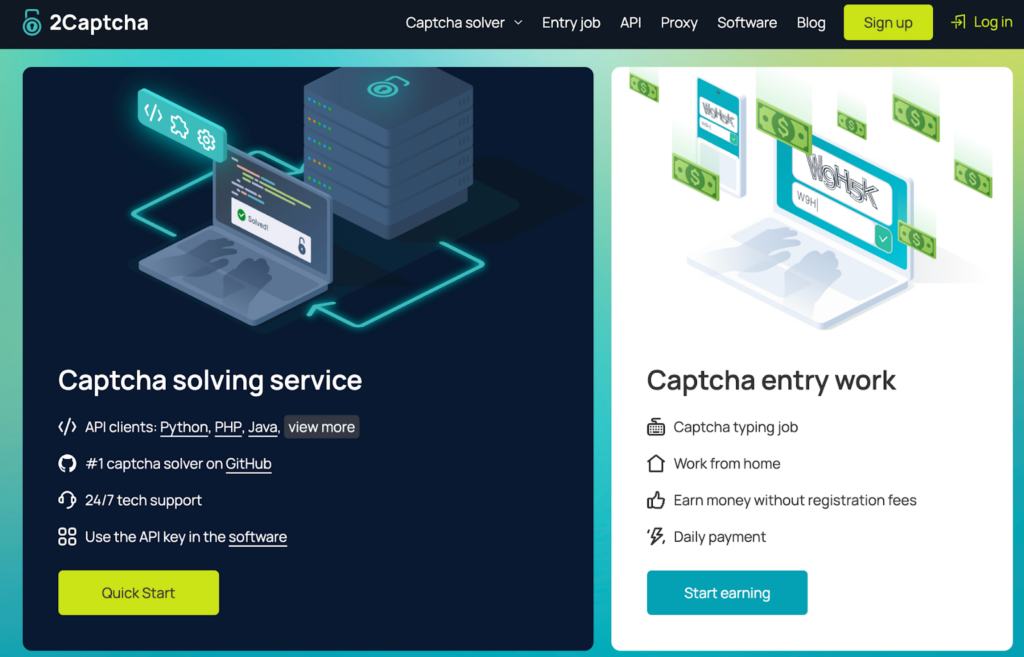
2Captcha is an international hybrid CAPTCHA solving service with a human-based approach. Unlike purely ML tools, the key role here is played by thousands of live operators, supplemented by machine learning algorithms. This allows handling tasks where automation hits a dead end.
Advantages of the hybrid approach:
- Human-based architecture: When algorithms struggle with unclear images or complex enterprise protection logic, the task is passed to a person. Operators consider context and nuances, ensuring high success rates even on aggressive systems.
- Universal and stable API: Integration is simple — createTask (sending the task) → getTaskResult (receiving the result). One interface covers all CAPTCHA types, without separate libraries or code rewrites when protection updates.
- Difference from ML-only services: Pure machine solvers are limited by training on known data and require weeks to adapt to new formats. 2Captcha masters fresh formats within hours: operators start solving immediately while competitors’ models retrain.
- Natural behavior and timing: Instant ML responses (0.1 sec) are a clear bot marker for anti-fraud. 2Captcha imitates a real user with variable delays (0.1–25 sec), reducing behavioral detection risks and increasing session longevity.
- Wide coverage: Support not only for popular reCAPTCHA but also regional and exotic formats on local sites.
This combination provides a balance of speed, cost, and resilience — a reliable infrastructure solution for automation where protection changes frequently.
How 2Captcha works
The process is predictable and flexible for different scenarios. First, a task is created: site parameters are sent (URL, sitekey, and additional fields for the specific type). The modern API is JSON-based, simplifying integration with Node.js, Python, and other languages — requests and responses in a convenient format.
The service returns a unique task ID. For advanced integrations, webhooks are available — the result arrives automatically on your server without periodic polling, saving resources and reducing load.
Then, status is checked with a recommended interval of at least 5 seconds. While the task is in progress, “processing” is returned. When status changes to “ready,” the solution arrives — token or data for application.
The solution must be used immediately in the same session to maintain context (tokens have limited lifetime). For SPA applications and enhanced protections, the service supports Proxy-on-board: you pass your proxy in createTask parameters, and the operator solves the challenge through your IP. This is critical for reCAPTCHA v3 Enterprise, where the solution is tied to IP address and session. User-Agent transmission is also possible for full fingerprint consistency.
Official SDKs for Python, JavaScript, PHP, Go, and C# simplify implementation — code integrates in hours, and libraries are always up to date.
Why 2Captcha is more effective than ML-only solvers
Pure machine solvers provide fast but too uniform responses — easily detected by fixed timing and lack of variations. 2Captcha adds the human factor, making behavior natural.
Comparison of key criteria:
| Criterion | 2Captcha | Pure ML solvers |
| Solution speed | 0.1 to 25 seconds depending on task complexity | Usually 0.1 to 2 seconds |
| Timing pattern | Variable and natural, imitating real human actions | Uniform and predictable, simplifying anti-bot detection |
| CAPTCHA type coverage | Over 30 types, including rare, regional, and exotic variants | Mainly popular types like reCAPTCHA and hCaptcha |
| Adaptation to new formats | Within hours thanks to operator involvement for analysis and solving | Days or weeks for model retraining and algorithm updates |
| Support for multiple types in one project | Full support through single API | Often requires separate integrations or modules |
| Solution success rate | Over 90% in real scenarios | 80–90%, dropping on complex tasks |
| Resistance to flagging | High due to behavior naturalness | Medium or low due to uniform patterns |
| Cost | Slightly higher due to human factor | Slightly lower, but with production failure risks |
| Support and maintenance | Minimal — stable API works for years without changes | High — frequent library and model updates for adaptation |
ML solvers (machine learning-based solutions) are cheaper and faster for simple tasks, but with smart platform protection, they often lead to blocks. 2Captcha costs a bit more but provides stability and longevity in real projects where reliability is critical.
The role of proxies in CAPTCHA solver work
A CAPTCHA solver shows maximum effectiveness only when paired with quality proxies. Using cheap server IPs results in low trust score: the site may accept the CAPTCHA solution but block further actions due to suspicious traffic. It’s even worse if the solver and proxies operate in different geo-locations — anti-fraud will see a “jump” between countries in fractions of a second and nullify the token.
The ideal combination is residential or ISP proxies (e.g., from MangoProxy) + 2Captcha. Residential IPs look like from a real home user, providing natural traffic, correct geolocation, and high acceptance rate. The MangoProxy + 2Captcha tandem ensures geo-relevance: you get the challenge solution from exactly the region where your bot operates. This creates a complete illusion of an ordinary person: protection doesn’t detect automation by network trace, solutions pass more often, and sessions last longer. Without good proxies, even the best solver wastes resources.
Typical mistakes when working with CAPTCHA solver
To avoid unnecessary expenses and failures, consider common pitfalls:
- Too frequent status requests: This triggers API limits — adhere to a minimum 5-second interval.
- Recreating tasks on “processing” status: Unnecessary — just wait, a new task only increases costs.
- Using outdated tokens: Tokens have limited lifetime (for reCAPTCHA — about 120 seconds), apply immediately after receiving.
- Ignoring reports on incorrect solutions: If the token didn’t work, send a report — get a refund and help improve the service.
When 2Captcha is the right choice
The service is ideal for high-load scenarios with changing protection:
- High-volume automation: large-scale marketplace scraping, price monitoring, account registration flows.
- Projects with various CAPTCHA types needing one universal integration.
- Production tasks where stability, acceptance rate, and minimal downtime are critical.
- Teams requiring predictable costs, natural traffic behavior, and fast adaptation to new anti-bots.
For developers: SDKs and integrations
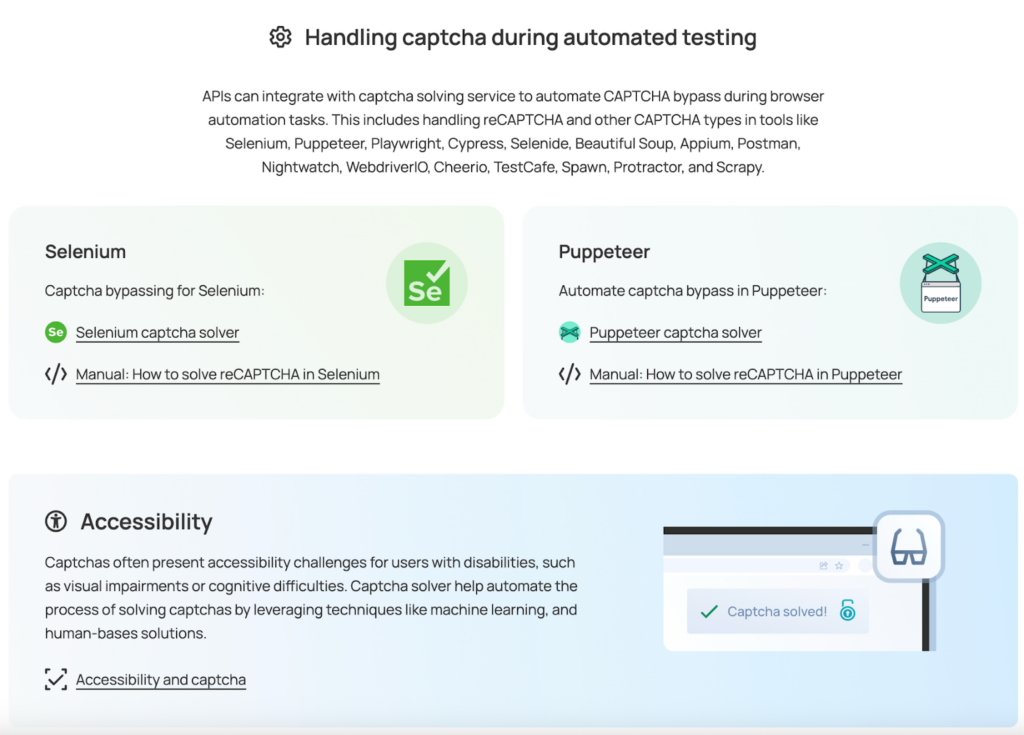
2Captcha simplifies developers’ lives with ready tools. Official libraries (e.g., 2captcha-python, 2captcha-javascript) allow integrating the service in hours — with ready functions for task creation, status polling, and error handling.
For those who prefer no coding, there’s a Chrome and Firefox extension: it automatically detects CAPTCHA on the page, sends the task, and applies the solution in the current browser. Useful for testing, QA, or manual scenarios.
Integrations with Selenium, Puppeteer, and Playwright have ready examples in documentation — from detecting CAPTCHA container in DOM to token substitution in the form.
Conclusion
2Captcha is a reliable infrastructure tool for automation where CAPTCHA turns into the main failure point. The hybrid approach combines wide type coverage, natural solution behavior, and stable API — processes continue working even with frequent anti-bot updates.
Maximum effectiveness is achieved when paired with quality proxies: they hide the network trace, increase trust score, and ensure session longevity. For production, this is a practical solution that lets you focus on data collection and analysis rather than constant fight with platform protection.For more details on the 2Captcha CAPTCHA solving service and integration examples — visit the official website.