
Why Accounts Get Banned Even with Low Activity
Many believe that if an account does almost nothing, there is no real risk. Limited activity, careful actions, no mass operations – everything should be safe. In practice, you may have seen a different scenario: the account works calmly, activity is minimal, and suddenly restrictions appear.
The reason is usually not the number of actions. Platforms evaluate not only how often you act, but how you connect, which region you log in from, how IP addresses change, and how consistently sessions behave. In many cases, network factors become the main trigger.
Low Activity Does Not Mean Low Risk
Anti-fraud systems evaluate the full picture. What matters is not only how much you do, but how it looks from the platform’s perspective. If you log in from one region and shortly afterward connect from another, the system registers it. If the IP changes abruptly and without logical consistency, even two or three actions can look suspicious. If the connection behaves inconsistently, latency fluctuates, or IP addresses repeat too frequently, the overall activity pattern may appear unusual. You may perform very few actions, but if the technical environment looks inconsistent, the platform reacts to that.
What Is a Network Profile and Why It Matters
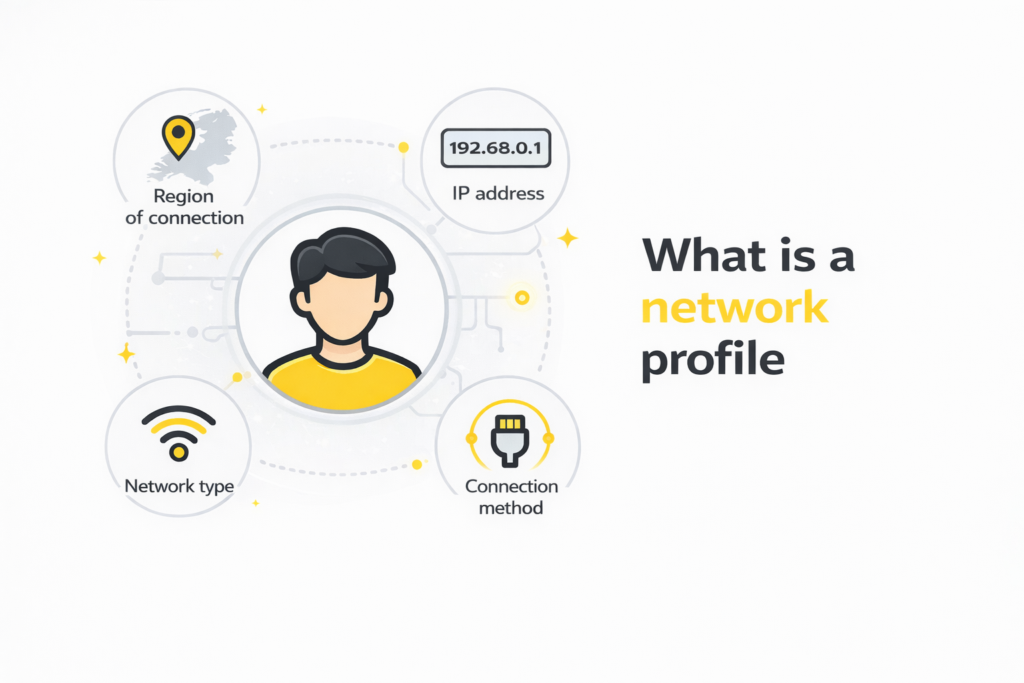
Every action you take is accompanied by technical parameters: connection region, IP address, network type, and connection format. Together, these form what can be described as a network profile.
If the account’s region does not match the IP region, if addresses change without a clear pattern, or if the connection behaves inconsistently, the platform detects a mismatch. This becomes even more noticeable when automation or API-based workflows are used, as technical signals are evaluated more closely in such cases.
That is why choosing proxies is not only about price or simply having an IP address. The connection type must match your task and provide stable behavior without abrupt changes.
Where Risk Most Often Appears
Automation
When automation is used, IP changes may happen more frequently. If rotation is configured without considering session duration, the system sees the same account connecting from different addresses on a regular basis. Even with low activity, this can appear unstable.
API Usage
When working through a programming interface, the platform sees the structure and rhythm of requests more clearly. If load is distributed unevenly or the connection behaves inconsistently, this becomes noticeable faster than in manual use.
Scraping
When collecting data, proxies are used in sequences. If IP addresses repeat too often or change without clear logic, the platform may identify a repeating connection pattern.
Increased Load
An account may operate smoothly during testing but start facing restrictions as volume increases. The issue is not necessarily the number of actions, but that the technical environment was not designed for sustained load. The system begins noticing recurring connection characteristics.
Why Infrastructure Matters More Than It Seems
If you experience restrictions despite low activity, it makes sense to look at the connection environment rather than the actions themselves. Do the region, IP address, proxy type, and rotation logic align with each other? How does the IP pool behave during extended sessions?
In professional setups, proxies become part of the overall technical structure. They ensure stable connections, consistent IP behavior, and controlled address rotation when necessary. For example, MangoProxy is used as a network layer for automation, API-based workflows, and data collection – where connection stability and a wide selection of formats, including residential, ISP, and datacenter proxies, are important.
What matters most is not simply using proxies, but how they behave over time.
Practical Takeaways
If an account receives restrictions despite minimal activity, consider asking yourself a few questions. Does the proxy type match the workflow? Is IP rotation configured logically? Does the connection region align with the account’s logic? Is the connection stable during longer sessions?
Anti-fraud systems react not only to volume but to technical inconsistency. The more structured and consistent your environment is, the fewer unnecessary signals are sent to the platform.
FAQ
Why is my account blocked if I barely use it?
Because platforms evaluate not only activity but also connection parameters. Sudden IP changes or regional mismatches can raise concerns even with minimal actions.
Can the issue really be the proxy?
Yes. If the connection is unstable or IP addresses change chaotically, it affects the overall account profile.
Is a static IP safer?
In some scenarios, yes, especially for longer sessions. But overall logic and consistency matter more than just using a static address.
Why did everything work in testing but fail later?
At low volumes, technical inconsistencies may go unnoticed. As load increases, repeated patterns become more visible to the system.
Is it possible to eliminate the risk completely?
No. Platforms use complex evaluation algorithms. The goal is not to remove risk entirely, but to reduce technical inconsistencies.
Conclusion
Accounts are not restricted only because of high activity. In many cases, the reason lies in the technical layer: how the account connects, how IP addresses change, and how stable the connection is. If you work with automation, APIs, or data collection, the network layer becomes critical. The more stable and logically structured it is, the fewer reasons the platform has to treat behavior as suspicious.
Clear and insightful article. It explains well why accounts can still get banned even with low activity and highlights factors people often overlook