
Why IP Rotation Does Not Always Help
In many automation teams, a simplified assumption still persists: if blocks start occurring, just enable IP rotation. The logic seems straightforward. If a platform detects suspicious activity from one address, change the address and the problem disappears. In practice, however, this approach works less and less.
Modern anti-fraud systems have long moved beyond analyzing a single IP. They evaluate behavior, request frequency, device fingerprints, network anomalies, and correlations between accounts. As a result, proxy rotation by itself is no longer a universal solution. It is important to understand not only which parameters to change, but also which mechanisms actually trigger a block.
How Platforms Actually Make Blocking Decisions
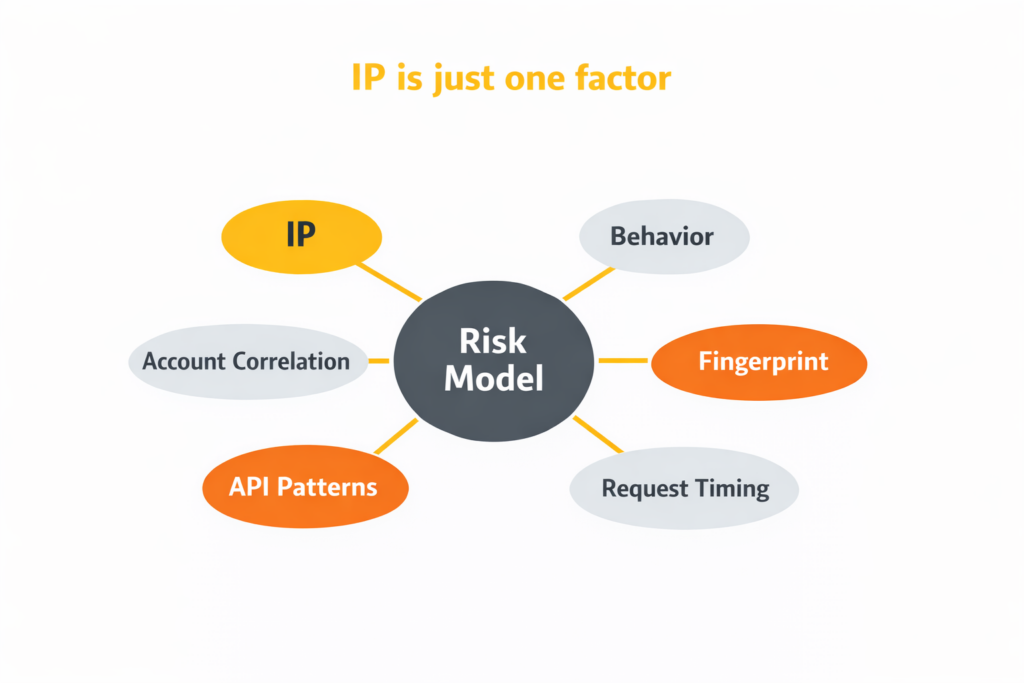
An IP address is only one signal in a broader risk model. Today, anti-fraud systems analyze:
- behavioral patterns (click speed, action sequence);
- request density and timing;
- fingerprint similarities;
- repetition of API scenarios;
- infrastructure overlap between accounts.
If automation is designed so that 100 accounts perform identical actions with identical delays, changing the IP does not change anything. The behavior still looks synthetic.
This is especially noticeable in:
- large-scale scraping,
- API integrations,
- scaling advertising accounts,
- farming and warming processes.
Why Frequent IP Changes Can Make Things Worse
Paradoxically, aggressive rotation can sometimes increase suspicion. When a single account appears in different subnets and geographic regions within a short period of time, the anti-fraud model detects inconsistent network behavior. This looks less natural than stable activity from one properly selected address.
That is why in some tasks it is more appropriate to use static ISP proxies, where there is a balance between IP stability and ISP-origin characteristics. For long-term processes, this is often more logical than chaotic address switching.
Behavior Matters More Than IP: The Architecture Problem
| Real User Behavior | Automated Scenario |
| Irregular click intervals | Fixed time intervals |
| Varying page depth | Identical navigation path |
| Random pauses and returns | Strict linear logic |
| Variable reaction speed | Constant execution speed |
| Different entry points | Same starting URL |
One of the most common causes of blocks is not the proxy type, but the logic of the system itself.
1. Scraping Without Adaptive Delays
If a script sends requests at equal intervals, the platform quickly identifies machine activity. Even residential proxies will not help if the behavior does not resemble real user patterns.
2. API Usage Without Rate Control
Large-scale API calls during scaling require proper load distribution. If the structure of requests remains identical, changing the IP does not hide the repetitive nature of the actions.
3. Multi-Accounting Without Environment Isolation
If accounts share the same fingerprint, user-agent, and network characteristics, anti-fraud systems link them regardless of IP differences. In such cases, it is important not only to connect through proxies, but also to separate and isolate each account’s working environment.
When Rotation Actually Makes Sense
This does not mean rotation is useless. It can be effective:
- when collecting public data with request limits;
- when distributing load across threads;
- when testing ad creatives in different regions;
- when running scalable price monitoring systems.
However, rotation should be part of the overall architecture, not a reaction to a block.
Differences Between Proxy Types in the Context of Blocks
To make informed decisions, it is important to understand the differences:
Datacenter proxies – fast and stable, but platforms often recognize them as server-origin addresses.
Residential proxies – appear as regular home-user connections and are suitable for distributed workloads.
ISP proxies – IP addresses issued by internet service providers; they provide address stability while not appearing as typical server networks.
The key is to focus not on fear of blocks, but on the logic and structure of your use case.
Practical Takeaways
- IP is only one of many risk signals.
- Simply increasing volume without adapting behavior increases detection risk, even when using different proxies.
- Stability can sometimes be safer than chaotic IP switching.
- Architecture is more important than reacting to individual blocks.
When building automation systems, it makes sense to design the network model in advance. In professional scenarios, infrastructure such as MangoProxy is treated as part of the overall system, not as a quick way to eliminate restrictions.
FAQ
Why am I still getting blocked even after changing IPs?
Platforms analyze behavior, request frequency, and digital fingerprints. If the activity still looks automated, changing the address will not solve the issue.
How many IPs are needed for safe automation?
There is no universal number. What matters is load distribution and behavioral diversity, not the sheer number of IPs.
Are residential proxies always safer?
They resemble real user traffic more closely, but incorrect automation logic can still result in blocks.
Is it better to use static or rotating IPs?
It depends on the task. For long-term account operations, stability is often preferable to frequent rotation.
Conclusion
IP rotation is a tool, not a universal solution. Blocks occur not because of a single address, but due to a combination of signals.
The deeper the understanding of anti-fraud logic and automation architecture, the more stable the system becomes. A systemic approach reduces risk far more effectively than simply changing IPs at the first sign of restrictions.