
Why Proxies Suddenly Lose Speed

Almost everyone who works with proxies has experienced this scenario. At the beginning, everything runs smoothly: tests pass, response time is good, automation launches without issues. But after a few hours or days, the situation changes – latency increases, connections become unstable, and tasks start taking noticeably longer.
At that point, it is tempting to assume the issue is “bad IPs” or the provider itself. In reality, a sudden drop in proxy speed is rarely random. It is usually the result of how the load is distributed, how IP rotation is configured, and whether the overall architecture is designed for real production volume.
Proxy Speed Is Not Just About Bandwidth
It is important to understand that proxy speed is not the same as network throughput. Even if the connection channel is fast, that does not guarantee stable response times under load.
When proxies are used occasionally – for example, for infrequent actions – problems are barely noticeable. But in automation scenarios, API integrations, or bulk operations, the load behaves differently. Competition for resources increases, the number of simultaneous connections grows, and latency starts to accumulate.
From the outside, this looks like a sudden drop in speed. In practice, the reason is more often related to how the load is distributed within the system and how proxies are used for the current volume of tasks.
IP Pool Overload
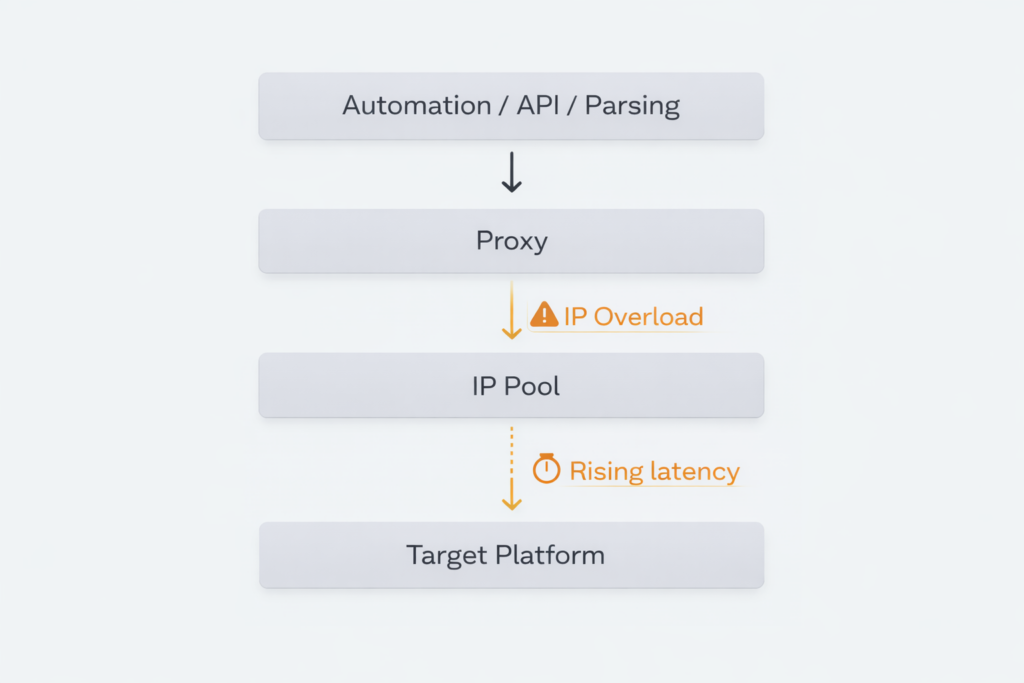
One of the most common causes is uneven use of the IP pool. When a large number of requests pass through a limited number of IP addresses, local overload appears. At small volumes, this may not be noticeable. But during data parsing or bulk actions, each IP begins handling more connections.
At some point, response time increases, delays appear, and proxy stability declines. Formally, nothing has changed: the proxy type is the same, the region is the same, the channel is the same. The only difference is the volume of load and the number of requests per IP.
| Factor | What Happens | Impact |
| IP overload | Too many requests through one address | Rising latency and failures |
| Frequent rotation | New connections constantly created | Increased response time |
| Uneven load | Some IPs overloaded | Instability |
| Scaling | Growing traffic streams | Speed fluctuations under load |
IP Rotation and the Accumulation Effect
Many assume that frequent IP rotation automatically improves stability. However, if rotation is configured without considering session logic, it can reduce performance instead. Each IP change means a new connection, new network checks, and additional initialization. In automation scenarios where thousands of short requests are executed, this overhead becomes significant. In such cases, slower performance is not related to proxy quality, but to connection logic and how often the system initiates new sessions.
Working with API: Why Consistency Matters
When working with APIs, peak speed is less important than consistent response times. If load is distributed unevenly, latency begins to fluctuate. API integrations are sensitive to these variations. Timeouts appear, retry requests increase, and overall task execution time grows. The system slows down not because of volume itself, but because of instability over time. In these cases, it is critical that the network profile remains consistent and that load is distributed evenly.
Parsing and Scaling
In data parsing, the accumulation effect becomes noticeable very quickly. Even minor instability multiplied by thousands of requests turns into a visible performance drop. When scaling, the issue becomes even more apparent. What seemed stable during testing starts to produce delays as volume increases. The system becomes sensitive to limitations – for example, increased load on specific IPs or uneven address rotation. This is usually the moment when it becomes clear whether the architecture was designed for growth or only worked under experimental conditions.
Why Infrastructure Matters
Proxy speed is the result of how the overall system is structured. If load is distributed logically, IP rotation is aligned with session duration, and the IP pool capacity matches task volume, proxies remain stable even as load grows. If these elements are not aligned, even a high-quality proxy server will show performance drops.
In professional scenarios – automation, API usage, parsing, traffic scaling – proxies become part of the overall technical infrastructure. For example, MangoProxy is used as a connection foundation in systems where not only speed but also stability under sustained load is important. What matters is not the advertised number, but behavior under pressure.
Practical Takeaways
If proxies suddenly lose speed, it makes sense to analyze not only the service itself but also how the load is structured. It is important to evaluate whether the IP pool capacity is sufficient, whether requests are distributed evenly, whether IP rotation is logically configured, and whether the proxy type matches the actual scenario.
Speed is a dynamic metric. It depends more on architecture than on formal specifications.
FAQ
Why do proxies work fast at first and then slow down?
Because initial testing usually involves minimal load. As request volume or simultaneous connections increase, limits in load distribution or IP pool capacity become visible.
Can IP rotation reduce speed?
Yes, if IP changes happen too frequently without considering session duration. Each new connection takes time to establish, and with many short requests, this affects overall response time.
Why is everything stable in testing but slower during scaling?
At low volumes, the system does not reach its limits. As load increases, IP overload, uneven request distribution, and architectural constraints start to affect performance.
Is the proxy provider always the problem?
Not necessarily. Often the issue lies in how load is organized, how many parallel threads are running, and whether the proxy type fits the real scenario.
What matters more – speed or stability?
For long-term work, stable response times are more important. High speed loses value if the connection behaves inconsistently and causes failures during automation or API usage.
Conclusion
A sudden drop in proxy speed almost never happens without a reason. In most cases, it is a signal that the system is operating beyond its comfortable load or that traffic is distributed unevenly.
When infrastructure is designed thoughtfully and load grows gradually, proxies maintain stability even as volume increases. This is the approach that helps avoid situations where speed suddenly declines without an obvious explanation.