
Why Proxies Work but Websites Still Restrict Access
This situation is familiar to many teams: proxies connect successfully, the IP responds, the test passes – yet the website still starts slowing responses, triggering CAPTCHA, or fully restricting access. It creates the impression that proxies are not working, even though the connection itself is technically correct.
In reality, the issue is rarely that proxies are not functioning. They work. However, websites do not evaluate only the fact that traffic comes from an IP address. They analyze behavior, request structure, frequency, and the overall consistency of the environment. If the architecture is not aligned, restrictions may appear even when using residential proxies or ISP proxies.
Understanding these mechanisms is critical for automation, API integrations, scraping, and traffic scaling.
Why a “Working Proxy” Does Not Mean Stable Access
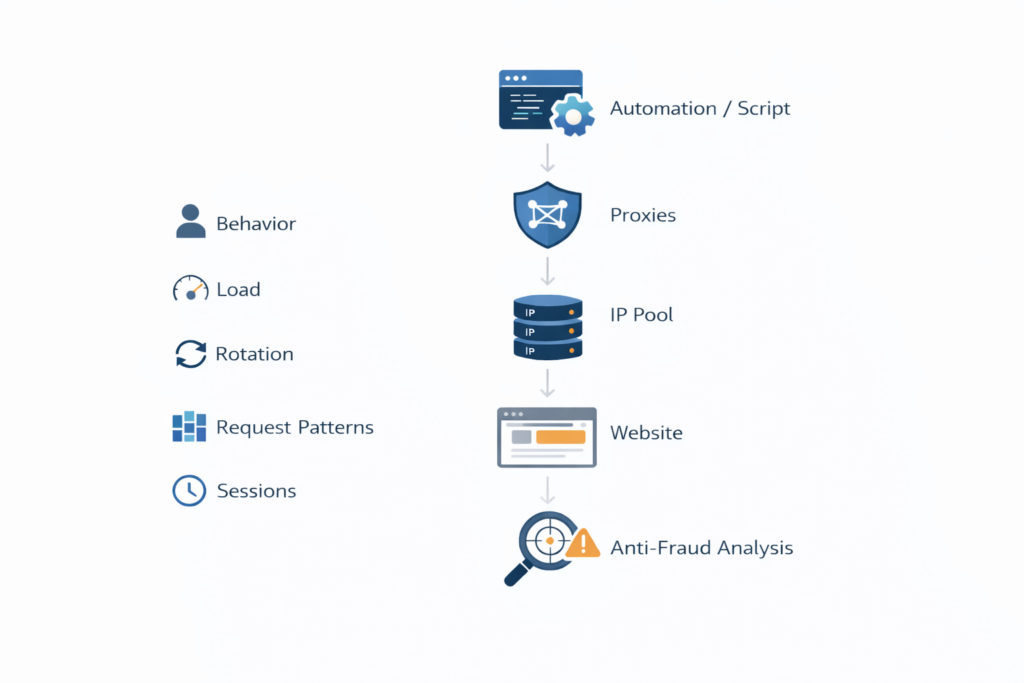
A proxy is only one layer of infrastructure. A website evaluates a combination of signals.
When running automation or collecting data, the system observes:
- request intensity
- load distribution across IPs
- repetition patterns
- session duration
- alignment between region and IP
For example, a proxy server may be configured correctly, but if traffic concentrates on a small IP pool, overload forms. Even when using rotating residential proxies, a website may detect unusually high activity coming from the same IP range. From the outside, proxies appear to function normally, but the platform gradually lowers trust in the traffic source.
Behavioral Factors in Automation and API Usage
When working via API, analysis becomes more granular. Platforms evaluate not only IP addresses but also the rhythm of requests.
In automation scenarios, common issues include:
- overly uniform request intervals
- large numbers of short-lived connections
- aggressive IP rotation
- lack of session logic
Even high-quality residential proxies cannot compensate for architectural mistakes. If the system detects a repeated machine-like pattern, it reacts to the behavioral profile rather than the proxy type.
Scaling: When the Problem Becomes Systemic
At small volumes, everything may appear stable. But as traffic scales, hidden limitations begin to surface.
Common issues include:
- uneven traffic distribution
- excessive request density on a single IP
- conflict between rotation logic and session duration
- mixing static and rotating configurations
At this stage, it becomes clear that proxies have not “stopped working.” The architecture simply was not designed for growth. In professional infrastructure, proxies become part of a broader load management system. For example, MangoProxy is often used as a component of technical architecture in automation, API, and scraping tasks – where stability of IP behavior under load matters more than sheer IP quantity.
Differences Between Proxy Types and Their Impact
| Proxy Type | Key Strength | Main Risk if Misconfigured |
| Datacenter | Speed | Rapid classification |
| Residential | Natural traffic profile | IP pool overload |
| ISP | Session stability | Restrictions under high request volume |
- Datacenter proxies can deliver high speed but are easily classified as hosting infrastructure.
- Residential proxies appear more natural but require well-managed rotation.
- ISP proxies provide session stability, yet under aggressive load they may still face restrictions.
The issue arises not because of the proxy type itself, but because of a mismatch between proxy type and workload scenario.
Practical Takeaways
If a website restricts access while proxies are technically working, analyze:
- whether load is distributed evenly
- whether the IP pool capacity is sufficient
- whether rotation aligns with session logic
- whether the proxy type matches the scenario
- whether the infrastructure remains stable over time
Websites do not react to proxy usage as such. They respond to inconsistencies between network and behavioral parameters.
FAQ
Why do proxies connect but the site still shows CAPTCHA?
Because detection systems analyze not only IP connectivity but also request structure, frequency, and session behavior.
Will switching proxy types help?
Sometimes. However, if the issue lies in load architecture, changing the proxy type alone will not fully resolve it.
Why do restrictions appear during scaling?
Traffic growth amplifies weak points in infrastructure, such as uneven distribution or IP overload.
Is the provider always responsible?
No. Often the cause lies in automation logic and traffic management rather than the proxy service itself.
Conclusion
When proxies work but a website still restricts access, it usually signals an architectural issue rather than IP failure. Stability depends not only on choosing the right proxy type but on aligning the entire infrastructure – rotation logic, load distribution, session management, and scaling strategy.
A systematic approach is what allows infrastructure to remain resilient under automation, API workflows, and growing traffic volumes.