
HTTP vs SOCKS5 Proxy: What Is the Difference?
HTTP and SOCKS5 are two of the most commonly used proxy protocols. While both allow users to route internet traffic through another server and hide their real IP address, they work in different ways and are designed for different use cases.
Understanding the difference between HTTP and SOCKS5 proxies is important when choosing infrastructure for tasks such as web scraping, automation, account management, or secure browsing.
This guide explains how both proxy types work, their main differences, and when each protocol should be used.
HTTP vs SOCKS5 Summary Table
| Feature | HTTP Proxy | SOCKS5 Proxy |
| Protocol layer | Application layer | Lower network layer |
| Supported traffic | HTTP / HTTPS | Any protocol |
| Speed | Fast | Often faster |
| Authentication support | Yes | Yes |
| UDP support | No | Yes |
| Ideal for web traffic | Yes | Yes |
| Ideal for automation | Limited | Yes |
| Ideal for torrents / gaming | No | Yes |
In simple terms:
HTTP proxy = optimized for web browsing
SOCKS5 proxy = flexible and protocol-agnostic
What Is an HTTP Proxy
An HTTP proxy is designed specifically to handle web traffic using the HTTP or HTTPS protocols.
When a user connects to a website through an HTTP proxy, the proxy server processes the request and forwards it to the destination server.
HTTP proxies can also perform additional functions such as:
- filtering traffic
- caching web content
- modifying headers
- controlling web access
Because HTTP proxies operate at the application layer, they are optimized for browser-based activity.
Common use cases include:
- web scraping
- SEO monitoring
- ad verification
- browsing through different locations
What Is a SOCKS5 Proxy
SOCKS5 is a more flexible proxy protocol that operates at a lower network level.
Instead of handling specific types of traffic, SOCKS5 simply forwards data packets between the client and the destination server.
Because of this design, SOCKS5 proxies support:
- HTTP
- HTTPS
- FTP
- SMTP
- peer-to-peer connections
- gaming traffic
- streaming protocols
Another advantage of SOCKS5 is support for UDP traffic, which HTTP proxies cannot handle.
This makes SOCKS5 proxies highly versatile.
Key Differences Between HTTP and SOCKS5
Although both proxy types hide your IP address, their technical architecture is different.
| Category | HTTP Proxy | SOCKS5 Proxy |
| Traffic type | Web traffic only | All network traffic |
| Protocol flexibility | Limited | High |
| UDP support | No | Yes |
| Network layer | Application | Transport |
| Performance | Good | Often better |
| Complexity | Simple | More advanced |
HTTP proxies are simpler and optimized for web-based activity.
SOCKS5 proxies provide more flexibility and can handle a wider variety of internet protocols.er connections.
When to Use HTTP Proxies
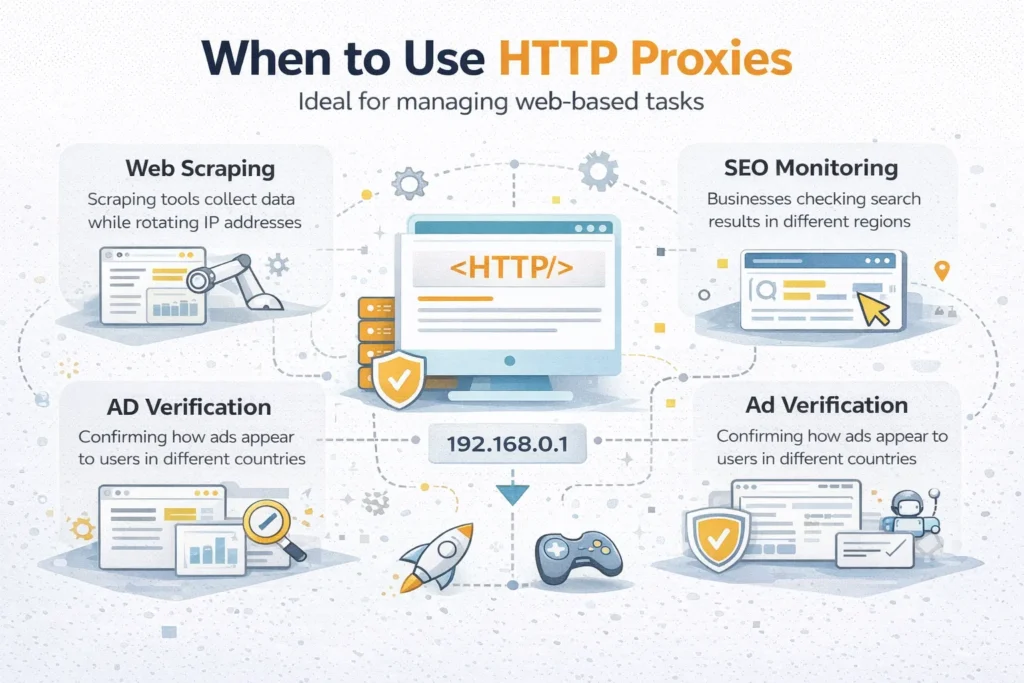
HTTP proxies are ideal when working primarily with web traffic.
Typical use cases include:
Web scraping
Many scraping tools use HTTP proxies to collect data from websites while rotating IP addresses.
SEO monitoring
Businesses checking search results from different regions often rely on HTTP proxies.
Ad verification
Companies use HTTP proxies to confirm how ads appear to users in different countries.
Browser-based automation
HTTP proxies integrate easily with browsers and many automation tools.
When to Use SOCKS5 Proxies
SOCKS5 proxies are preferred when flexibility and protocol support are required.
Typical use cases include:
Automation tools
Many automation platforms support SOCKS5 proxies for account management and bot workflows.
Torrenting and peer-to-peer traffic
SOCKS5 proxies support P2P protocols.
Gaming
Gamers sometimes use SOCKS5 proxies to reduce routing restrictions.
Streaming or specialized traffic
Because SOCKS5 works with many protocols, it can support more complex traffic patterns.
Proxy Infrastructure at MangoProxy
MangoProxy provides multiple proxy networks that support both HTTP and SOCKS5 connections.
These proxy types include:
Residential proxies
- Real ISP IP addresses suitable for scraping and data collection.
ISP proxies
- Static IPs combining residential trust with datacenter speed.
Datacenter proxies
- High-speed proxies optimized for automation and large request volumes.
Mobile proxies
- Mobile carrier IP addresses that offer high anonymity and rotation.
Each proxy type can be used with HTTP or SOCKS5 depending on the project requirements.
Key Takeaways
- HTTP and SOCKS5 are two different proxy protocols
- HTTP proxies are optimized for web traffic
- SOCKS5 proxies support multiple network protocols
- SOCKS5 offers more flexibility and UDP support
- Businesses often choose SOCKS5 for automation tasks
Glossary
Proxy Protocol
A set of rules that defines how a proxy server communicates with clients and destination servers.
HTTP
A protocol used for transferring web pages and browser traffic.
SOCKS5
A network protocol that routes traffic between a client and server without modifying the data.
UDP Traffic
A fast network protocol often used in streaming, gaming, and real-time communications.

Frequently asked questions
Here we answered the most frequently asked questions.
Which proxy is better, HTTP or SOCKS5?
SOCKS5 is more flexible because it supports more protocols, while HTTP proxies are optimized for web traffic.
Are SOCKS5 proxies faster?
Often yes, because they do not inspect traffic and work at a lower network layer.
Can SOCKS5 proxies handle HTTP traffic?
Yes. SOCKS5 can forward HTTP, HTTPS, and many other protocols.
Are HTTP proxies still useful?
Yes. They remain widely used for web scraping and browser-based tasks proxy are typically used as one component of that infrastructure.