
IP Rotation: How Often You Should Really Change Your Proxies
Digital platforms have become increasingly sensitive to patterns. Not just to what users do, but to how consistently their activity unfolds over time.
In this environment, IP rotation has shifted from a purely technical option to an operational decision that directly affects stability, trust, and long-term scalability.
Introduction
Account restrictions, captchas, and sudden access limitations are often attributed to account quality or obvious behavioral violations.
In practice, however, the IP layer is frequently the first signal platforms respond to. Repeated actions from the same address, mismatched activity rhythms, or an IP with a problematic history can quietly erode trust long before an account shows visible issues.
Even high-quality proxies are not immune to this process. Without a rotation strategy, any IP — no matter how clean it appears initially — begins to accumulate behavioral context.
How IP Rotation Works
IP rotation refers to the process of changing the IP address used for outgoing connections at defined intervals. Instead of routing all traffic through a single static address, requests are distributed across multiple IPs over time.
This approach differs from static proxies, where the same IP remains attached to a session or profile for extended periods. Static setups emphasize continuity, while rotation focuses on distributing activity and avoiding signal overload.
Rotation can be implemented manually by reconnecting or switching endpoints, or automatically, where IPs change based on time, request volume, or session logic. The goal is not randomness, but controlled variability aligned with how real users behave.
Many teams assume they are using IP rotation simply because their provider offers a large pool of addresses. In reality, this often means the IP changes only after a long inactivity period or a manual reset, which is closer to static usage than true rotation.
Having many IPs available is not enough: effective rotation requires intentional change at appropriate moments. Chaotic, frequent switching can be just as suspicious as never changing an address at all.
Why You Can’t Ignore IP Rotation
To understand why rotation matters, it helps to look beyond individual requests and consider how platforms evaluate activity over time.
Modern antifraud systems are designed to detect patterns at scale, not isolated actions. These systems track how often an IP appears, how dense its activity is, and how closely its behavior aligns with expected usage. When actions become too frequent or mechanically repetitive, trust begins to decline. An IP that behaves calmly and contextually tends to accumulate reputation, while one that fires requests continuously attracts friction.
Beyond single actions, platforms build a behavioral history around each IP. This history reflects consistency across sessions, predictability of timing, and whether interactions resemble human behavior. When actions accelerate too quickly or arrive in dense bursts, trust erodes even if each request looks harmless in isolation. This long-term accumulation of signals explains why even low-risk workflows can fail without thoughtful rotation.
Proper rotation influences three critical outcomes: the perceived trust score of an IP, the frequency of captchas, and the likelihood of soft or hard restrictions. Instead of pushing one address beyond its tolerance threshold, rotation spreads activity in a way that looks organic over time.
How Often to Rotate Your IPs
There is no universal rotation interval that works across all scenarios. Frequency depends on task intensity, platform sensitivity, and the type of proxy being used. Looking for a fixed rule — change the IP every few minutes or after every action — usually leads to instability rather than safety.
Match rotation to task intensity: longer sessions suit moderate workflows, frequent changes fit high-volume tasks. In others, higher request volumes make more frequent changes unavoidable, but only when paired with consistent pacing.
In practice, different scenarios tend to favor different approaches:
- SMM and marketing: session-based rotation with moderate activity levels, where IPs change naturally between work cycles.
- Advertising accounts: stable IP usage within active sessions, combined with rotation between campaigns or login periods.
- Multi-account operations: longer-lived IPs tied to specific profiles, with rotation occurring between accounts rather than within sessions.
- Parsing and automation: more frequent rotation, but only when request timing remains consistent and predictable.
- Analytics and monitoring: slower rotation, as stability often improves data quality and reduces noise.
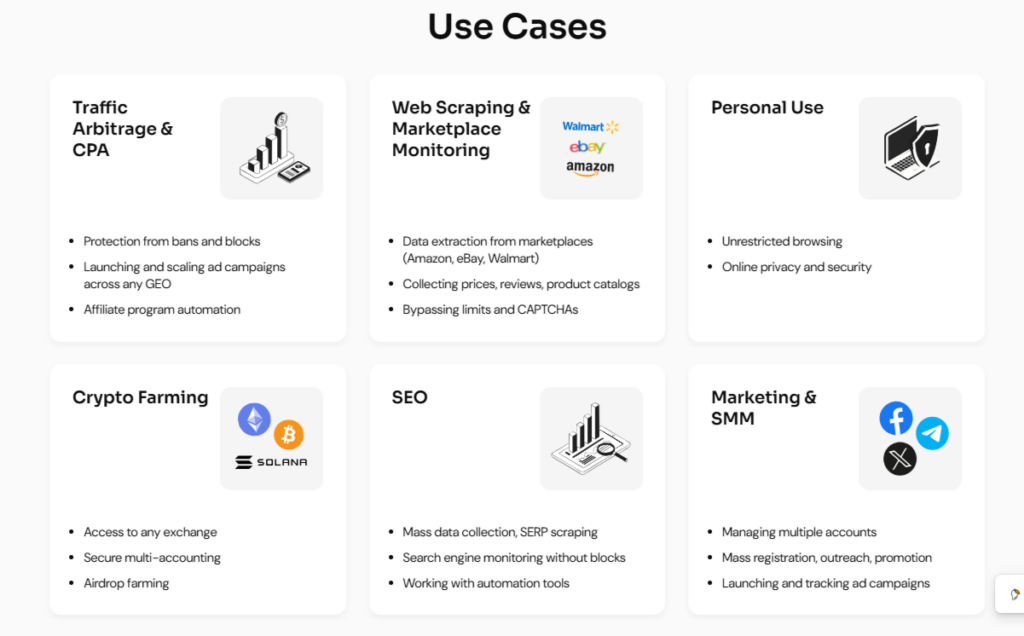
These differences highlight why rotation should be adapted to the task rather than enforced uniformly. Alignment matters more than frequency alone.
Beyond captchas and outright blocks, platforms often signal mounting pressure on an IP much earlier. Subtle indicators such as rising response latency, intermittent request failures, or a gradual decline in successful actions usually appear before explicit restrictions.
These signals suggest that an IP is accumulating behavioral stress faster than expected. Monitoring these shifts helps adjust rotation frequency proactively, rather than reacting only after access becomes visibly degraded.
How Your Proxy Type Shapes Rotation Strategy
Different proxy types come with different behavioral expectations, which directly affects how rotation should be handled:
Residential proxies typically tolerate slower, steadier pacing because they resemble real household connections. They are less sensitive to long sessions, so they can remain on a single IP longer than other proxy types.
ISP proxies strike a balance between stability and flexibility. Moderate rotation is acceptable, but it is preferable to maintain one IP per session whenever possible.
Datacenter proxies, while fast and predictable, tend to require stricter limits on session length due to their visibility and shared infrastructure. These proxies need rotation more often, as IPs quickly accumulate negative signals under high request density.
Align proxy type with workflow: residential for human-like pacing, datacenter for high-speed automation. Over-rotating, on the other hand, especially with residential or ISP proxies, can break continuity and appear less natural than well-paced, longer sessions.
Matching rotation frequency to the inherent tempo of the proxy type is more important than maximizing uptime on any single IP.
Common IP Rotation Mistakes
Many problems attributed to proxy quality stem from configuration and usage errors rather than technical limitations. The most common mistakes include:
- rotating IPs too frequently without logical session boundaries;
- assigning the same IP to multiple unrelated accounts;
- performing actions back-to-back without pauses;
- mismatches between IP location, interface language, and timezone.
Another frequent mistake is over-optimizing rotation based on generic guidelines rather than real feedback.
Teams often increase rotation frequency simply because it is recommended in documentation or community discussions, without observing how platforms actually respond. In practice, this can fragment otherwise stable sessions and introduce inconsistencies that were not present before. Rotation becomes harmful when it is adjusted mechanically instead of analytically.
Taken together, these issues usually point to the same root cause: rotation is treated as a standalone fix instead of part of a broader behavioral model. Without aligning timing, volume, and context, even well-configured proxies quickly lose effectiveness.
When Isn’t a Complete Solution
Rotation cannot correct fundamentally problematic behavior. If actions are too fast, overly repetitive, or poorly structured, changing IPs only delays the outcome.
Platforms evaluate sessions as coherent sequences rather than isolated requests. Browser fingerprints, device consistency, navigation patterns, and timing between steps all factor into risk assessment.
An IP may appear clean, but fragmented or unnatural sessions undermine trust quickly. This is why environment consistency — how sessions start, progress, and end — matters just as much as rotation frequency.
IP rotation supports stability, but it cannot replace sound behavioral logic.
Practical Recommendations
Choose the Right Proxies for the Task: Use residential or ISP proxies for long-term, human-like workflows, and datacenter proxies for high-speed automation where stability is less critical. Don’t force tasks to fit available IPs — correct selection simplifies rotation.
Establish Safe Rotation Rules: Base rotation on session logic, introduce natural pauses between requests, limit simultaneous actions per IP, and start with conservative frequency. Increase rotation only after confirming stable platform responses.
Scale Operations Gradually: Monitor key metrics — error rates, response stability, and session completion. Add new IPs or increase rotation cycles incrementally to maintain trust scores and prevent sudden performance drops.

Proxy Infrastructure as a Control Layer
In practice, proxy providers function less as tools and more as infrastructure layers that shape how rotation is implemented. Mango Proxy support residential, ISP, and server-based proxies, allowing teams to choose an appropriate connection model before defining rotation behavior. Broad geographic coverage across more than 200 locations helps align IP behavior with real-world usage patterns rather than artificial setups.
Operationally, freshness and flexibility matter most. Mango Proxy maintains large, frequently updated IP pools with new addresses appearing daily, reducing long-term behavioral buildup on individual IPs. Combined with rotation support and instant delivery, this kind of infrastructure enables teams to adjust pacing, session length, and scale without constantly redesigning workflows or reacting to platform limits.
Conclusion
IP rotation is not about hiding activity, but about shaping it responsibly. When aligned with task logic, platform expectations, and proxy type, rotation reduces friction and extends operational lifespan.
Remember: there is no perfect interval, only informed decisions guided by observation and context. Treating rotation as part of behavior design — rather than a mechanical switch — is what ultimately determines long-term stability.
I liked the emphasis on the fact that chaotic rotation can be just as harmful as its absence.
A practical take on IP rotation that goes beyond generic advice