
Residential Proxies Explained: How ISP-Based IP Routing Works
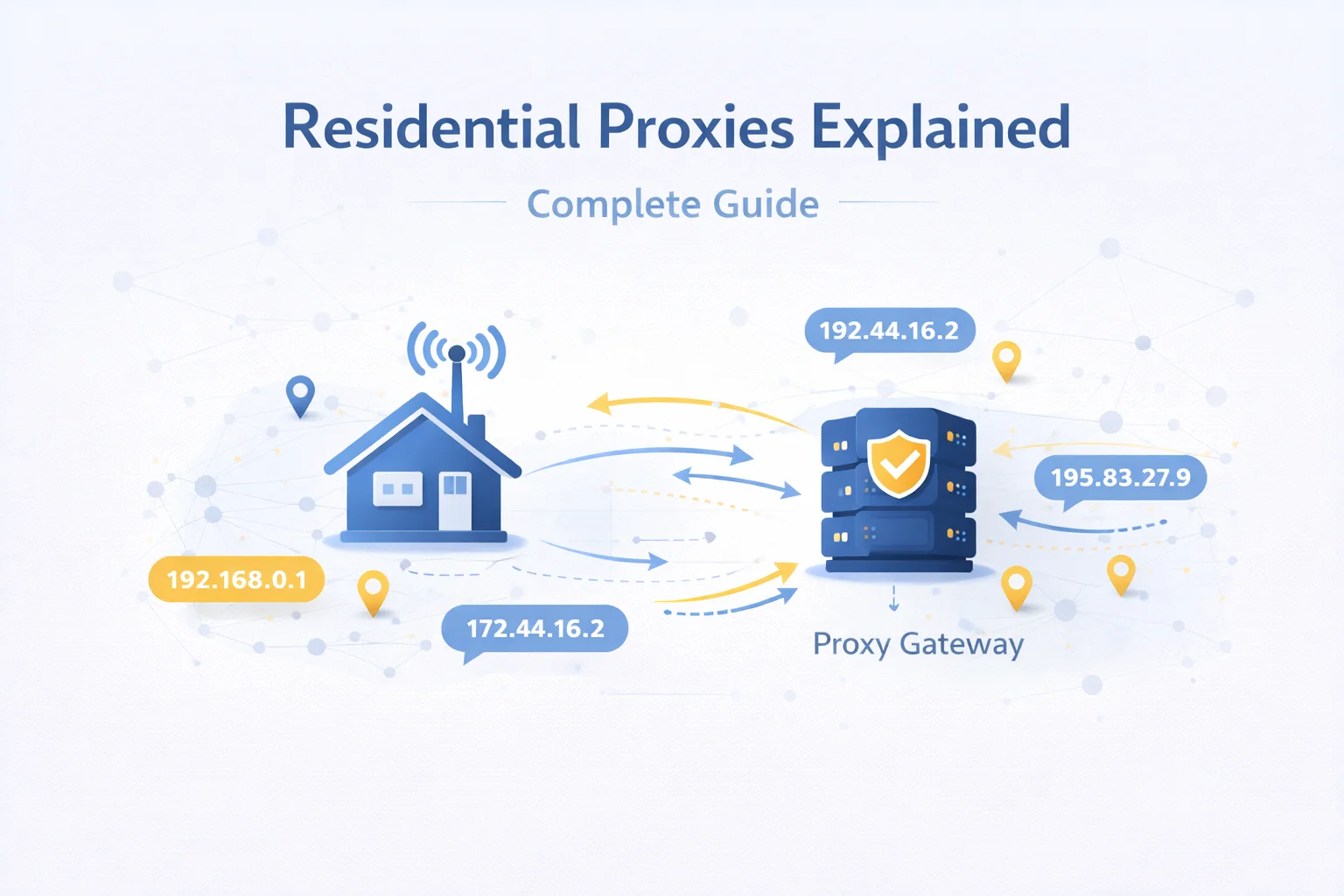
Residential proxies route internet traffic through IP addresses assigned by internet service providers to real households. Instead of appearing as activity generated from hosting infrastructure, requests resemble normal consumer browsing behavior.
Because many platforms evaluate connection reputation and behavioral signals, residential proxy routing is often used in workflows where maintaining access continuity is critical.
This guide explains how residential proxy networks operate, how they differ from other proxy categories, and when they provide measurable advantages.
Key Takeaways
- residential proxies use real ISP-issued IP addresses
- they help simulate organic browsing environments
- rotation strategies influence detection risk
- performance trade-offs exist compared to datacenter routing
- hybrid proxy deployment improves scalability
What Are Residential Proxies
A residential proxy is an intermediary routing endpoint that forwards traffic through consumer broadband connections. These connections originate from legitimate ISP address pools and are periodically reassigned depending on network policies.
From an external platform perspective, requests delivered through residential infrastructure may be harder to distinguish from normal user activity compared to traffic generated from predictable cloud ranges.
How Residential Proxy Networks Function
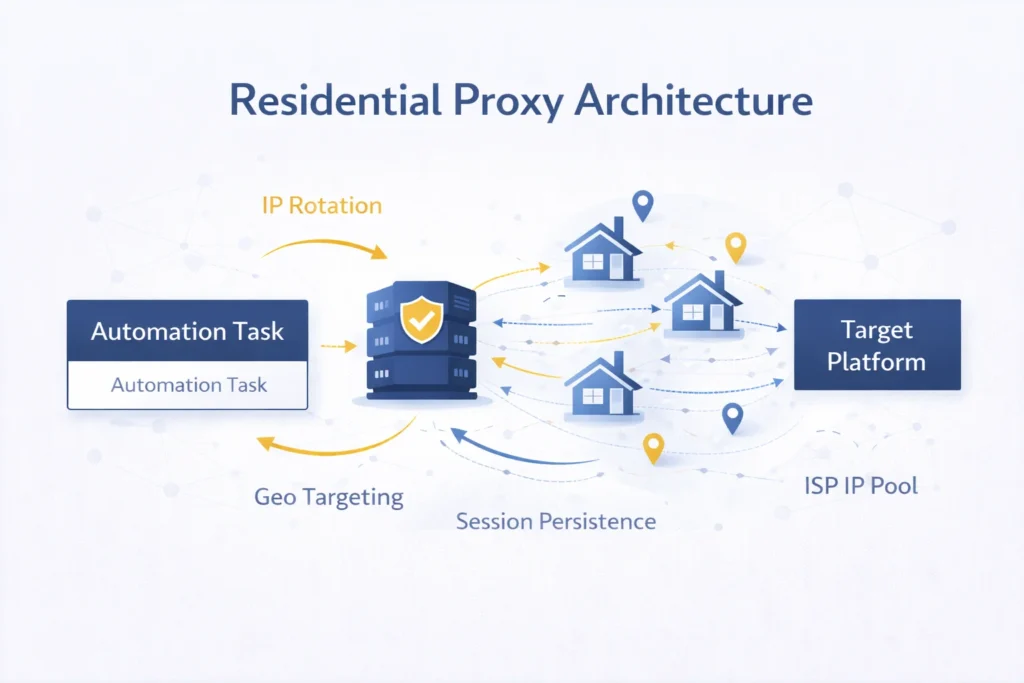
Residential proxy ecosystems typically include several infrastructure layers:
- proxy gateway that distributes traffic
- IP pool sourced from ISP networks
- rotation logic controlling session persistence
- routing policies based on geography or workload
Execution flow often follows this sequence:
- automation task sends request
- proxy network selects a residential endpoint
- ISP connection provides visible IP identity
- target platform responds
- gateway returns data to task engine
This model enables distributed execution patterns while maintaining a realistic connection footprint.
Rotation Models in Residential Proxy Routing
Per-Request Rotation
Each request exits through a new IP.
Useful for discovery-phase data collection.
Sticky Sessions
An IP remains stable for several minutes.
Useful for login sequences and multi-step interactions.
Geo-Locked Rotation
Traffic rotates within a defined country or city pool.
Useful for localized testing workflows.
Benefits of Residential Proxies
Reputation Stability
Consumer ISP ranges typically generate diverse background traffic, which can reduce anomaly signals.
Geographic Precision
Businesses can observe region-specific content delivery or pricing differences.
Scalable Data Collection
Large request volumes can be distributed across wide address pools.
Behavioral Simulation
Residential routing may better align with expected browsing patterns on certain platforms.
Limitations
- higher bandwidth cost compared to datacenter proxies
- potential latency variability
- dependency on pool quality and rotation logic
- limited throughput per endpoint
Understanding these constraints is essential when designing proxy deployment strategies.
Residential vs Other Proxy Types
|
Proxy Type |
Identity Profile |
Speed |
Rotation Control |
Best Use Case |
|---|---|---|---|---|
|
Residential |
ISP household |
Medium |
Flexible |
scraping |
|
Datacenter |
cloud server |
Very high |
Full |
automation |
|
ISP |
static ISP hosted |
High |
Minimal |
session workflows |
|
Mobile |
carrier network |
Medium |
Dynamic |
social platforms |
Selecting the correct proxy mix depends on task sensitivity and performance requirements.
Real-World Use Cases
Search Result Monitoring
Teams evaluate how rankings appear to users in different regions.
Competitive Intelligence
Organizations analyze pricing or product availability.
Ad Delivery Validation
Brands confirm campaign visibility across markets.
Platform Interaction Automation
Distributed identity routing helps reduce concentration signals.
Hybrid Residential Deployment
Modern execution environments rarely rely on one proxy category alone.
Example architecture:
- residential proxies for initial discovery
- datacenter proxies for bulk extraction
- ISP endpoints for account persistence
- mobile routing for sensitive actions
This layered routing model improves reliability while maintaining execution speed.
Residential Proxies at MangoProxy
MangoProxy provides access to residential proxy routing environments with configurable session duration, geographic filtering and adaptive rotation strategies.
These networks can be combined with:
- datacenter clusters for throughput
- ISP proxies for persistent sessions
- mobile proxies for dynamic identity scenarios
Glossary
ISP Pool – collection of IP addresses issued by internet providers
Session Persistence – maintaining the same IP identity
Traffic Distribution – spreading requests across endpoints
Execution Layer – infrastructure delivering automation traffic

Frequently asked questions
Here we answered the most frequently asked questions.
Are residential proxies better than datacenter proxies?
They may provide stronger authenticity signals but usually lower throughput.
Do residential proxies rotate automatically?
Rotation depends on provider configuration.
Are residential proxies suitable for scraping?
Yes, especially where platform restrictions are strict.
Which proxy type is best?
The optimal proxy type depends on whether authenticity, speed, or session stability is the priority.