
What Are Mobile Proxies?
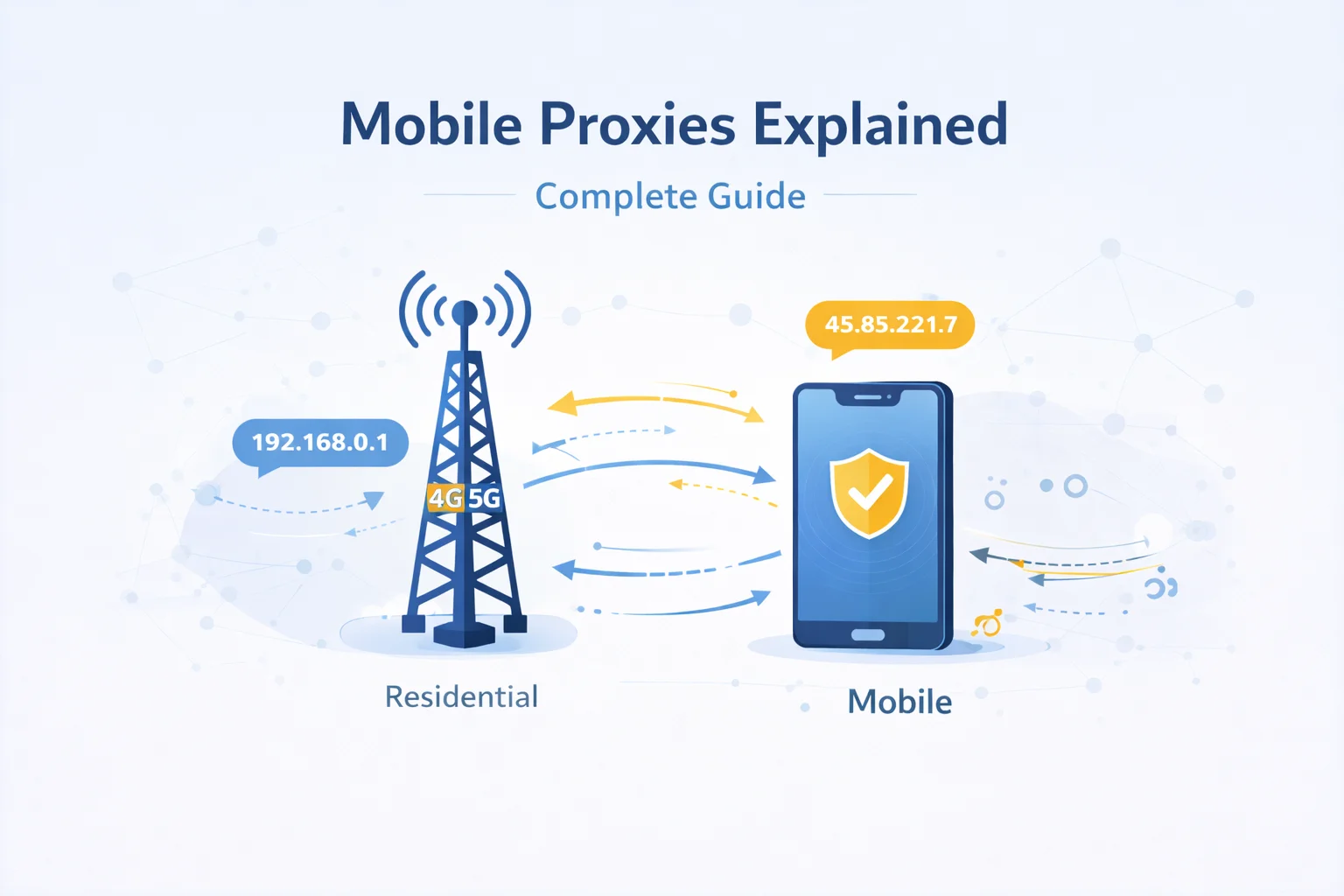
Mobile proxies are routing endpoints that allow internet requests to exit through IP addresses assigned by cellular network operators. Instead of appearing as traffic generated from hosting infrastructure, requests are transmitted through mobile carrier environments where address allocation is dynamic and often shared between many real devices.
Because of this network behavior, platforms that rely on reputation signals may treat mobile traffic differently from server-originated connections.
How Mobile Proxy Infrastructure Functions
Unlike traditional proxy servers located in datacenters, mobile proxy systems rely on physical modems, embedded SIM devices, or carrier-integrated gateways. These components connect to telecom base stations and obtain publicly routable IP addresses that can change as network sessions are refreshed.
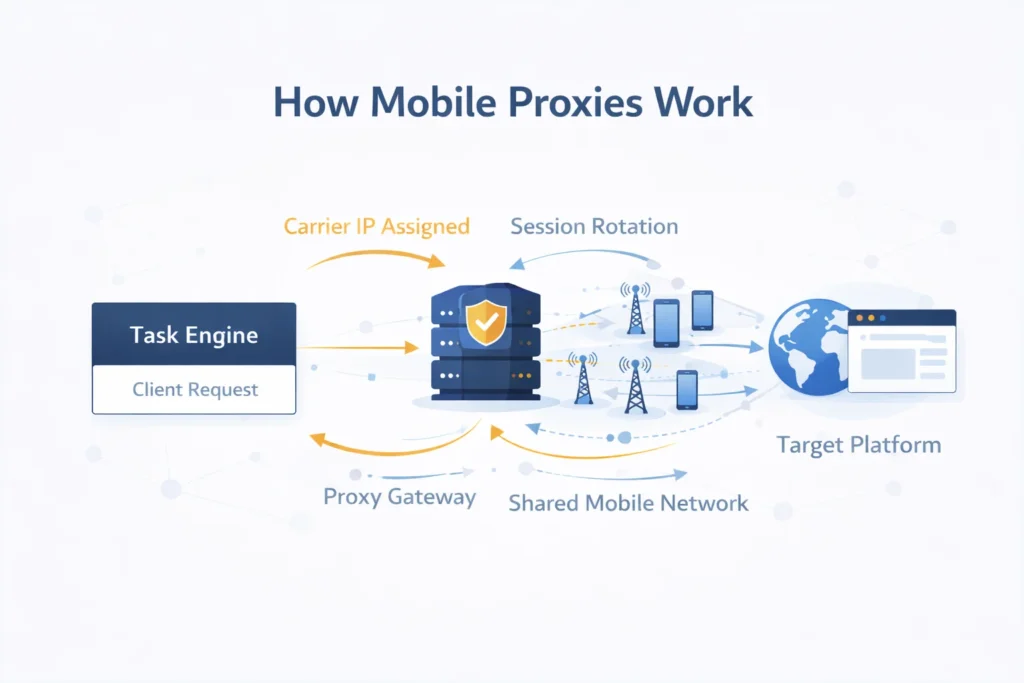
A simplified execution sequence may look like this:
- task engine sends request to proxy gateway
- gateway selects an active mobile endpoint
- carrier assigns or maintains a public IP
- target platform receives traffic as mobile network activity
- response returns through the same routing path
This layered routing model introduces variability that can be beneficial in high-sensitivity environments.
Why Mobile Proxies Are Considered High-Trust
Mobile internet traffic is typically routed through large-scale carrier NAT systems. Thousands of users can share overlapping IP reputation signals at different times of day.
From the perspective of external platforms, isolating one automated workflow within this background noise can be more complex compared to identifying traffic generated from predictable cloud ranges.
As a result, mobile proxy routing is often used when:
- request authenticity signals matter
- platform restrictions are aggressive
- identity persistence must be balanced with rotation
Rotation Behavior in Cellular Networks
Rotation in mobile proxy environments may occur through:
Network reconnection
Disconnecting and reconnecting to a carrier session can trigger a new IP assignment.
Tower switching
Physical movement or signal optimization may lead to routing changes.
Provider-controlled cycling
Some proxy gateways automate modem resets to produce rotation patterns.
Unlike static proxy pools, mobile rotation often depends on real network conditions rather than purely software logic.
Performance Characteristics
Mobile proxy routing introduces trade-offs.
Advantages:
- reputation resilience
- organic session patterns
- natural geographic distribution
Constraints:
- increased latency
- limited bandwidth ceilings
- higher operational cost
These factors influence whether mobile proxies are suitable for bulk execution or targeted workflows.
Comparing Mobile Proxies to Other Proxy Types
| Proxy Category | Identity Profile | Throughput Potential | Rotation Control |
| Mobile | Carrier-based | Moderate | Semi-predictable |
| Residential | ISP household | Moderate | Configurable |
| Datacenter | Cloud infrastructure | Very high | Fully controlled |
| ISP | Static hosted ISP | High | Minimal rotation |
Choosing the correct proxy layer depends on whether the priority is speed, trust simulation, or session consistency.
Real-World Use Cases
Mobile Search Result Validation
Teams verifying localized search visibility often rely on mobile routing to observe how rankings appear to smartphone users.
Campaign Delivery Testing
Advertising workflows may use mobile proxies to confirm that creatives load correctly in mobile network environments.
Platform Interaction Automation
Some account workflows benefit from dynamic identity behavior when interacting with systems that monitor device fingerprints and connection reputation.
Application Localization Checks
Mobile proxy routing allows testers to validate regional access flows without physical device relocation.
Sticky Sessions vs Rapid Rotation
Maintaining the same mobile IP for a limited duration can support login continuity and transactional workflows.
In contrast, aggressive rotation patterns may be preferable when distributing discovery-phase requests across multiple endpoints.
Balancing these modes is part of proxy strategy design rather than a purely technical configuration.
Mobile Proxy Deployment at MangoProxy
MangoProxy offers access to mobile proxy routing environments designed to support session-based workflows, adaptive rotation logic, and geographically distributed execution scenarios.
These environments can be combined with:
- residential proxy pools for data discovery
- datacenter clusters for large request throughput
- ISP endpoints for persistent identity workflows
Hybrid deployment models often provide the most stable operational outcomes.
Key Takeaways
- mobile proxies route traffic through carrier network IP ranges
- rotation behavior may depend on real connectivity conditions
- trust simulation is stronger than in server-based proxy environments
- performance trade-offs must be considered in scaling strategies
Glossary
Carrier NAT – shared routing environment used by telecom– operators
Session Cycling – forced reconnection to obtain a new IP
Execution Layer – proxy infrastructure used to deliver requests
Identity Noise – background traffic that masks automation patterns

Frequently asked questions
Here we answered the most frequently asked questions.
Are mobile proxies always rotating?
Not necessarily. Rotation depends on network resets or gateway configuration.
Are they better than residential proxies?
They may provide stronger reputation signals but often at higher cost.
Can mobile proxies be used for scraping?
Yes, especially in environments with strict access controls.
Which proxy type is best?
The optimal proxy type depends on whether authenticity, speed, or session stability is the priority.