
Which Proxies to Choose: Proxy Types Comparison
Published: ≈ 7 min read
This article is a quick guide to choosing proxies. It covers the main proxy types available at MangoProxy and their key differences, helping you quickly compare the options and choose the right one for your task.
MangoProxy offers residential, Residential Light, dynamic datacenter, dynamic ISP, static datacenter, static ISP, and mobile proxies.
They differ in IP type, pool size, geographic coverage, targeting options, rotation, speed, and pricing model. That is why, when choosing a proxy, it is important to consider not only the price but also the requirements of your specific task.
Residential Proxies
Residential proxies are suitable for tasks where a high level of IP trust, a wide range of locations, and advanced geo-targeting are important.
| Characteristic | Value |
| Best for | Multi-accounting, scraping |
| IP type | Residential + Mobile |
| IP reputation | Highest |
| Access type | Shared pool |
| Pool size | 90M+ IPs |
| Countries | 200+ |
| Targeting | Country / State / City / ASN / ZIP code |
| Sticky sessions | 30–40 minutes on average |
| IP rotation | Instant / Sticky / Timer / New session / Manual link |
| Protocols | HTTP + SOCKS5 |
| Speed | 10–30 Mbps |
| Traffic | Limited |
| Price from | $2 / GB |
| Pricing model | Per traffic (GB) |
Residential proxies are worth choosing when you need a large IP pool, precise geo-targeting, and the ability to use different rotation mechanisms.
Residential Light Proxies
Residential Light proxies are a more affordable version of residential proxies with a simplified set of features.
They are designed for scenarios where country-level targeting is sufficient and advanced proxy generator settings are not required.
| Characteristic | Value |
| Best for | Scraping and automation |
| IP type | Residential + Mobile |
| IP reputation | High |
| Access type | Shared pool |
| Pool size | 85M+ IPs |
| Countries | 200+ |
| Targeting | Country |
| Sticky sessions | 30–40 minutes on average |
| IP rotation | Instant / Sticky / Timer |
| Protocols | HTTP + SOCKS5 |
| Speed | 10–30 Mbps |
| Traffic | Limited |
| Price from | $0.99 / GB |
| Pricing model | Per traffic (GB) |
Residential Light proxies are a good choice if you do not need detailed geo-targeting or the additional features of standard residential proxies and your main priority is a more affordable price.
Dynamic Datacenter Proxies
Dynamic datacenter proxies use IP addresses from data centers and are designed for tasks where speed, automatic IP rotation, and handling a large number of requests are important.
| Characteristic | Value |
| Best for | Automation and scraping less restrictive targets |
| IP type | Datacenter |
| IP reputation | Medium |
| Access type | Shared pool |
| Pool size | 1M+ IPs |
| Countries | 50+ |
| Targeting | Country |
| Sticky sessions | 30-40 minutes on average |
| IP rotation | Instant / Sticky |
| Protocols | HTTP + SOCKS5 |
| Speed | Up to 100 Mbps |
| Traffic | Limited |
| Price from | $0.6 / GB |
| Pricing model | Per traffic (GB) |
This is one of the fastest options among dynamic proxies. It is well suited for automation and scraping resources where a high level of IP trust is not required.
Dynamic ISP Proxies
Dynamic ISP proxies use IP addresses assigned by internet service providers while operating through server infrastructure.
Compared with datacenter IPs, they have a higher reputation while maintaining good connection speeds.
| Characteristic | Value |
| Best for | Automation and scraping less restrictive targets |
| IP type | Internet Service Provider |
| IP reputation | High |
| Access type | Shared pool |
| Pool size | 500K+ IPs |
| Countries | 70+ |
| Targeting | Country |
| Sticky sessions | 30–40 minutes on average |
| IP rotation | Instant / Sticky |
| Protocols | HTTP + SOCKS5 |
| Speed | 20–80 Mbps |
| Traffic | Limited |
| Price from | $0.8 / GB |
| Pricing model | Per traffic (GB) |
Dynamic ISP proxies can be considered for tasks that require a combination of speed, IP rotation, and a higher level of IP trust.
Static Datacenter Proxies
Static datacenter proxies provide a permanent IP address for the entire rental period.
They are suitable for tasks where it is important to keep the same IP address across sessions and automatic rotation is not required.
| Characteristic | Value |
| Best for | Account management, streaming, automation |
| IP type | Datacenter |
| IP reputation | Medium |
| Access type | Dedicated IP |
| Pool size | 200K+ IPs |
| Countries | 30+ |
| Targeting | Country |
| Sticky sessions | Fixed IP |
| IP rotation | No |
| Protocols | HTTP + SOCKS5 |
| Speed | Up to 100 Mbps |
| Traffic | Unlimited |
| Price from | $1.43 / IP |
| Pricing model | Per IP per month |
Static datacenter proxies are convenient for persistent connections, automation, streaming, and account management when a datacenter IP type is sufficient.
Static ISP Proxies
Static ISP proxies provide fixed IP addresses assigned by internet service providers.
They are designed for long sessions and account management where it is important to maintain the same IP address while using an IP with a higher reputation.
| Characteristic | Value |
| Best for | Long sessions and account management |
| IP type | Internet Service Provider |
| IP reputation | High |
| Access type | Dedicated IP |
| Pool size | 100K+ IPs |
| Countries | 30+ |
| Targeting | Country / ASN |
| Sticky sessions | Fixed IP |
| IP rotation | No |
| Protocols | HTTP + SOCKS5 |
| Speed | 20–80 Mbps |
| Traffic | Unlimited |
| Price from | $3.29 / IP |
| Pricing model | Per IP per month |
This is a suitable option for users who need a fixed IP for an extended period, high IP reputation, and the ability to select an ASN.
Mobile Proxies
Mobile proxies use IP addresses from mobile carriers and offer the highest level of IP reputation alongside standard residential proxies.
They are particularly popular for multi-accounting and working with platforms where a mobile connection type is important.
| Characteristic | Value |
| Best for | Multi-accounting |
| IP type | Mobile Carrier |
| IP reputation | Highest |
| Access type | Dedicated IP |
| Pool size | 5M+ IPs |
| Countries | 46+ |
| Targeting | Country |
| Sticky sessions | Fixed IP |
| IP rotation | No |
| Protocols | HTTP + SOCKS5 |
| Speed | 2–5 Mbps |
| Traffic | Unlimited |
| Price from | $9 / day |
| Pricing model | Per port per day / week / month |
Mobile proxies are worth choosing for tasks where using mobile carrier IPs and maintaining a high level of trust from platforms are the main priorities.
Which Proxy Type Should You Choose?
The right proxy type depends on your specific task, geographic requirements, speed, IP reputation, and whether you need IP rotation. To make the choice easier, we have summarized the main scenarios in one table.
| If you need | Best choice |
| Flexible geo-targeting, a large IP pool, and high IP reputation | Residential proxies |
| Country-level targeting and a more affordable price | Residential Light proxies |
| High speed for automation and scraping less restrictive targets | Dynamic datacenter proxies |
| Speed combined with higher IP reputation | Dynamic ISP proxies |
| A fixed IP, high speed, and a more affordable price | Static datacenter proxies |
| A fixed IP and high IP reputation | Static ISP proxies |
| A mobile IP for multi-accounting tasks | Mobile proxies |
If your requirements do not fit a single criterion, it is better to compare several proxy types based on key parameters such as IP type, targeting, rotation, speed, and pricing model.
Compare Before Choosing
The MangoProxy homepage features a general comparison table of all major proxy types.
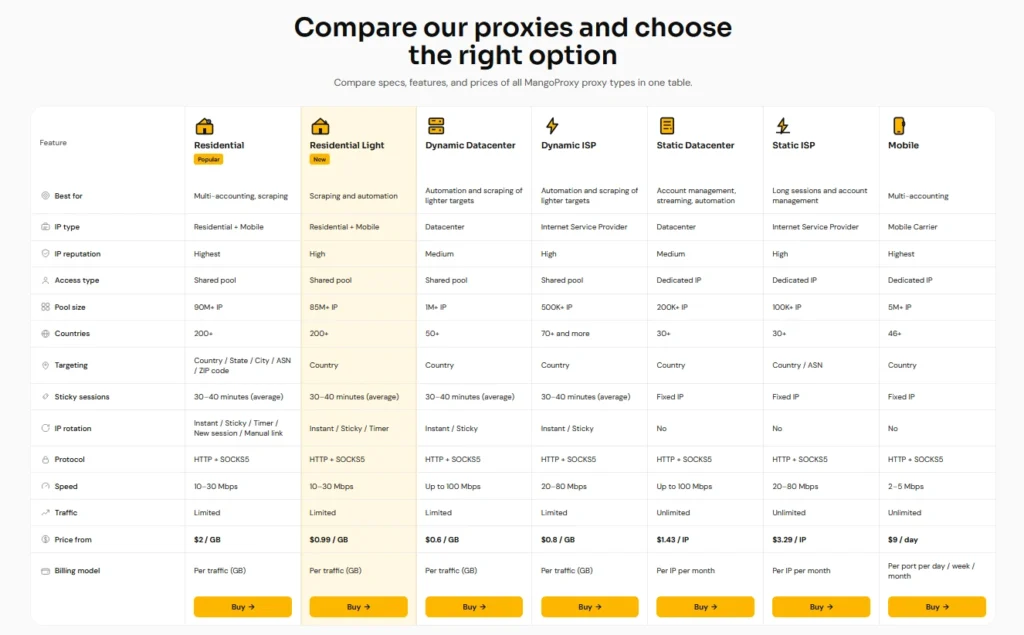
It allows you to quickly compare pool size, number of countries, IP type, IP reputation, targeting, rotation, speed, traffic, pricing, and billing model.
The table works as a quick reference: if you already have a general understanding of your task requirements, you can simply compare a few key parameters and choose the most suitable option.
Frequently asked questions
Here we answered the most frequently asked questions.
Which proxies are best for scraping?
Different proxy types can be used for scraping. Residential proxies are suitable for tasks where high IP reputation and flexible geo-targeting are important. Residential Light proxies are designed for scraping and automation with country-level targeting, while dynamic datacenter and ISP proxies are suitable for automation and scraping less restrictive targets.
How are Residential Light proxies different from standard residential proxies?
The Light version offers a simplified feature set and supports targeting only at the country level. Standard residential proxies additionally allow you to select a state, city, ASN, and ZIP code and provide more options for managing IP rotation.
Which proxies should I choose for long sessions?
Static ISP proxies are one of the best options for long sessions. They use a fixed IP and have a high IP reputation. Static datacenter proxies can also be used for persistent connections.
Which proxies are suitable for multi-accounting?
In the MangoProxy comparison table, residential and mobile proxies are specifically highlighted for multi-accounting. The choice depends on whether you need a large residential IP pool with flexible rotation or a mobile IP.