
How to Tell When an IP Pool Is Losing Quality Over Time
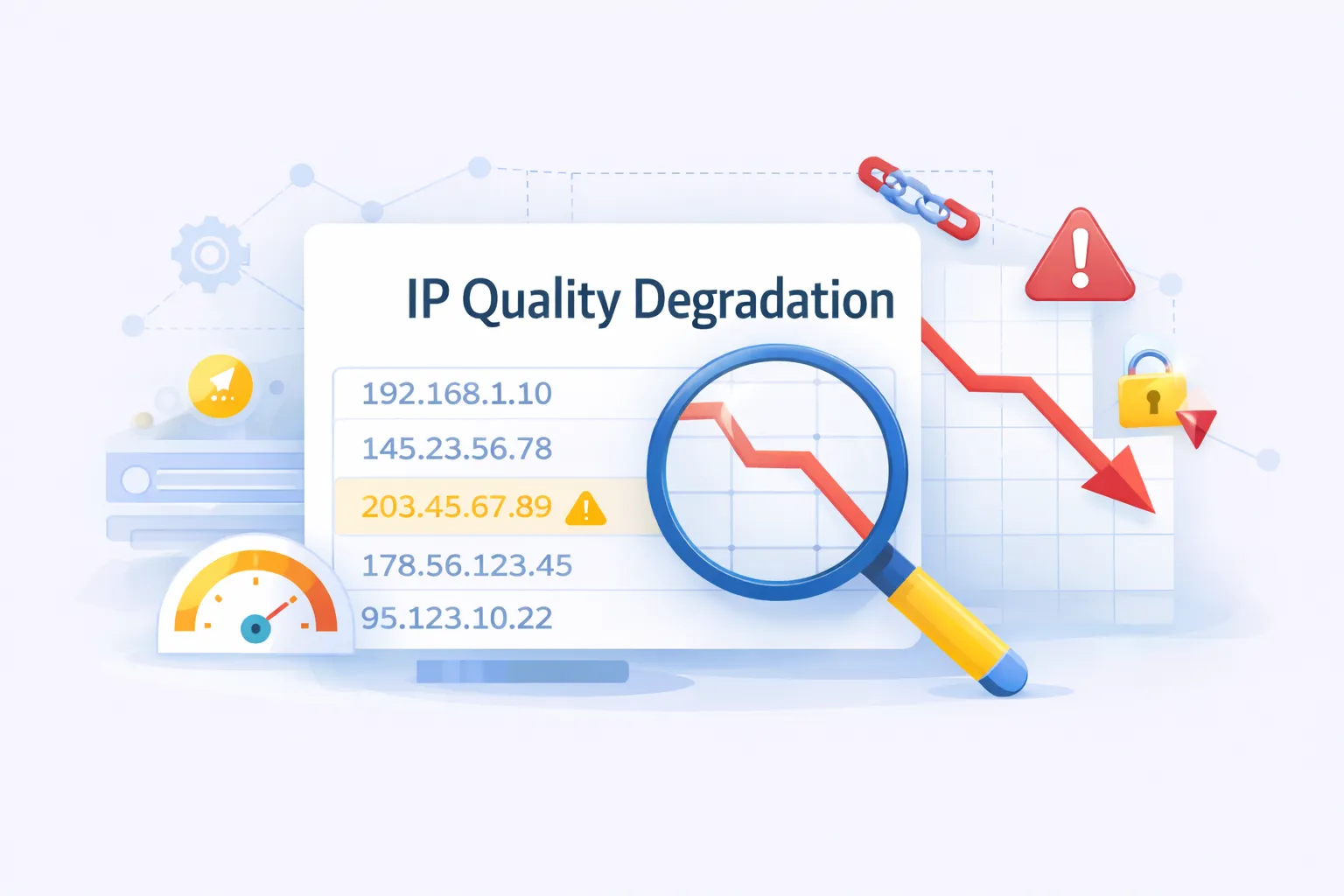
When working with proxies, the first step is usually to check basic parameters: how quickly the connection is established, whether the IP address responds to requests, and how many addresses are available in the pool. Websites open normally, requests go through without errors, and everything appears to be working as expected. However, in real-world projects this is often not enough. Over time, even a large IP pool can gradually lose effectiveness. This process usually happens quietly: first you may notice occasional captchas, then API limits begin to decrease, and later blocks may appear at the session or account level.
The key issue is that IP pool quality is not a static property. It can change over time depending on how IP addresses are used, how anti-fraud systems respond to traffic, and how much load is placed on the pool. If you understand how IP quality starts to decline, you can adjust your infrastructure or automation setup early and avoid problems in long-running projects.
Why IP Pool Quality Changes Over Time
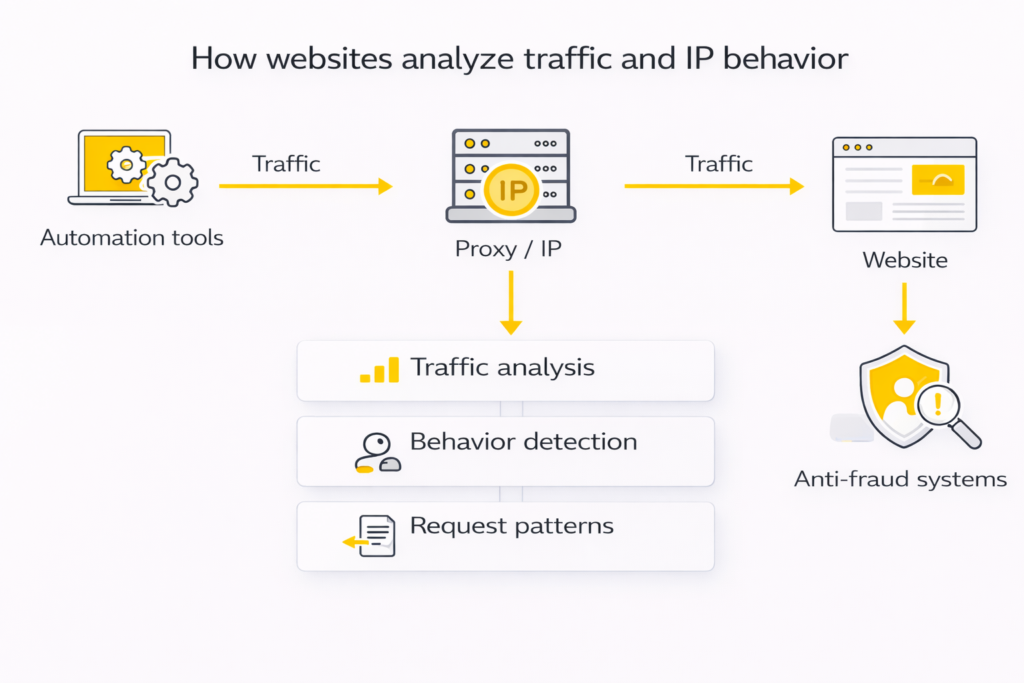
Every IP pool operates within the broader internet environment. Websites constantly analyze incoming traffic. Anti-fraud systems inspect requests, protection mechanisms look for signs of automation, and internal algorithms evaluate user behavior and session patterns.
When the same IP address starts being used heavily for automation or a large number of requests, its behavior gradually begins to differ from normal user traffic. As the load increases, websites may start identifying that address as a source of automated activity.
At the same time, the IP itself may still technically work – websites will continue to load normally. However, its reputation within protection systems gradually declines. As a result, proxy stability decreases: additional checks appear, server responses may become slower, or the allowed number of requests may be reduced.
This is especially noticeable in workflows that rely on proxies for automation or when scaling large numbers of accounts.
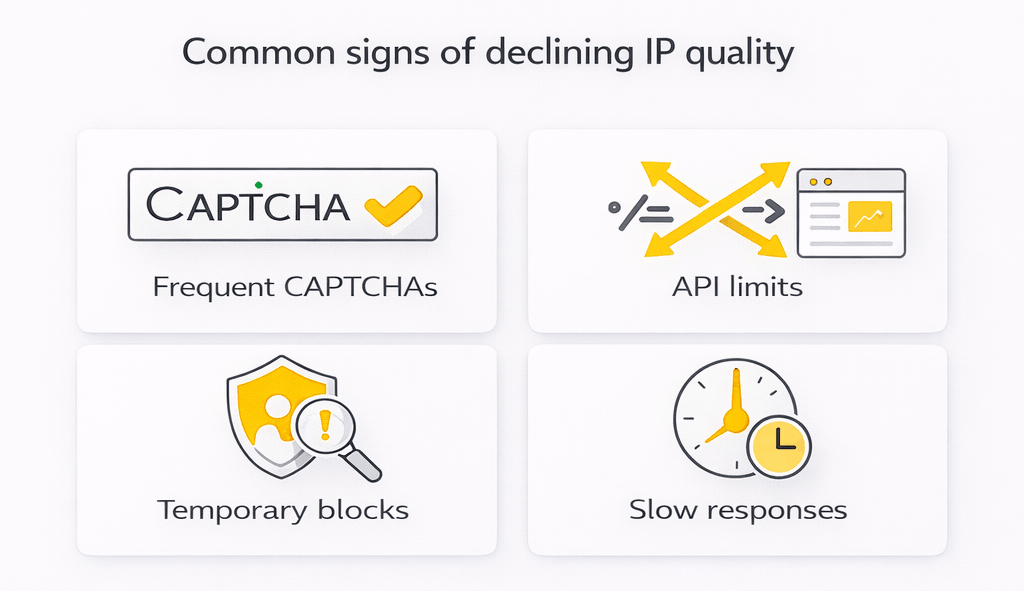
Common signs of declining IP pool quality
Increase in Additional Verification Checks
One of the first signals is a growing number of captchas and verification steps.
If requests previously passed without issues but the system starts requiring frequent verification, it may indicate that some IP addresses have already been flagged within anti-fraud behavior models.
When using proxies for scraping, this often appears as:
- unstable server responses
- an increase in HTTP errors
- unexpected redirects
Decreasing API Limits
Automation tasks often rely on direct interaction with APIs.
When IP pool quality begins to decline, API limits may start triggering earlier. For example:
- the number of allowed requests decreases
- responses begin to arrive with delays
- rate limits are activated sooner
At first it may seem like the issue is related to the script or the automation architecture. In practice, however, it often turns out that the behavior of the IP addresses has changed.
Instability During Scaling
Another common effect appears when the load increases.
An IP pool may perform well with a small number of sessions, but once account scaling begins, problems can start appearing:
- some accounts require additional verification
- regional restrictions may appear
- temporary blocks become more frequent
This happens because anti-fraud systems begin to detect patterns in how IP addresses are being used.
Reduced Effectiveness of IP Rotation
IP rotation is often used as a way to distribute traffic load.
However, when IP pool quality declines, rotation alone may no longer be effective. Websites start recognizing repeated patterns more quickly, such as:
- identical IP ranges
- similar geographic traffic patterns
- repeated network characteristics
As a result, even properly configured IP rotation may no longer provide the expected results.
Why This Happens Even with Large IP Pools
A common misconception is that having a large number of IP addresses automatically guarantees stability. In reality, the size of the pool matters less than how often it is refreshed and how diverse it is.
If the same IP ranges are used extensively for automation or high-volume requests, they gradually start appearing in various traffic analysis systems. Over time, even large IP pools can experience a gradual decline in effectiveness.
This is why it is important to consider that IP addresses may lose quality over time. In practice, this means distributing load, using different proxy types for different tasks, and managing traffic more carefully.
Practical Insights and Recommendations
When working with proxies, it is helpful to treat the IP pool as a dynamic system.
First, it is important to regularly monitor behavioral metrics such as error rates, API limits, and the frequency of additional verification checks.
Second, the proxy architecture should be designed with the possibility of declining IP quality in mind. In practice, this means distributing workloads, assigning different tasks to different proxy types, and managing traffic in a flexible way.
It is also beneficial to work with a pool where IP addresses are refreshed regularly and not used for the same scenarios for extended periods of time. In such cases, proxies for automation, API requests, and scraping can remain effective much longer.
Conclusion
IP pool quality is not a fixed property. Over time it can change. Even working IP addresses may gradually lose effectiveness as anti-fraud systems become better at analyzing traffic behavior.
For this reason, long-term proxy stability depends not only on the size of the IP pool but also on how it is used: how traffic is distributed, how frequently addresses are refreshed, and how flexible the overall architecture is.

Frequently asked questions
Here we answered the most frequently asked questions.
Why can an IP still work but still be considered “bad”?
An IP address may still respond to requests and load websites, but it can have a low reputation in anti-fraud systems. In such cases, servers may start applying additional restrictions.
Can IP rotation completely solve IP quality issues?
No. Rotation distributes traffic load, but if the overall reputation of the IP pool declines, rotation alone cannot solve the underlying problem.
Why do problems often appear only when traffic increases?
Anti-fraud algorithms are more effective at detecting automated behavior when traffic volume grows. That is why IP degradation often becomes noticeable during scaling.
Is it possible to detect declining IP quality in advance?
Usually it becomes visible through indirect signals such as increasing captcha frequency, unstable API responses, or a growing number of blocks.