
Why One IP Is the Biggest Mistake in Automation and Bulk Actions

At small scale, a single IP address feels orderly and efficient — that illusion collapses the moment systems begin to scale.
A single IP is often treated as a neutral technical detail, something that simply “hosts” activity. As long as it appears stable and reputable, it is assumed to be safe. This assumption no longer holds in modern web environments. Even when routed through proxy servers, platforms do not see IP addresses as passive transport layers.
They see them as containers of accumulated behavior. When activity concentrates, even legitimate workflows begin to resemble risk.
How Platforms Read and Score IP-Level Activity
In web infrastructure, an IP address acts as a first-layer identity. Before cookies, device fingerprints, account-level signals, traffic is grouped by its network origin. Over time, that context becomes a behavioral baseline that frames how all subsequent actions are interpreted.
From the platform’s perspective, an IP is a correlation point. Frequency, timing, request structure, response interaction, and error patterns are aggregated long before intent is evaluated. This is why IP analysis precedes behavioral interpretation. It is computationally cheaper, historically reliable, and effective at early-stage filtering.
Crucially, IP-level evaluation exists not because it is precise, but because it is efficient. An IP address allows platforms to collapse thousands of requests into a single risk container. Even imperfect signals are acceptable at this stage. From a system-design standpoint, it is safer to over-filter early than to allow suspicious traffic to progress deeper into application logic, where remediation becomes more expensive.
As activity increases, variance decreases: requests arrive at similar intervals, paths repeat, payload structures align. These are not extreme anomalies, they are statistical compressions. Anti-fraud systems are designed to surface precisely this kind of regularity. Risk does not emerge from a single request, but from accumulation across time.
Most platforms operate on probabilistic scoring models. Signals are weighted, thresholds are crossed gradually, and enforcement escalates in stages. What appears “normal” in isolation becomes risky when concentrated. The issue is not volume alone, but density, predictability, and persistence over time.
Where a Single IP Starts to Break Down
Certain workflows amplify these dynamics by design.
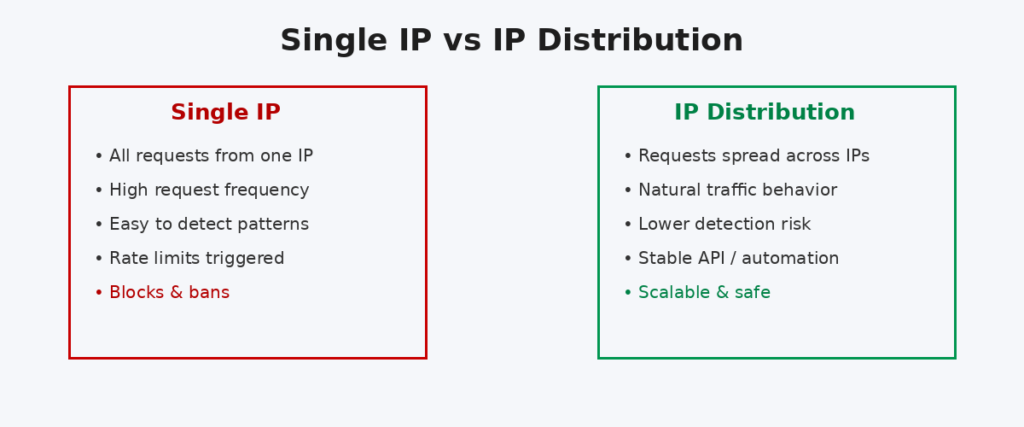
Automation introduces temporal regularity. Scripts execute on schedules, respond instantly, and repeat sequences with mechanical precision. Human traffic contains jitter: hesitation, interruption, and inconsistency. Automated traffic does not. When all automated actions originate from a single IP, platforms observe consistency that is statistically implausible for organic use.
Parsing and data collection create a different signature. Repeated access to similar endpoints from the same origin produces stable access graphs. These graphs persist even when headers rotate or user agents change. Retries often worsen the profile rather than mask it, reinforcing structural repetition. Over time, systems learn to associate these access patterns with non-interactive consumption regardless of request cosmetics.
Bulk actions compress activity into bursts. Large batches of updates, submissions, or checks collapse temporal spacing and create correlation spikes. Rate limiting may slow execution, but it does not eliminate correlation. Once a burst is attributed to a single source, subsequent actions inherit the accumulated context, even if their individual rate appears acceptable.
Multi-account workflows introduce a more subtle failure mode. Multiple logical identities may appear isolated at the application layer, but they converge at the infrastructure layer. When accounts share an IP, linkage emerges before behavioral analysis even begins. This infrastructure-level association often leads to identity collapse, where independent accounts are treated as a single coordinated entity.
Why IP-Level Restrictions Escalate Quickly
Blocking is rarely immediate, platforms typically apply soft constraints first: throttling, response delays, partial feature suppression. These measures are diagnostic. They test whether behavior adapts under pressure.
Behind the scenes, enforcement decisions occur across layers. Early infrastructure scoring evaluates IP reputation and concentration. Mid-layer systems analyze behavioral patterns within that constrained context. Only later do account-level enforcement mechanisms activate.
When activity continues unchanged, escalation follows. Because all requests originate from the same IP, penalties propagate across workflows. Temporary limits harden into persistent bans. In complex environments, restrictions cascade into dependent systems, creating failures far beyond the original task.
Platforms optimize for system stability, not individual fairness. IP-level enforcement persists because it works. Historical context is retained, and pausing activity does not reset accumulated risk. When work resumes, it is evaluated against prior signals, not a clean slate.
How IP Distribution Reduces Risk
Distribution works because it restores variance. When traffic spreads across independent IPs, no single address accumulates enough behavioral weight to dominate risk scoring. Requests are evaluated in smaller, context-appropriate segments.
Distributed load appears statistically normal. Legitimate growth is uneven, fragmented, and inconsistent. Concentrated growth is linear, smooth, and predictable. Systems tolerate uneven traffic far better than uniform patterns because it mirrors organic usage at scale.
Temporal dispersion improves naturally — load shaping emerges without artificial delays. Distribution does not eliminate scrutiny, it prevents premature aggregation from triggering enforcement at the infrastructure layer.
Which Proxy Types Fit These Workloads
Different proxy types project different infrastructure signals, and platforms respond to them in fundamentally different ways.
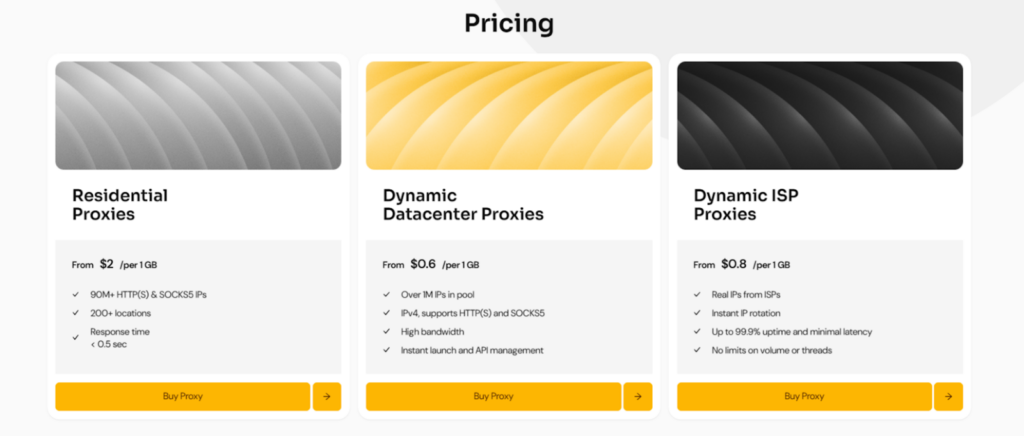
Residential proxies inherit trust from consumer networks. Their primary advantage is plausibility: traffic appears to originate from real households and mobile users, embedded in long-lived ISP address space. However, this trust is shallow. Residential IPs are volatile, sensitive to concentration, and particularly vulnerable to pattern accumulation. When residential addresses begin to exhibit sustained automation rhythms or repetitive access graphs, the contrast between “who they are supposed to be” and “how they behave” becomes a liability rather than a shield.
ISP proxies offer greater stability than residential IPs while retaining some consumer-network characteristics. They are suitable for sustained workloads where consistency matters but full datacenter fingerprints would raise early flags. Their limitation emerges under scale. Because ISP ranges are smaller and more uniform, concentration becomes visible faster. They tolerate moderate load, not systemic aggregation.
Datacenter proxies are the most transparent from an infrastructure standpoint. Their strength lies in performance, control, and predictability, but platforms recognize datacenter address space instantly and evaluate it with stricter baselines. Datacenter IPs require disciplined distribution, careful pacing, and explicit acceptance that scrutiny will be higher from the outset.
A common misconception is that a “high-quality” IP can carry unlimited workload. In reality, reputation influences the rate at which risk accumulates, not the limit. It affects the slope, not the ceiling. The determining factor is not origin, but how much behavioral context an address is forced to absorb.
Designing Infrastructure to Avoid IP Concentration
Once IP addresses are treated as behavioral containers rather than static connection points, infrastructure design decisions change. Sustainable scaling is not about avoiding scrutiny, but about preventing premature concentration from collapsing multiple signals into a single failure domain.
- Design for dispersion from the beginning. Network diversity should scale alongside request volume. Adding load without adding IP diversity accelerates risk accumulation rather than throughput.
- Segment infrastructure by function. Automation, parsing, bulk operations, and account access should not share network identity. Separation limits correlation even when individual workloads behave correctly.
- Monitor variance, not just volume. Uniform timing, identical request paths, and consistent pacing are stronger risk indicators than raw request counts.
- Assume historical memory. Pausing activity does not reset IP reputation. Rotation and pooling strategies should account for long-lived context, not just short-term blocks.
- Align distribution with platform expectations. Systems tolerate uneven, fragmented growth far better than smooth, centralized scaling. Infrastructure should reflect how legitimate traffic expands in practice, not how workflows are easiest to implement.
The core mistake is not selecting the wrong IP, but expecting one address to support systemic load indefinitely. Platforms interpret concentrated activity as risk because, historically, it is. Sustainable scaling aligns infrastructure signals with platform expectations. When traffic distributes intelligently, systems stabilize. When it concentrates, even the cleanest IP becomes a predictable point of failure.

Frequently asked questions
Here we answered the most frequently asked questions.
Why is using a single IP considered a mistake in automation?
Because all activity is concentrated in one point. Platforms detect repetitive actions, identical timing patterns, and group them into a single risk profile, which quickly leads to restrictions.
When is it still acceptable to use one IP?
For small-scale tasks with minimal load, where behavior remains close to “human-like.” However, as you scale, this approach stops working and starts creating risks.
Why don’t blocks happen immediately?
Platforms usually start with soft limitations: slower responses, CAPTCHAs, or partial feature restrictions. If behavior doesn’t change, restrictions escalate and can eventually lead to full blocking.
How should automation be scaled properly?
By distributing the load: using multiple IPs, separating tasks across them, and avoiding identical behavior patterns. This reduces risk and makes activity look more natural.