
How Proxies Affect Anti-Fraud Systems: Behavior, Signals, and Scaling Mistakes
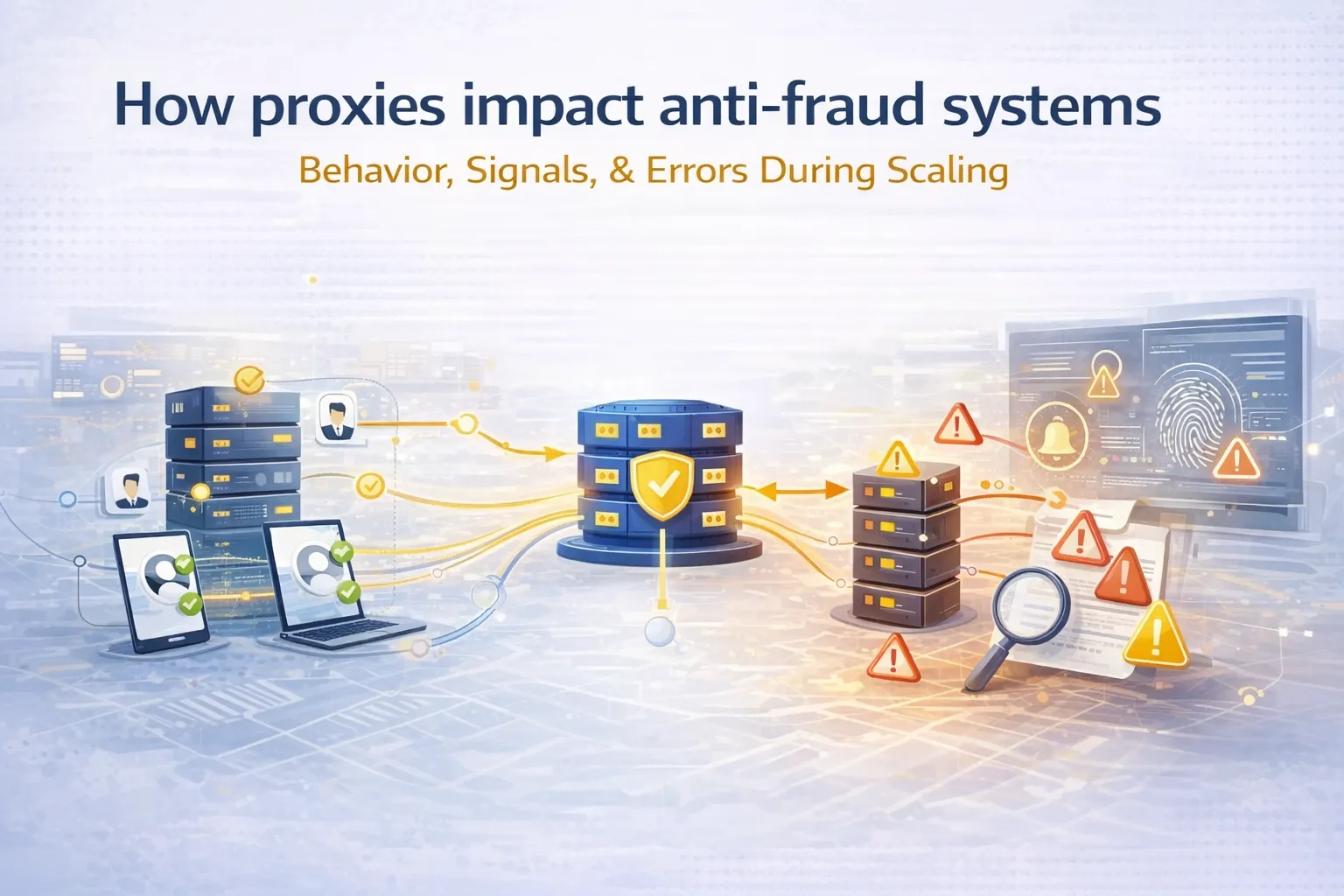
One of the most common mistakes is treating proxies as a solution to anti-fraud challenges. In reality, proxies are not a bypass mechanism – they are part of the signal model that systems analyze.
This is why a typical pattern appears: everything works fine at first, then restrictions gradually start to show up, even though nothing seems to have changed. The reason is that anti-fraud systems evaluate not just the IP, but behavior over time.
To understand this, proxies should not be viewed in isolation, but as part of the overall interaction infrastructure with a platform.
How Anti-Fraud Systems See Network Connections
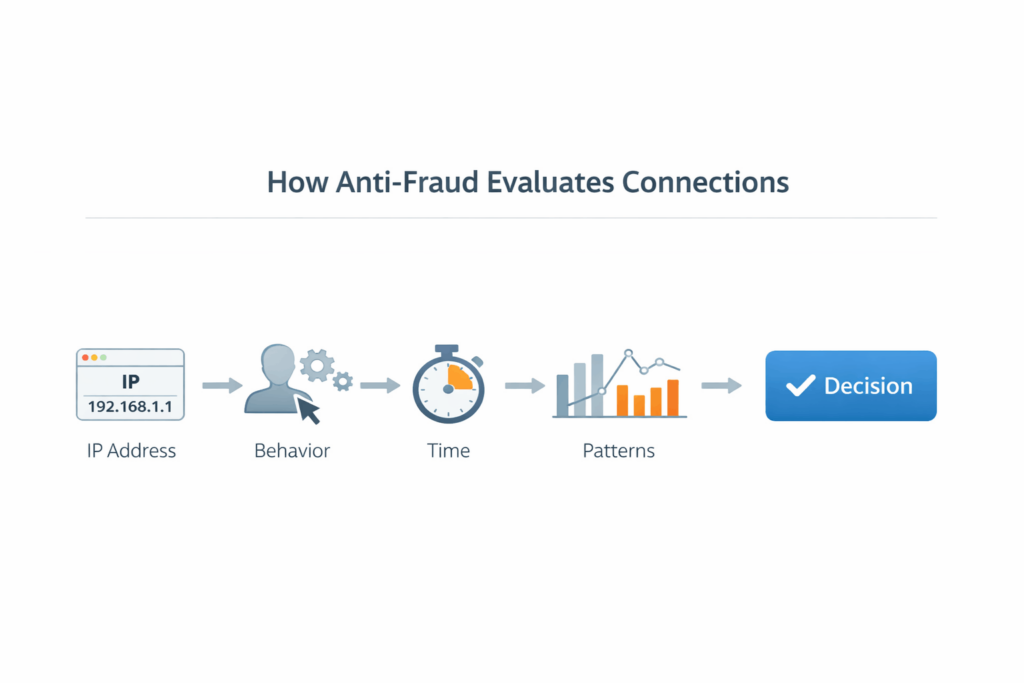
Anti-fraud systems do not rely on a single parameter. They build a broader picture from multiple signals, where the IP address is just one element.
In simple terms, the system evaluates how closely behavior resembles that of a real user. This includes both network characteristics and action patterns.
For example, even high-quality residential proxies may not deliver the expected result if requests follow identical intervals or repeat the same scenario. In such cases, the IP itself raises no concerns, but the behavior may appear unnatural.
Why Proxy Type Still Matters
Different proxy types create different baseline contexts.
On one hand, datacenter proxies provide high speed and consistent connection characteristics. This is useful for performance-driven tasks. On the other hand, this same consistency often becomes a signal for anti-fraud systems.
ISP proxies sit somewhere in between. They appear more stable, but under prolonged load may gradually lose trust.
Residential proxies are closest to real user traffic, but less predictable in terms of stability.
In real workflows, this becomes clear: the same process can behave differently depending only on the IP type.
Where Problems Start When Scaling
Almost any setup works at a small scale. Problems begin when scaling starts.
At this point, systems begin to detect patterns that were previously invisible. Behavior becomes repetitive – and that is exactly what starts to stand out.
Typical signals include:
- identical request intervals
- synchronized task execution
- repeated actions
- IP overlap between processes
This is especially noticeable when proxies are used without separating scenarios. Multiple flows start to look like a single source of activity.
Sessions and Behavioral Naturalness
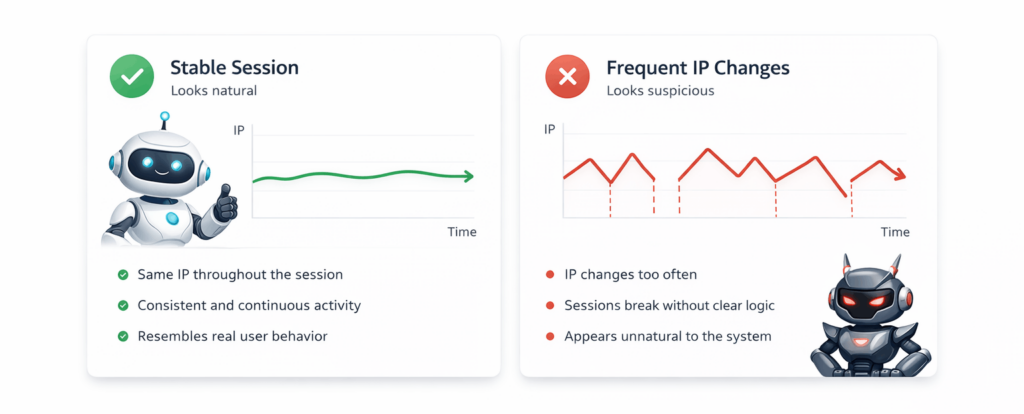
Another important aspect is session handling. Anti-fraud systems track not only the connection itself, but how long and how consistently a user or process behaves within it. If IPs constantly change and sessions break without clear logic, it may look unnatural. That is why the common assumption that “more rotation is always better” does not always hold. In some cases, stable IP usage within a task looks far more realistic.
API and Clean Behavioral Signals
When working through APIs, the role of proxies becomes even more visible. Here, interaction is limited to requests, so the system focuses on their structure and sequence.
In such an environment, lack of variability quickly becomes noticeable. When requests repeat the same structure, follow identical timing, and show no deviation, behavior starts to look too uniform. For the system, this is not stability – it is a clear signal of pattern repetition that becomes increasingly visible over time.
Proxies as Part of the System, Not a Solution
A key point: proxies do not solve the problem by themselves. They only define the network context in which everything operates.Even with a stable infrastructure, including solutions like MangoProxy, the outcome depends on how the logic is built:
- whether load is distributed or concentrated
- whether tasks are separated or overlapping
- whether behavior varies or stays identical
It is the architecture that determines long-term stability.
Practical Takeaways
Proxies should be seen as part of a signal model, not a bypass tool. The IP type influences starting conditions, but does not define the result. When scaling, it is more important to control behavioral repetition than to constantly change proxies. In practice, behavioral stability often matters more than speed or the number of IPs.
Conclusion
Proxies are not a way to bypass anti-fraud systems – they are part of the infrastructure that shapes how traffic is perceived. The outcome is determined not by the IP itself, but by behavior, load distribution, and system logic. This is what separates setups that work temporarily from systems that remain stable over time.
Glossary
Anti-fraud system – a system that analyzes behavior and traffic to detect suspicious activity
Session – a sequence of actions within a single user or process
IP rotation – changing an IP address during task execution
Behavioral pattern – a repeating model of actions

Frequently asked questions
Here we answered the most frequently asked questions.
Do proxies directly affect anti-fraud systems?
Yes, but only as one of many factors. Behavior and its structure play the primary role.
Are residential proxies safer?
They are closer to real traffic, but identical scenarios can still trigger restrictions.
Should you rotate IPs frequently?
Not always. Excessive rotation may look less natural than a stable session.
Which proxy type is best?
It depends on the task. The key is not just the IP type, but how it is used.