
How Affiliate Marketers Choose Proxies for Multi-Accounting and Campaign Testing
Affiliate marketing often involves multiple accounts, GEOs, offers, creatives, and landing pages running at the same time. In this setup, proxies sit next to anti-detect browsers, trackers, payment cards, and account farming systems as part of the affiliate’s working stack.
A proxy helps separate environments and keep each profile consistent. Platforms read the account together with its technical signals: IP address, location, fingerprint, timezone, language, connection stability, and behavior patterns.
Why Proxy Choice Matters in Affiliate Marketing
A poor proxy can get an account flagged before the campaign even starts. Low-quality shared IPs, unstable connections, or GEO mismatches may trigger checks, limits, or bans.
Price and country are only the starting point. Proxy type, IP reputation, speed, stability, rotation settings, and compatibility with anti-detect browsers also matter. A proxy for redirect checks does not need the same quality as one used for paid ad accounts or account farming.
The setup should look like one coherent profile. IP location, timezone, browser language, WebRTC, DNS, and account details should point to the same GEO and usage pattern. For a broader breakdown of proxy types and affiliate use cases, AffDays has a detailed guide to proxies for affiliate marketing.
Main Affiliate Tasks That Require Proxies
Affiliate marketers use proxies for several practical tasks:
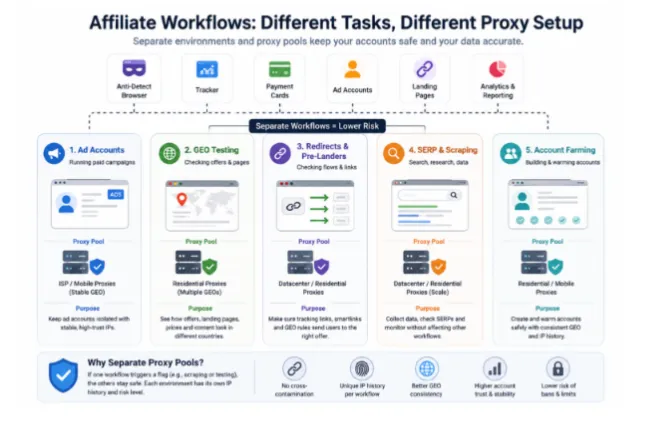
- Managing multiple ad accounts — separating accounts by proxy, browser profile, GEO, and login pattern, so platforms do not easily connect unrelated accounts.
- Testing offers in different GEOs — checking how landing pages, prices, bonuses, languages, and payment methods appear from the target country.
- Checking redirects and pre-landers — making sure tracking links, smartlinks, and GEO rules send users to the intended offer, not to a fallback, error page, or blocked flow.
- Avoiding profile mismatches — keeping IP location aligned with timezone, browser language, WebRTC, DNS, and account details.
- Separating workflows — using different proxy pools for scraping, SERP checks, account farming, and paid ad accounts, so one flagged activity does not affect the rest of the setup.
Redirect checks, account farming, and paid ad accounts carry different levels of risk, so they should not rely on the same proxy setup.
Residential vs ISP vs Datacenter vs Mobile Proxies for Affiliates
Affiliates should not use the same proxy type for every job.
| Proxy type | Best for | Main risk |
| Residential | GEO testing, account warming, sensitive platforms | Higher price and uneven provider quality |
| ISP / static residential | Stable ad accounts, long-term profiles, fewer IP changes | More expensive than regular residential proxies |
| Datacenter | Scraping, redirect checks, low-risk technical tasks | Easier to detect on strict platforms |
| Mobile | Social platforms, mobile-first GEOs, high-trust account work | Higher price, lower speed, less predictable rotation |
How to Match Proxy Type to Traffic Source
Proxy choice depends on the traffic source, platform strictness, GEO consistency, and IP reputation. Redirect checks and SERP monitoring can tolerate lower-trust IPs. Paid ad accounts and long-term social profiles usually cannot.
| Traffic source | Better proxy setup | Why |
| Facebook / Instagram | ISP or mobile proxies with a stable GEO | Strict account checks, linked-profile risks, and sensitivity to IP history |
| Google Ads | ISP or static residential proxies | Payment data, login location, and account GEO should stay consistent |
| TikTok | Mobile or high-quality residential proxies | Mobile-first usage patterns make mobile and residential IPs safer |
| SEO / SERP checks | Residential or datacenter proxies | Residential proxies give more realistic local results; datacenter proxies work for scale |
| Native / push / pop traffic | Datacenter or residential proxies | Lower-risk traffic checks can use cheaper IPs; stricter platforms may need residential |
| Telegram / Reddit / account farming | Residential or mobile proxies | Account age, GEO history, and repeated logins are more sensitive to IP quality |
Common Proxy Mistakes That Burn Affiliate Accounts
The same few proxy mistakes cause most account losses:
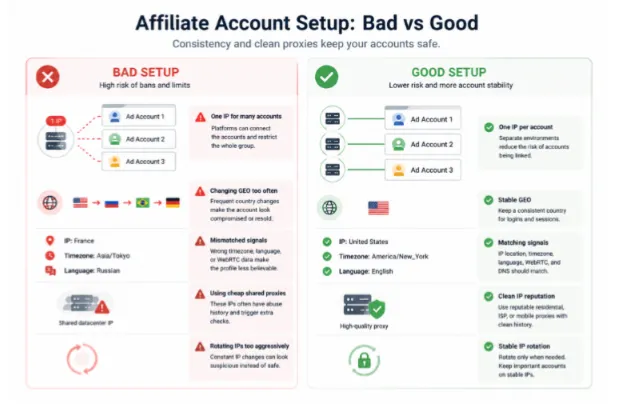
- Using one IP for unrelated accounts — platforms may connect the accounts and restrict the whole group.
- Changing GEO too often — frequent country changes can make a stable account look compromised or resold.
- Mixing IP location with the wrong timezone or language — mismatched signals make the profile less believable.
- Using cheap shared proxies for paid ad accounts — shared IPs may already have abuse history and trigger extra checks.
- Ignoring IP reputation — a proxy can look clean on paper but still carry previous spam, scraping, or fraud signals.
- Using datacenter proxies on strict platforms — they are easier to detect and may cause faster limits or bans.
- Rotating IPs too aggressively — some accounts need stable access; constant IP changes can look suspicious instead of safe.
Where Cheap Proxies Fit
Cheap datacenter proxies can work for low-risk tasks:
- checking redirects;
- testing basic automation;
- parsing non-sensitive data;
- checking landing pages;
- monitoring simple technical issues.
Trust-sensitive accounts need a different setup. Paid ad accounts, social profiles, payment-linked accounts, and long-term farming setups usually need more stable and reputable proxies, such as residential, ISP, or mobile proxies.
In these cases, saving money on proxies can be more expensive than the proxy itself: one bad IP can lead to account bans, lost spend history, failed payments, or broken campaign data.
Final Thoughts
For affiliate marketers, proxy choice should match the value and risk of the task. Low-risk checks can tolerate cheaper IPs; paid accounts and long-term profiles need cleaner, more stable ones.
In affiliate marketing, the proxy is part of the account environment. A weak IP can ruin a campaign before the first real test.
About the author
This article was contributed by the AffDays editorial team. AffDays is a media project covering affiliate marketing, ad networks, affiliate programs, traffic sources, and tools used by media buyers.

Frequently asked questions
Here we answered the most frequently asked questions.
What type of proxies are best for affiliate marketing?
The best proxy type depends on the task. ISP and mobile proxies are commonly used for ad accounts and social platforms, while residential and datacenter proxies are often used for GEO testing, scraping, and redirect checks.
Why do affiliate marketers use proxies?
Proxies help separate accounts, test offers in different GEOs, verify redirects, and keep browser fingerprints consistent. They are commonly used together with anti-detect browsers and tracking tools.
Are datacenter proxies safe for affiliate accounts?
Datacenter proxies can work for low-risk tasks like redirect checks or automation, but strict platforms such as Facebook Ads or TikTok may detect them more easily compared to residential or mobile IPs.
Why is GEO consistency important?
Platforms compare IP location, timezone, browser language, DNS, and other signals together. If they do not match, the account may look suspicious and trigger verification or restrictions.