
Which Metrics Matter When Evaluating Proxy Quality
When choosing proxies, many people focus on surface-level factors: proxy type, country, price, or advertised speed. In practice, however, most real issues arise not from the connection format itself, but from an incorrect initial assessment of proxy quality.
In automation, API workflows, data scraping, and high-volume requests, proxies become part of the technical setup. If there are weak points at this level, they quickly show up as unstable connections, errors, speed drops, and an increasing number of failed requests. That is why it is important to understand which proxy quality metrics actually matter and how to interpret them correctly.
Why Proxies Behave Differently
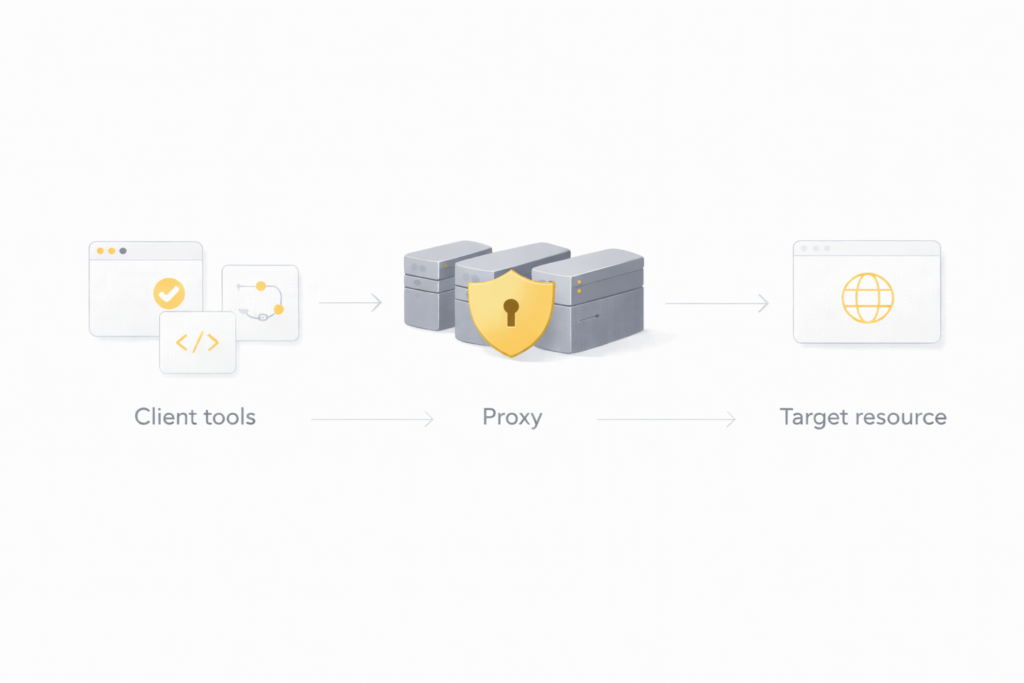
Two proxies of the same type can behave very differently under identical conditions. This happens because the term “proxy” hides a set of characteristics: the IP source, the rotation logic, behavior under load, and the quality of the network layer.
For example, residential proxies, ISP proxies, and datacenter proxies are designed for different use cases. Problems arise when the same expectations and metrics are applied to all of them without considering the actual usage context.
Key Proxy Quality Metrics
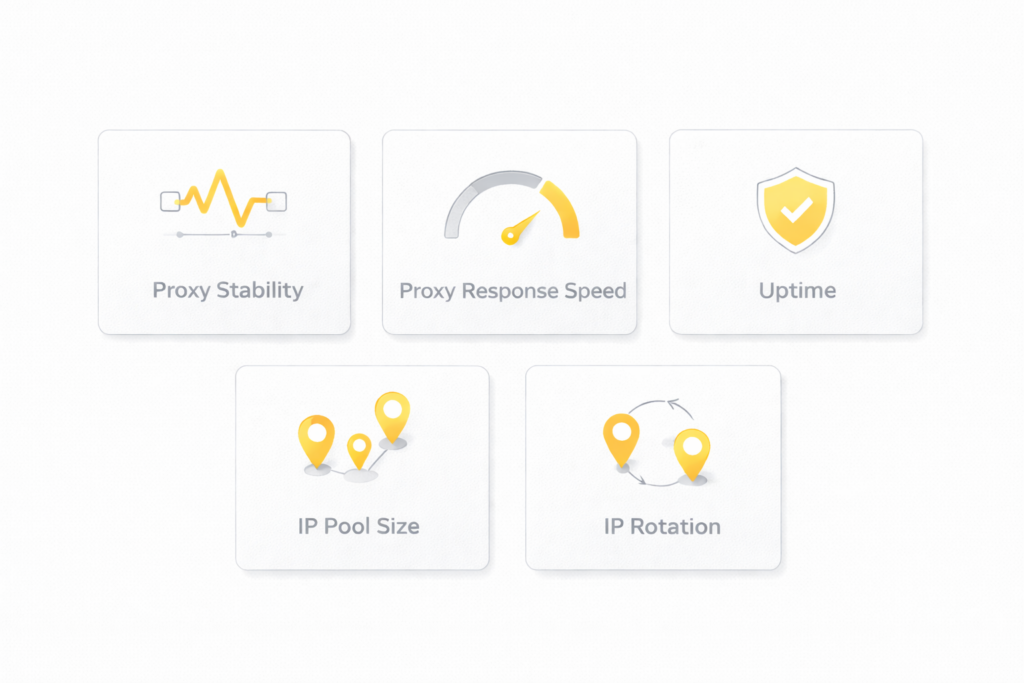
Proxy Stability
Proxy stability is not about whether a proxy works or not. It is about how consistently the connection behaves over time.
In real-world scenarios, instability usually appears as:
- intermittent connection drops,
- fluctuations in response time,
- uneven request processing.
When running automated workflows or handling large volumes of requests, these fluctuations quickly accumulate and break the logic of the entire system.
Proxy Response Time
Proxy response time is the delay between sending a request and receiving a response.
When evaluating it, it is important to consider:
- typical response time during normal operation, not peak values,
- behavior under load,
- differences between regions.
In API usage and data scraping, even small delays multiplied by thousands of requests can significantly increase total execution time.
Proxy Uptime
Proxy uptime shows how consistently a proxy remains available over a long period.
High uptime is especially important for:
- long-running sessions,
- integrations,
- continuous processes.
A proxy may show good speed on paper, but unstable uptime creates a false sense of reliability that quickly breaks down in real workloads.
IP Pool and Rotation
The size of the IP pool and the IP rotation logic directly affect how traffic is distributed.
Key aspects to watch here include:
- how often IPs are refreshed,
- whether addresses are reused too frequently,
- how the proxy behaves during long request sequences.
As request volume grows, this factor starts to influence results even when other metrics appear acceptable.
Metrics in Real-World Scenarios
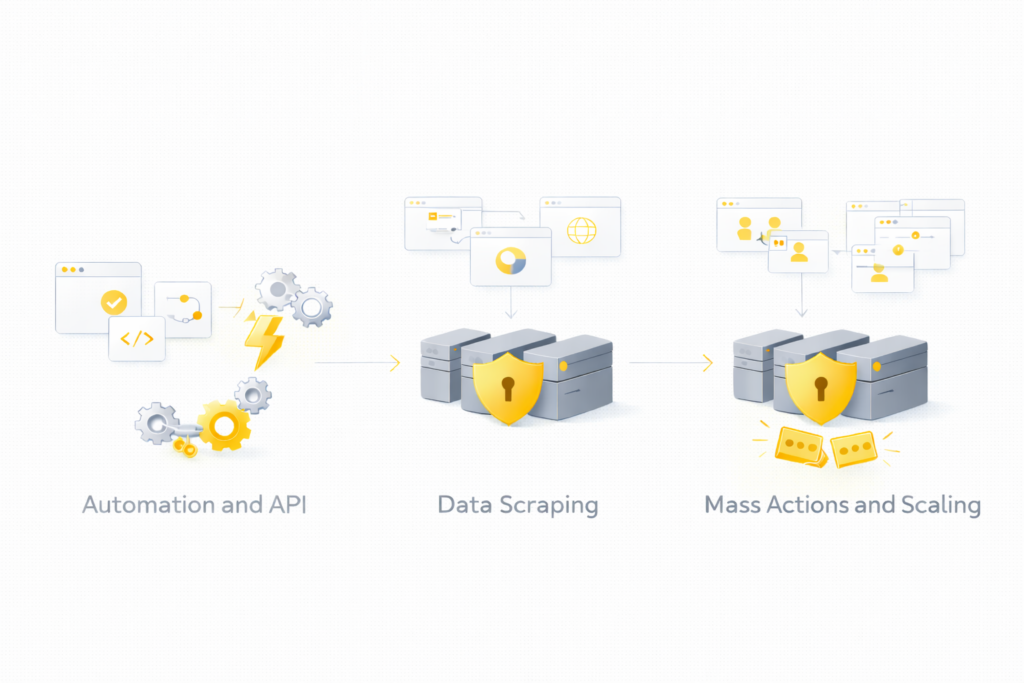
Automation and APIs
In automated systems, proxies become part of the execution chain. Issues rarely appear immediately – they tend to accumulate over time.
A common situation looks like this:
- a proxy passes a short test,
- but starts behaving inconsistently under sustained load.
This is why multiple metrics must be considered together: proxy stability, response time, and availability should be evaluated as a whole rather than in isolation.
Data Scraping
In data scraping workflows, proxies are not used one by one, but sequentially as part of request batches. Any instability leads to data loss and repeated requests.
Critical metrics here include:
- response time,
- consistency of operation,
- correct IP rotation.
Mass Actions and Scaling
As request volume grows, proxies become part of the overall working setup rather than a standalone tool.
At this stage, it is especially important to understand:
- how proxies behave under peak loads,
- how the IP pool responds as load increases,
- how the system handles failures.
Practical Takeaways
Evaluating proxy quality is not about checking a single parameter. It is about understanding how proxies behave:
- over time,
- under load,
- within a specific use case.
Good metrics do not guarantee success, but poor ones almost always lead to problems. That is why proxy selection should focus on the system as a whole, not on individual numbers.
Conclusion
Proxy quality is defined not by the proxy type or advertised specifications, but by how it behaves in real tasks. Proxy quality metrics help reveal this behavior early and avoid architectural mistakes.
Understanding stability, response time, uptime, and rotation logic makes it possible to build more reliable setups for automation, APIs, data scraping, and traffic scaling.

Frequently asked questions
Here we answered the most frequently asked questions.
Which proxy quality metric is the most important?
There is no single key metric. In practice, stability, response time, and availability matter together.
Why do proxies pass tests but cause issues later?
Short tests do not show how proxies behave under sustained load. Many issues appear only during longer sessions.
Is it enough to focus only on response time?
No. Fast response time does not compensate for unstable connections or poor availability.
Does proxy evaluation differ for APIs and data scraping?
Yes. APIs rely more on stability and uptime, while scraping depends on consistent behavior across request batches.
Why does IP pool size affect results?
Frequent IP reuse leads to problems faster, especially as request volume increases.
Can you tell in advance if a proxy is suitable for scaling?
Partially. Observing behavior under higher load and long request sequences gives early signals.
Does the proxy type guarantee quality?
No. The proxy type defines the use case, but quality depends on real-world behavior.