
Residential vs Datacenter vs ISP vs Mobile Proxies
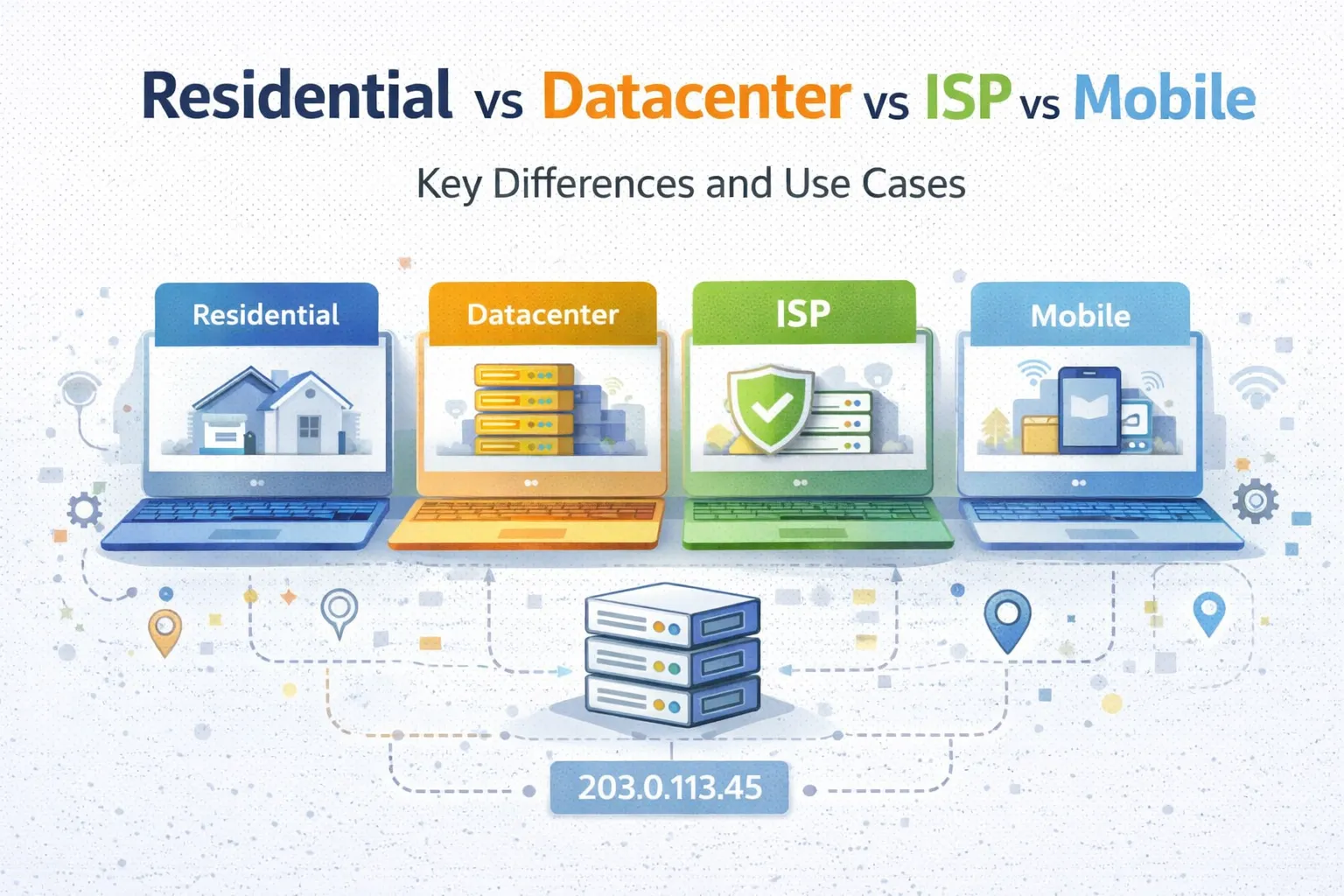
Selecting the right proxy infrastructure is a critical step for companies working with web automation, data extraction, account management, or digital intelligence workflows. While many guides focus only on comparing residential and datacenter proxies, modern proxy ecosystems include additional categories such as ISP and mobile proxies.
Each proxy type offers a different balance between authenticity, performance, scalability, and operational stability. Understanding these differences allows businesses to design proxy strategies that minimize blocking risk while maintaining high execution speed.
This guide explains how the main proxy categories work, compares their technical characteristics, and helps you determine which proxy type is most suitable for specific tasks.
Proxy Types Overview
|
Proxy Type |
IP Origin |
Detection Resistance |
Performance |
Session Stability |
Common Use Cases |
|---|---|---|---|---|---|
|
Residential |
Consumer ISP networks |
High |
Medium |
Medium |
scraping, localized research |
|
Datacenter |
Cloud server infrastructure |
Moderate |
Very high |
High |
automation, bulk processing |
|
ISP |
ISP ranges hosted on servers |
High |
High |
Very high |
account workflows |
|
Mobile |
Cellular carrier networks |
Very high |
Medium |
Variable |
social automation |
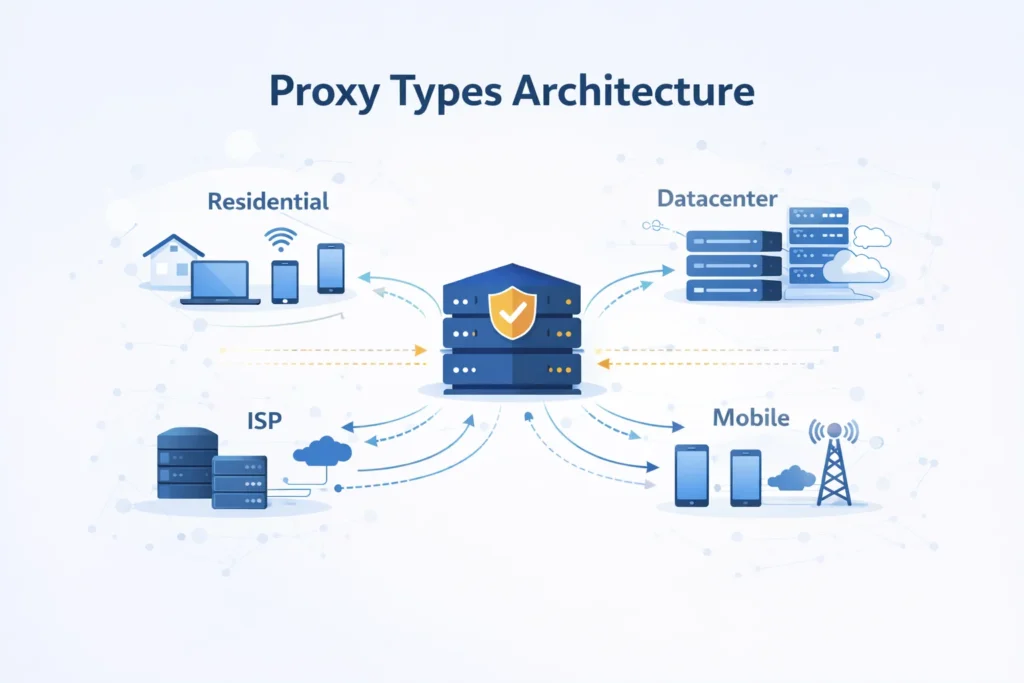
In simplified terms:
- residential proxies simulate real users
- datacenter proxies maximize throughput
- ISP proxies balance trust and stability
- mobile proxies provide dynamic anonymity
Residential Proxies Explained
Residential proxies use IP addresses that belong to real internet subscribers. These connections originate from consumer broadband or home networks, which makes traffic appear natural to most online platforms.
Because of this, residential proxies are frequently chosen for operations where maintaining credibility is essential. Websites tend to apply stricter scrutiny to automated requests coming from known server networks, while traffic from residential IP ranges often passes with fewer restrictions.
Typical scenarios where residential proxies perform well include:
- monitoring regional pricing variations
- collecting publicly accessible marketplace data
- verifying ad placement accuracy
- evaluating search visibility across cities
Their main limitation is lower scalability compared to server-based proxy infrastructure.
Datacenter Proxies Explained
Datacenter proxies are provisioned within professional hosting environments rather than residential networks. These proxies are generated in large volumes and can support significant traffic loads with minimal latency.
Because they operate within optimized network conditions, datacenter proxies deliver predictable performance and fast response times. This makes them highly effective for tasks requiring high-frequency request execution.
Common applications include:
- automated account creation frameworks
- distributed crawling systems
- load testing environments
- large-scale API interactions
Although some platforms can recognize datacenter IP ranges, their efficiency makes them indispensable for high-volume workflows.
ISP Proxies Explained
ISP proxies represent a hybrid model that combines characteristics of residential and datacenter proxies. They use IP ranges officially assigned to internet service providers but are hosted on dedicated server hardware.
This approach enables:
- consistent long-duration sessions
- strong platform trust signals
- improved routing performance
ISP proxies are widely adopted in environments where maintaining stable connections is more important than rotating identities frequently.
Typical use cases include:
- managing multiple seller accounts
- monitoring ticket inventory
- maintaining authenticated sessions
- executing scheduled automation routines
Mobile Proxies Explained
Mobile proxies route traffic through IP addresses assigned by cellular network operators. These IP addresses are dynamically reused across large groups of mobile subscribers, which creates highly organic traffic patterns.
Because of this network behavior, mobile proxy traffic can be more resilient to detection systems that rely on static IP analysis.
Organizations use mobile proxies for:
- social platform automation
- testing mobile-first applications
- accessing content gated by device classification
- interacting with systems sensitive to proxy infrastructure
However, connection consistency can vary depending on carrier routing policies.
Key Differences That Matter in Practice
When comparing proxy categories, the most relevant factors usually include:
|
Factor |
Residential |
Datacenter |
ISP |
Mobile |
|---|---|---|---|---|
|
Trust signal strength |
High |
Medium |
High |
Very high |
|
Request throughput |
Medium |
Very high |
High |
Medium |
|
Session persistence |
Medium |
High |
Very high |
Variable |
|
Blocking probability |
Low |
Medium |
Low |
Very low |
|
Deployment flexibility |
Medium |
Very high |
High |
Medium |
These differences directly influence how proxy infrastructure should be deployed.
Which Proxy Type Is Best for Web Scraping
There is no single proxy type that performs best in every scraping scenario.
Residential proxies are effective when accessing platforms that enforce strict behavioral filtering. Datacenter proxies are better suited for large-scale crawling tasks where speed and cost efficiency are priorities.
ISP proxies are often chosen when scraping workflows require persistent authenticated sessions. Mobile proxies can be useful when interacting with platforms that apply aggressive anti-bot heuristics.
In practice, many organizations distribute scraping workloads across multiple proxy layers to balance efficiency and reliability.
Hybrid Proxy Strategies
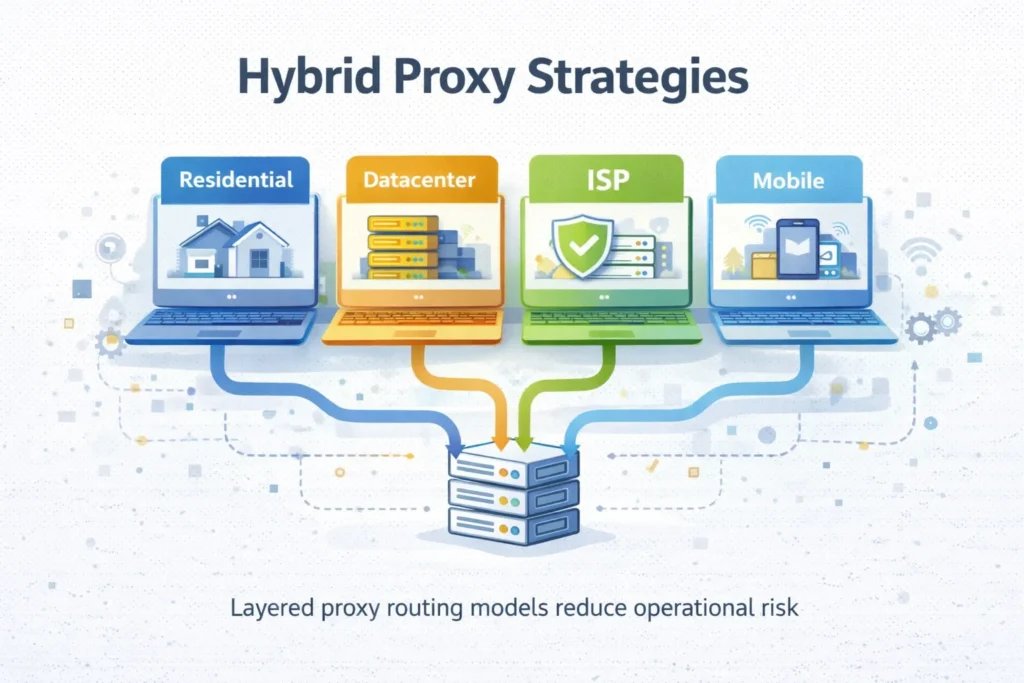
Modern automation architectures rarely rely on one proxy category alone. Instead, teams design layered proxy routing models.
For example:
- initial discovery requests may use residential proxies
- bulk data extraction may run through datacenter nodes
- login sessions may be maintained via ISP proxies
- sensitive interactions may be executed using mobile networks
This diversified routing strategy helps reduce operational risk.
Proxy Infrastructure at MangoProxy
MangoProxy provides multiple proxy networks tailored to different workload requirements.
Residential proxies enable region-aware data collection with realistic traffic profiles.
ISP proxies support stable session management for automation frameworks.
Datacenter proxies deliver scalable performance for high-volume execution pipelines.
Mobile proxies offer dynamic IP environments for high-sensitivity workflows.
Selecting the right combination of proxy types can significantly improve task success rates.
Key Takeaways
- proxy categories differ mainly by IP origin and routing behavior
- residential and mobile proxies provide stronger authenticity signals
- datacenter proxies enable large-scale execution at lower cost
- ISP proxies offer stable long-session connectivity
- hybrid proxy deployment improves resilience
Glossary
- Proxy Infrastructure
A distributed network of intermediary servers used to route internet traffic. - IP Reputation
A classification metric used by platforms to evaluate traffic credibility. - Session Persistence
The ability to maintain a consistent connection identity over time. - Traffic Scaling
Increasing request volume by distributing traffic across multiple IP endpoints.
Frequently asked questions
Here we answered the most frequently asked questions.
Are residential proxies always better than datacenter proxies?
Not necessarily. Residential proxies reduce detection risk, while datacenter proxies provide higher performance and scalability.
Why do businesses use ISP proxies?
ISP proxies help maintain stable long-running sessions while preserving residential trust characteristics.
Are mobile proxies harder to block?
Mobile proxy traffic can appear more natural due to dynamic carrier IP assignment patterns.
Can proxy types be combined?
Yes. Many automation systems use multiple proxy layers to balance speed and reliability.