
From Proxy to White Page: The Complete Infrastructure for Running Ad Campaigns

Many affiliate marketers face the same situation: proxies are set up, the account is warmed up, creatives are ready — and the campaign still gets rejected, or the account gets banned within a few days. The reason is almost always the same: ad platforms analyze not individual elements, but the entire environment around the launch.
A stable launch is a system. A proxy matters, but it’s only one layer of several. In this guide, we’ll break down what components make up a working infrastructure, what role a white page plays in it, and how to put everything together correctly.
Why a Proxy Alone Is Not Enough
A proxy solves one specific problem: it replaces your real IP address with the right one matching the target geo, connection type, and carrier. This is critical for multi-accounting, running ads across multiple geos, and working with platforms that restrict access by region.
But modern ad platforms Facebook, Google, TikTok have gone far beyond simple IP checks. Their moderation algorithms analyze:
- Browser fingerprint a unique combination of browser characteristics (Canvas, WebGL, fonts, screen resolution)
- Behavioral patterns how exactly the user interacts with the platform
- Landing page quality whether it meets requirements and looks like a real business
- Data consistency whether the proxy geo, browser language, landing page language, and campaign targeting all match
If the IP looks right but everything else raises questions the platform will notice. This is why professional teams build not individual tools, but a unified infrastructure.
What Ad Campaign Infrastructure Consists Of
Proxy — Stable IP for the Target Geo
The foundation of any launch. A proxy provides the right IP address matching the campaign’s target geo. For advertising tasks, mobile and residential proxies are optimal they look like real user traffic, not data center connections. Key parameters: connection stability, geo accuracy down to city level, connection type, and IP rotation capability.
Anti-Detect Browser — Profile Isolation
An anti-detect browser creates a separate isolated profile for each account: a unique fingerprint, independent cookies, and local storage. From the platform’s perspective, each profile looks like a separate physical device. Without an anti-detect browser, running multiple accounts from one machine almost guarantees they’ll be linked by fingerprint.
White Page — Legitimate Landing for Moderation
A white page is the landing page a platform moderator sees when reviewing an ad. It contains nothing prohibited, complies with platform rules, and looks like a real business website. Without a quality white page, campaigns in most verticals (nutra, dating, iGaming, crypto) won’t pass moderation regardless of how good the proxy and anti-detect setup is.

Tracker — Traffic Distribution
A tracker determines which page a specific visitor sees: a platform moderator lands on the white page, while real traffic goes to the offer. Without a tracker, the setup doesn’t function as a complete system.
The Role of a White Page in the Proxy Setup
A proxy and a white page solve different problems, but they’re interdependent. The proxy handles the geo at the IP level. The white page handles the content check for the landing page. If either of these conditions isn’t met, the entire setup falls apart.
An important point that’s often overlooked: the white page must match the proxy’s geo. If you’re running a campaign with a German IP, the landing page must be in German with content relevant to a German audience. A mismatch between the white page language and the proxy geo is one of the most common reasons for rejection.
Beyond language, the white page must match the specific vertical. Requirements for a nutra landing page and an iGaming one are fundamentally different: different content volume, different legal elements, different restrictions on phrasing.
How to Build the Setup Correctly
- Define the geo and vertical. Everything else is built around these two parameters.
- Choose a proxy for the target geo. For advertising tasks mobile or residential. Make sure the proxy geo exactly matches the campaign targeting.
- Set up a profile in the anti-detect browser. The profile fingerprint must match the proxy geo: browser language, timezone, locale.
- Prepare a white page for the target geo and vertical. The page must be in the audience’s language, include Privacy Policy, contact information, and meet the platform’s specific requirements.
- Connect a tracker. Configure the rules: moderator traffic → white page, real traffic → offer.
- Check consistency before launch: proxy geo = white page language = ad language = targeting.
Common Infrastructure Mistakes
Proxy geo and white page language mismatch. The most common mistake. A German IP with an English white page is a red flag for moderation.
One white page for all geos. When working across multiple regions, each geo requires a separate localized version of the landing page.
Template white page. Pages that algorithms have seen thousands of times get detected automatically. Unique content and unique code are non-negotiable.
No Privacy Policy. Without this page, campaigns on Facebook, Google, and TikTok won’t pass moderation.
Ignoring mobile adaptation. Especially critical for TikTok. The page must display correctly on mobile devices and load quickly.
How to Handle the White Page Quickly
Preparing a white page manually for a specific geo and vertical takes 1–3 days of work. When working with multiple geos simultaneously, manual production becomes the bottleneck of the entire process.
One tool that solves this is Gen White Page an automated white page generation service for affiliate marketers, working through a Telegram bot. Every page is built from scratch: unique texts, unique images, unique code.
The flow takes a few minutes: select vertical → language → brand name → keywords → site description → ready ZIP archive with a complete set of files (HTML or PHP, Privacy Policy, contact page). Supports 20+ languages — which directly addresses the requirement of matching the white page language to the proxy geo.
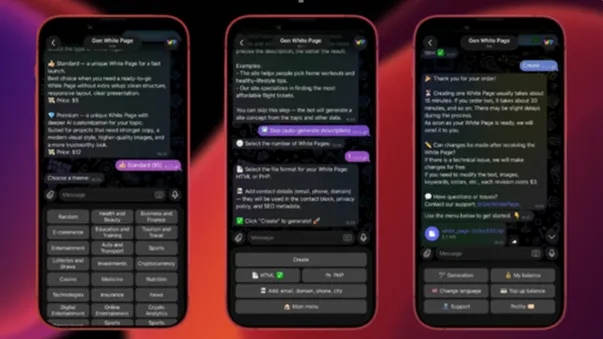
Two modes: Standard ($5) — for the main volume of launches, Premium ($12) — for premium geos and periods of stricter moderation. More details on the service website.
Conclusion
A stable ad campaign launch is a system where each element handles its own task. The proxy provides the right IP, the anti-detect browser isolates profiles, the white page passes the content check, and the tracker distributes traffic. Remove any of these layers and you leave a gap in your infrastructure. When all components are aligned with each other, campaigns launch more reliably and tests run faster.

Frequently asked questions
Here we answered the most frequently asked questions.
Can I run ads without a white page using only a proxy and anti-detect?
In most verticals no. A proxy and anti-detect handle the account level and connection environment, but not the landing page content check. For nutra, dating, iGaming, and crypto, a white page is a mandatory part of the setup.
Do I need a separate white page for each geo?
Yes. The white page must match the language and cultural context of the target audience. An English-language page for a campaign running on a German IP creates a mismatch that platforms detect automatically.
What type of proxy works best for ad campaigns?
For advertising tasks, mobile and residential proxies are optimal — they look like real user traffic. Datacenter proxies work for tasks where the platform doesn’t scrutinize connection quality as closely, such as parsing.
How quickly can I prepare a white page for a new geo?
Using a white page generator 5 to 10 minutes. Select the vertical, specify the language for the target geo, enter the brand name, and receive a ready ZIP archive for uploading to hosting.
I found the recommendations on organizing white pages especially useful. It’s a good reminder that consistent project structure can save a lot of time when scaling campaigns.