


Rotating for Research, Static for Checkout: How Proxies and Crypto Cards Work Together
Published: ≈ 12 min read
Running an online business increasingly means juggling tools that were never designed to work together.
You may use residential proxies for market research, an ISP proxy for a long-lived account, USDT for working capital, and a traditional card checkout when it is time to pay for advertising, AI tools or cloud infrastructure.
That last step is where services such as IZIPAY become useful.
IZIPAY gives crypto users a way to fund a card from supported digital assets and then use ordinary online payment infrastructure. Instead of cashing USDT out through an exchange and bank every time a SaaS bill arrives, part of the crypto balance can be moved onto a card and used at eligible merchants.
Once proxies are added to the workflow, however, there is an important detail many users overlook:
the best proxy setup for gathering data is not necessarily the best setup for making a payment.
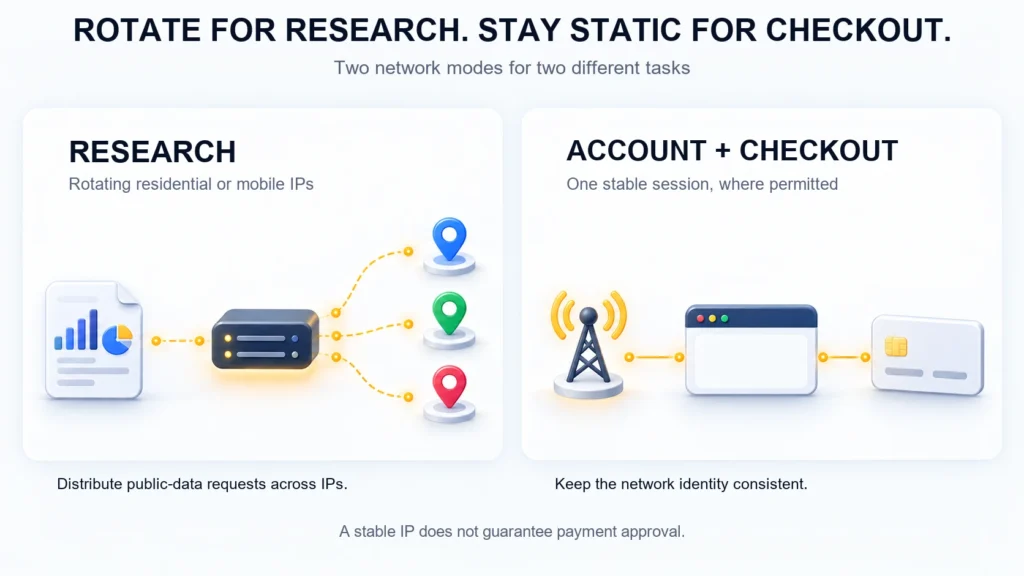
Rotating IPs are useful when distribution matters. Billing sessions generally benefit from consistency.
Understanding when to rotate and when to stay put can make the difference between a smooth workflow and a payment session full of unnecessary problems.
Why proxy users are a natural fit for crypto cards
The overlap is larger than it first appears.
People using serious proxy infrastructure are often involved in businesses such as:
- affiliate marketing;
- advertising;
- e-commerce;
- web scraping;
- SEO;
- price monitoring;
- account management;
- AI development;
- SaaS;
- remote work;
- crypto businesses.
These are also industries where stablecoins are common.
A media buyer may receive affiliate revenue in USDT. A Web3 company may hold part of its treasury in stablecoins. A freelance developer may be paid in crypto but still need to pay for APIs, hosting and AI tools.
The problem is that most of those expenses are not paid on-chain.
Advertising platforms, software vendors and cloud providers usually want a card.
That creates a familiar chain:
crypto → exchange → fiat sale → bank withdrawal → bank card → merchant
A crypto-funded card removes some of those steps.
With IZIPAY, the operating flow can become:
USDT → IZIPAY card → advertising, SaaS or other online expense
The proxy handles the connection. The card handles the payment.
Those two systems solve different problems, but they often appear in the same business workflow.
IZIPAY as the payment layer
IZIPAY is particularly relevant to people who already keep part of their working capital in crypto.
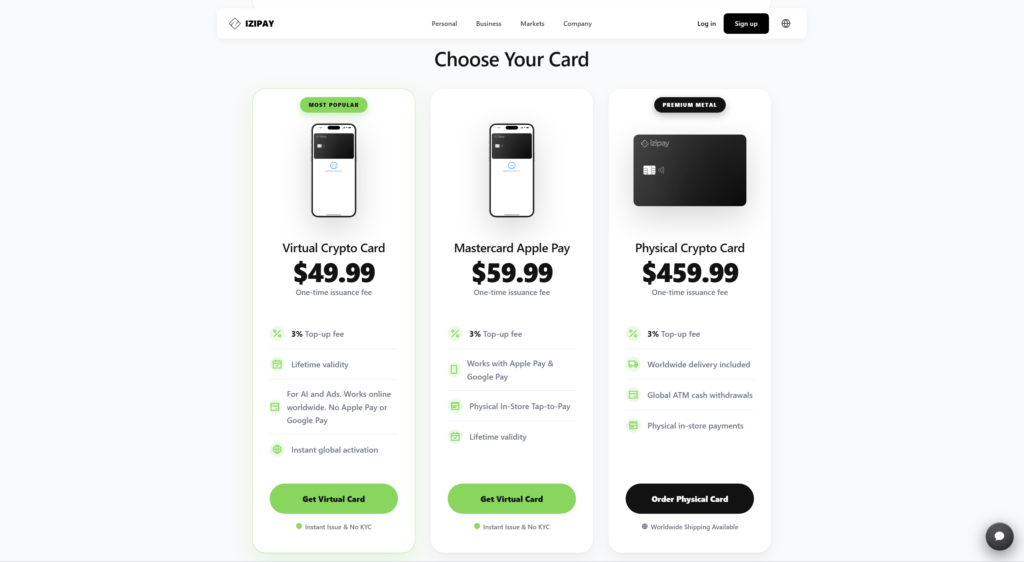
Instead of converting everything to fiat before it can be used, an eligible user can fund a virtual card with supported digital assets and then use the card at merchants that accept the payment method.
That can include expenses such as:
- AI subscriptions;
- advertising platforms;
- cloud infrastructure;
- hosting;
- domains;
- developer tools;
- travel;
- online shopping;
- SaaS;
- digital services.
For a remote business, that is useful because it turns crypto into a spending balance without requiring the merchant itself to understand cryptocurrency.
The merchant sees a card transaction.
The business still gets to keep much of its treasury or revenue on-chain until it actually needs to spend it.
Where proxies enter the picture
A proxy changes the network identity seen by a website.
Depending on the job, that can be extremely useful.
A residential proxy may be used to check how a website appears in a specific country. A rotating network can distribute thousands of public-data requests. A mobile proxy can show how a service behaves through a cellular connection.
MangoProxy’s own product categories reflect those different jobs.
The mistake is assuming the same proxy behavior should continue through every stage of the workflow.
Suppose a marketing team is using rotating residential IPs to verify ads across several countries.
That makes sense during the research stage.
Then someone opens the advertiser billing page and adds an IZIPAY card.
If the proxy continues rotating during checkout, the account may appear from several different network locations within a short period.
That provides no real benefit.
For authenticated sessions and payments, consistency is usually the better choice.
Rotating proxies are excellent for discovery
There are many situations where IP rotation is exactly what you want.
For example:
Price monitoring
An e-commerce company may need to collect public prices from thousands of pages.
Sending all requests through one address is inefficient and may quickly hit rate limits.
A rotating proxy pool distributes the workload.
Search monitoring
Search results change by country, city and network context.
Geo-targeted proxies let SEO teams inspect those differences without physically operating in every market.
Ad verification
Advertisers can check whether the correct creative, landing page and offer are being shown in different regions.
Residential or mobile proxies are particularly useful for this kind of validation.
Public web data
Large research jobs benefit from distribution.
Here, rotating IPs are part of the architecture rather than a problem.
The key is knowing when that phase has ended.
Checkout is a different environment
A checkout page does not need to be treated like a scraping target.
Once you are inside an authenticated account, the platform already has context.
It may know:
- account history;
- login history;
- browser session;
- device characteristics;
- IP location;
- billing country;
- payment method;
- previous payment attempts.
Changing your IP several times during this process creates extra variables.
Imagine a billing flow like this:
- Login from a German IP.
- Open account settings from a French IP.
- Load checkout from a U.S. IP.
- Enter a British billing address.
- Add a new virtual card.
- Payment fails.
- Switch to another country and retry.
None of those signals alone proves anything is wrong.
The problem is that the overall session looks unnecessarily inconsistent.
A much cleaner setup would use one stable connection for the authenticated session and payment.
Static ISP proxies make more sense for persistent accounts
This is where ISP proxies become useful.
A static ISP proxy gives the session one IP for an extended period.
That can make sense for:
- advertising dashboards;
- SaaS accounts;
- seller platforms;
- long-running authenticated sessions;
- administration tools;
- billing pages.
It does not mean a user should pretend to be in a country where they are not supposed to operate.
A proxy does not override a website’s terms, compliance requirements or local law.
Its benefit in this context is simply continuity.
The same account keeps seeing the same network identity.
IZIPAY and stablecoins make business budgeting easier
Crypto-funded cards become especially useful when paired with stablecoins.
Bitcoin may be the better-known asset, but it is awkward for a weekly operating budget.
Suppose an affiliate team has $5,000 earmarked for:
- Taboola campaigns;
- AI tools;
- hosting;
- tracking software;
- proxies;
- cloud infrastructure.
Keeping that operating budget in USDT or USDC makes the number easier to manage.
The company can leave the rest of its holdings elsewhere and transfer only what it expects to spend.
An IZIPAY card can then become the actual payment instrument.
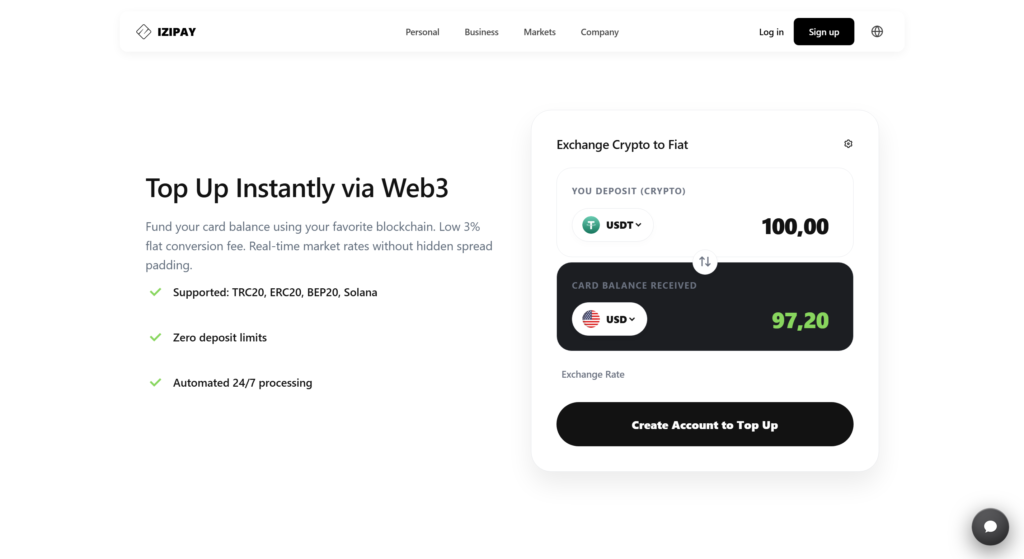
That creates a simple separation:
crypto treasury → operating stablecoin balance → card → business expenses
For companies that already earn crypto, this is much cleaner than treating every software invoice as a separate cash-out event.
A virtual card is enough for most proxy users
Most of the expenses associated with proxy-based businesses happen online.
That includes:
- proxy subscriptions;
- advertising;
- analytics;
- AI products;
- hosting;
- domains;
- email tools;
- tracking systems;
- cloud platforms.
There is little reason to wait for a physical card when the merchant checkout is online.
A virtual crypto card gives users the card details needed for eligible internet payments while keeping the funding source tied to their crypto balance.
For businesses that also travel or make physical purchases, a physical card or mobile wallet can be useful as a second layer. But for day-to-day operational expenses, the virtual card is usually the important piece.
A practical media-buying setup
Paid advertising is probably the clearest example of proxies and crypto cards working in the same operation.
Imagine a performance-marketing team running campaigns internationally.
They might use MangoProxy-style infrastructure to:
- inspect ads in different countries;
- verify landing pages;
- check localization;
- monitor competitor campaigns;
- test search results;
- confirm redirect behavior.
Their revenue might arrive in USDT.
The team then needs to fund advertising accounts.
A clean workflow could be:
Step 1: Research
Use rotating residential or mobile proxies for regional verification.
Step 2: Account management
Move to a sticky session or stable ISP proxy.
Step 3: Funding
Top up the IZIPAY card from the business’s crypto operating balance.
Step 4: Payment
Use the stable authenticated environment when working in the advertiser billing dashboard.
Each tool is doing the job it is good at.
The proxy is not being used to make the payment “look different.” It is being used to provide the right network environment for each stage.
The same model works for AI teams
AI developers have similar expenses.
A team may pay for:
- model APIs;
- GPU rental;
- Cursor;
- Claude;
- ChatGPT;
- cloud storage;
- hosting;
- observability;
- databases;
- web-search APIs.
At the same time, developers may use proxies for:
- regional testing;
- data collection;
- public web research;
- application testing.
If client revenue arrives in USDT, an IZIPAY card can turn part of that balance into an operating budget for the software stack.
The useful distinction remains the same.
Rotation is for tasks that need distribution.
Payment sessions need continuity.
Bad VPN and proxy habits can cause avoidable problems
Proxy users sometimes assume that more IP changes equal more privacy or more reliability.
That is not always true.
During a payment session, repeatedly changing endpoints can add friction.
The same applies to poor-quality VPNs.
A free VPN exit node may be shared by thousands of unrelated users. Its history may be completely different from the normal behavior of the account being accessed.
If you do not need a proxy or VPN during checkout, keeping the connection simple is often best.
If you do need one, use a stable, high-quality endpoint.
Do not rotate simply because the option exists.
Billing details still matter
A stable IP does not fix bad billing information.
Users should fill in the information requested by the merchant accurately and completely.
That may include:
- full name;
- street address;
- city;
- postal code;
- billing country;
- company information.
The goal is not to trick a payment system into believing something false.
It is to avoid introducing unnecessary inconsistencies into a legitimate transaction.
A stable network session, accurate billing information and sufficient card balance create a much cleaner checkout than random addresses and constantly changing IPs.
Do not rotate after a decline
A common reaction to a failed payment is to change everything at once.
New proxy.
New country.
New browser.
New billing address.
Another payment attempt.
That makes troubleshooting harder.
If a payment fails, first check the obvious things:
- available balance;
- card details;
- expiration date;
- billing information;
- merchant card policy;
- account restrictions;
- previous failed attempts.
If the card side appears correct, contact the card provider.
If the account itself is restricted, contact the merchant.
Changing IP repeatedly should not be the first response.
One card does not need to run the entire business
Crypto cards become even more useful when businesses stop treating them as one giant shared balance.
Different cards or budgets can be used for different functions.
For example:
- advertising;
- AI and software;
- infrastructure;
- travel.
This makes reconciliation easier.
If a media platform reports a failed charge, the team knows which card and budget to inspect.
It also helps prevent one unexpected SaaS renewal from consuming the money intended for an advertising campaign.
For teams already used to segmenting proxy infrastructure by workload, applying the same idea to payments is natural.
Privacy works better when behavior stays consistent
There is a useful distinction between privacy and randomness.
A proxy can prevent a website from seeing the user’s original IP.
A crypto-funded card can keep a merchant from being directly tied to the user’s primary bank card.
Those are legitimate privacy benefits.
Neither requires the user to present random information.
A privacy-conscious setup can still have:
- a stable proxy;
- a consistent billing profile;
- one dedicated card;
- predictable account behavior.
In fact, that is often the cleaner setup.
Privacy should reduce unnecessary exposure. It should not require chaos.
The bigger lesson: use specialized tools for specialized jobs
Remote businesses increasingly operate across several systems at once.
Crypto handles value transfer.
Stablecoins handle operational balances.
Crypto cards connect those balances to existing merchants.
Residential proxies handle distributed web access.
ISP proxies handle persistent sessions.
Mobile proxies help reproduce mobile-network behavior.
Trying to make one tool do every job usually creates unnecessary problems.
A rotating proxy is excellent for large-scale research. It is not automatically the best choice for a checkout session.
A crypto wallet is excellent for holding USDT. It is not what most SaaS providers expect at checkout.
IZIPAY fills the second gap in much the same way proxy infrastructure fills the first: by translating one environment into something the destination already understands.
The most reliable setup is therefore not particularly complicated.
Rotate where rotation helps.
Stay static where consistency matters.
Keep business spending separate.
Use crypto for the part of the workflow where crypto is useful, and use a card when the merchant wants a card.
For businesses already working across proxies, stablecoins and global online services, those layers fit together surprisingly well.
Frequently asked questions
Here we answered the most frequently asked questions.
Can every IZIPAY virtual card be added to a mobile wallet?
Check the exact card type before ordering. IZIPAY describes different virtual card options with different wallet capabilities, so a card intended for online checkout may not have the same features as its wallet-enabled option.
What should I verify before funding a card with stablecoins?
Check the supported asset and blockchain network for the selected card, the current top-up fee, and any applicable limits on IZIPAY’s official pages. Confirm the destination details in your account before sending funds.
What should I check before using a crypto-funded card for recurring subscriptions?
Confirm that the merchant accepts your selected card for recurring billing. Check the renewal currency and schedule, and keep enough available balance for the charge and applicable fees. A successful one-time purchase does not by itself confirm support for recurring payments.