
How to Analyze Native and Teaser Ads and Discover Promising Campaign Angles Faster
Why Finding Winning Ideas Manually Is Becoming More Difficult
A few years ago, analyzing teaser and native advertising often came down to simple observation. You could browse popular websites, look at ad placements, save interesting creatives, and draw conclusions about what advertisers were actively promoting.
Today, that approach is becoming less effective.
The number of advertising networks has grown, campaigns now target a wider range of countries, and advertisers constantly test new creatives, landing pages, and audience engagement strategies. As a result, a single specialist can no longer see the full picture of what is happening in the market.
The challenge becomes even more noticeable when teams operate across multiple verticals or regions. While data is being collected manually for one country, market conditions in another may already have changed. While several creatives are being analyzed, dozens of new ones may appear.
Eventually, gathering information starts taking more time than actually using it.
What Data Actually Helps You Make Better Decisions
When it comes to advertising analytics, individual ads are less important than the patterns behind them.
A visually appealing ad alone does not reveal much about its effectiveness. It is often more valuable to understand how long the ad has been running, where it is being displayed, which advertising networks distribute it, and which landing pages it uses.
The same principle applies to landing pages. In many cases, page structure and messaging have a greater impact on user engagement than the ad creative itself.
That is why professional advertising analysis typically focuses on several groups of data:
- Ad creatives
- Landing pages and pre-landers
- Geographic targeting
- Traffic sources
- Campaign duration
- Offers and brands being promoted
- Devices and browsers used by the audience
The more of these data points are available in one place, the easier it becomes to identify real market trends instead of drawing conclusions from isolated examples.
Why Successful Teams Rely on Systematic Analysis
Experienced marketers rarely look for campaigns they can simply copy.
Instead, they study the market to understand broader patterns. Which ad formats appear most frequently? Which headlines repeatedly show up in active campaigns? Which approaches remain relevant for weeks rather than days?
This type of analysis helps teams develop their own hypotheses and reduce the number of unsuccessful tests.
Systematic monitoring also makes it easier to identify emerging trends. While some market participants rely on occasional observations, others can already see shifts happening across entire advertising networks and geographic regions.
In competitive markets, access to information is often just as important as the information itself.
When Manual Monitoring Is No Longer Enough
Manual research remains useful, but it has clear limitations.
When you need to analyze multiple advertising networks, dozens of countries, or hundreds of ad creatives, the process quickly becomes time-consuming. Even experienced professionals may find themselves spending more time collecting data than analyzing it.
Specialized tools typically become valuable when teams need to:
- Regularly discover new creatives
- Analyze multiple GEOs simultaneously
- Study competitor landing pages
- Track advertising activity over time
- Identify trends within specific niches
- Work with a shared database across a team
In these situations, speed of access becomes just as important as the data itself.
How SpyOver Helps Research the Teaser Advertising Market
One tool designed specifically for teaser ad intelligence is SpyOver.
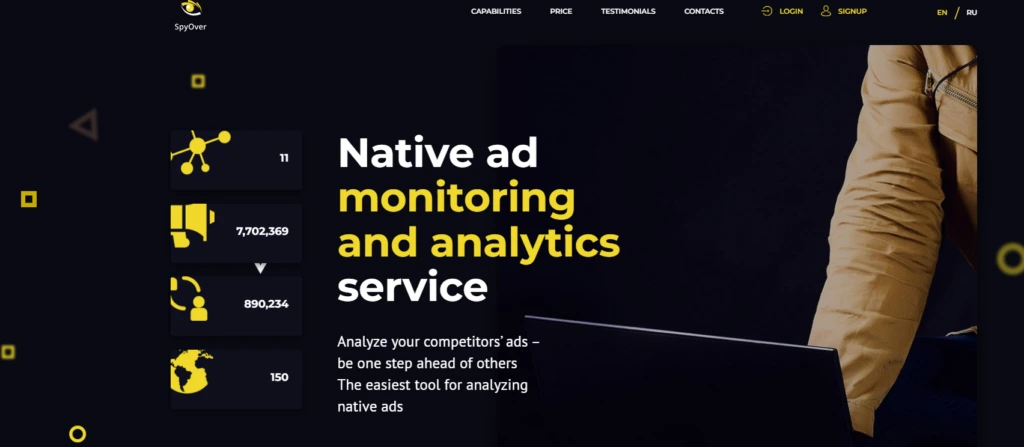
The platform collects data on advertisements and landing pages from various advertising networks and allows users to work with that information through search and filtering tools.
SpyOver provides access to a database of teaser ads and landing pages gathered from multiple advertising networks. Users can search materials by keywords and apply filters based on countries, languages, devices, browsers, advertising networks, and other parameters available within the platform.
The practical value of the service lies in its ability to analyze advertising campaigns from multiple angles at once.
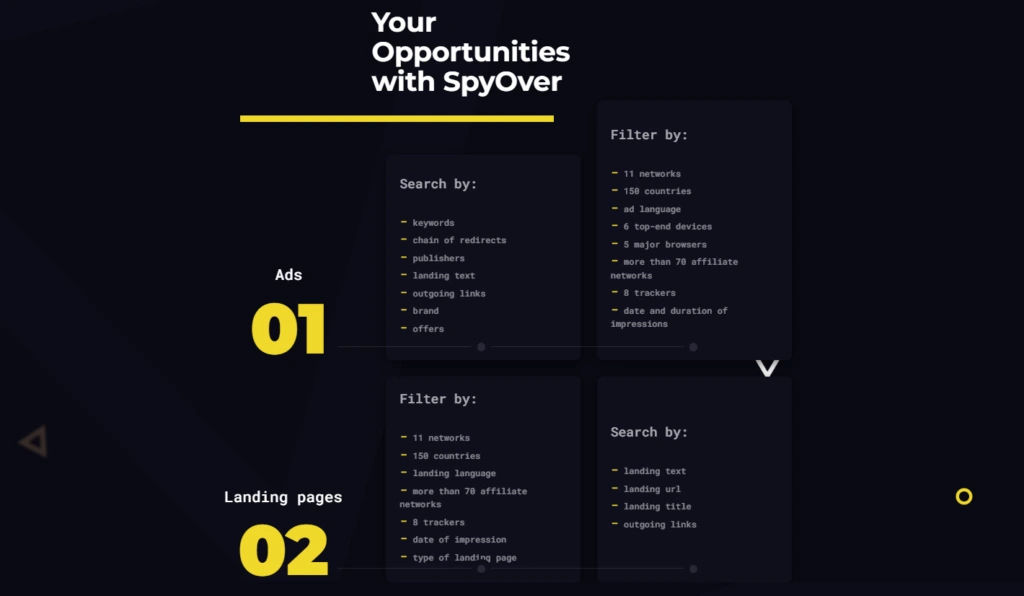
For example, users can search ads by keywords, branding text, offers, languages, devices, or traffic sources. The platform also includes landing page analysis, allowing marketers to study not only the advertisement itself but also the user journey after the click.
For teams working internationally, country and language segmentation can be particularly useful. It helps reveal local advertising approaches and identify differences between markets more efficiently.
Another notable feature is the ability to analyze campaign duration. If a creative remains active over an extended period, it may be worth investigating further as part of a broader market analysis process.
Practical Use Cases
Imagine a team preparing to launch campaigns in a new GEO.
One of the first steps is usually understanding which advertising approaches are already being used in that market. With SpyOver, users can find active ads in a specific country, review creatives, examine ad copy, and analyze the landing pages associated with them.
Another common use case involves researching a particular niche. Instead of randomly browsing ads, marketers can build targeted datasets around specific keywords or brands and gain a clearer understanding of advertising activity within that segment.
The platform can also support creative research. By observing which formats appear most frequently and which campaigns remain active for longer periods, teams gain additional inspiration for their own testing strategies.
Finally, SpyOver helps reduce the time spent on repetitive research tasks. Rather than manually monitoring dozens of websites, users can work with a structured database that can be explored through filters and search functionality.
Who Can Benefit from This Type of Tool
SpyOver can be useful for media buyers, marketers, CPA teams, and professionals who regularly work with teaser or native advertising.
The platform tends to provide the most value when there is an ongoing need to monitor market changes, discover new testing opportunities, or analyze advertising activity across multiple countries.
At the same time, it is important to remember that no intelligence platform can guarantee campaign success. The information it provides should be treated as a source of research and inspiration. Final decisions still require testing, audience analysis, and performance evaluation.
Conclusion
Teaser advertising remains one of the fastest-changing areas of digital marketing. New creatives appear every day, trends evolve quickly, and successful approaches rarely stay effective forever.
As a result, more professionals are shifting away from occasional observations and toward structured market analysis. This approach makes it easier to understand market dynamics, identify new testing opportunities, and make decisions based on data rather than assumptions.
SpyOver is one of the tools that can help organize this process more effectively. By bringing together ad creatives, landing pages, and advertising intelligence in a single environment, it helps marketers research markets more efficiently and uncover valuable insights for future campaigns.

Frequently asked questions
Here we answered the most frequently asked questions.
What is SpyOver?
SpyOver is a teaser advertising intelligence platform that allows users to analyze ads, landing pages, and advertising campaigns through various search and filtering options.
Can I search ads by country?
Does SpyOver help analyze landing pages?
Yes. In addition to ad creatives, the platform provides access to landing pages, allowing users to gain deeper insights into campaign structures and marketing strategies.
Can SpyOver be used for creative research?
Is SpyOver suitable for teams?
Yes. The platform can be used by multiple team members who need access to advertising research and market insights.
Teasers can be a total money pit if you don’t know what you’re doing, so having a systematic way to filter through the noise is a lifesaver.