
Why Accounts Work at First and Then Lose Stability: The Role of Proxies in Scaling
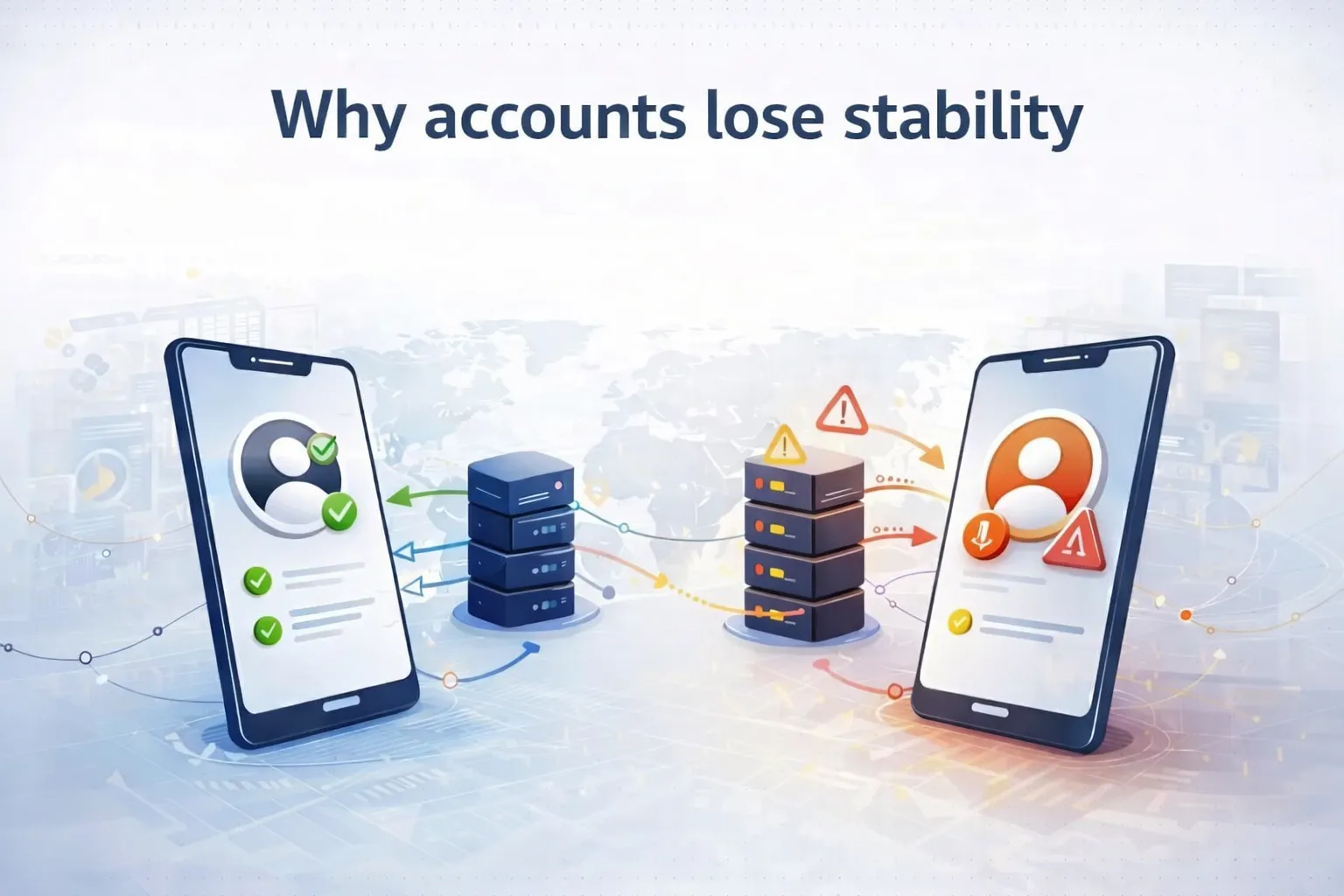
When working with accounts, the same situation often occurs: everything looks stable at the start. Sessions hold, actions go through, and there are no restrictions. But after a few days or weeks, the system begins to degrade. Restrictions appear, efficiency drops, and accounts lose trust.
This is often explained by proxy quality, but in practice the issue is usually deeper. It’s not just about the IPs themselves, but about how they are used over time.
Why Short Tests Are Misleading
Short tests do not allow you to evaluate system stability. At the beginning, there is no accumulated behavioral history, so activity appears natural. When using residential or ISP proxies, performance may remain stable at this stage.
However, as load increases, factors start to appear that cannot be seen in the first hours or days. The system begins analyzing the repeatability of actions and the overall behavioral pattern.
In these conditions, it’s important to understand that stability is tested over time, not at launch.
What Systems Actually Analyze
| Factor | What Is Evaluated | Why It Matters |
|---|---|---|
| Sessions | Duration and structure | Shows how natural activity is |
| Actions | Frequency and intervals | Reveals automation |
| Behavior | Repetition of scenarios | Builds an account profile |
| Synchrony | Simultaneous actions | Indicates centralized control |
| Geography | IP distribution | Checks activity consistency |
Modern anti-fraud systems evaluate not only IP addresses but also behavior.
They focus on several key factors:
- session duration and structure
- frequency and intervals of actions
- synchrony between accounts
- request distribution
Even when using datacenter proxies, issues may arise if the structure of activity remains uniform. For example, when one IP is used across different scenarios or multiple accounts perform identical actions in the same sequence.
As a result, the system begins to perceive such activity as artificial.
Behavioral Patterns as the Key Factor
When working with automation and APIs, there is often a tendency to simplify logic. This leads to identical actions and intervals.
In practice, this looks like:
- actions are triggered at the same timing
- scenarios repeat without variation
- request geography remains unchanged
Even when using dynamic proxies, the action structure stays the same. From the system’s perspective, this is a stronger signal than the IP itself.
That’s why simply rotating proxies does not always solve the problem.
It’s also important to consider account quality. Even with properly configured proxy usage, instability can be caused by the account itself: its age, activity history, and registration country.
In such cases, using reliable sources matters. For example, Akkaunti-Shop.ru offers Telegram and VK accounts from 150+ countries, including aged profiles and accounts with activity history. This helps reduce risks at the start and avoid situations where instability is caused not by infrastructure, but by the account itself.
However, even high-quality accounts require proper proxy usage and load distribution – without this, stability will not last in the long run.
Load and Traffic Distribution
Another issue is load distribution. When scaling, it’s important not only how many proxies you have, but how they are used.
In practice, most mistakes are related to:
- overloading individual IPs
- sudden spikes in activity
- lack of logical geographic distribution
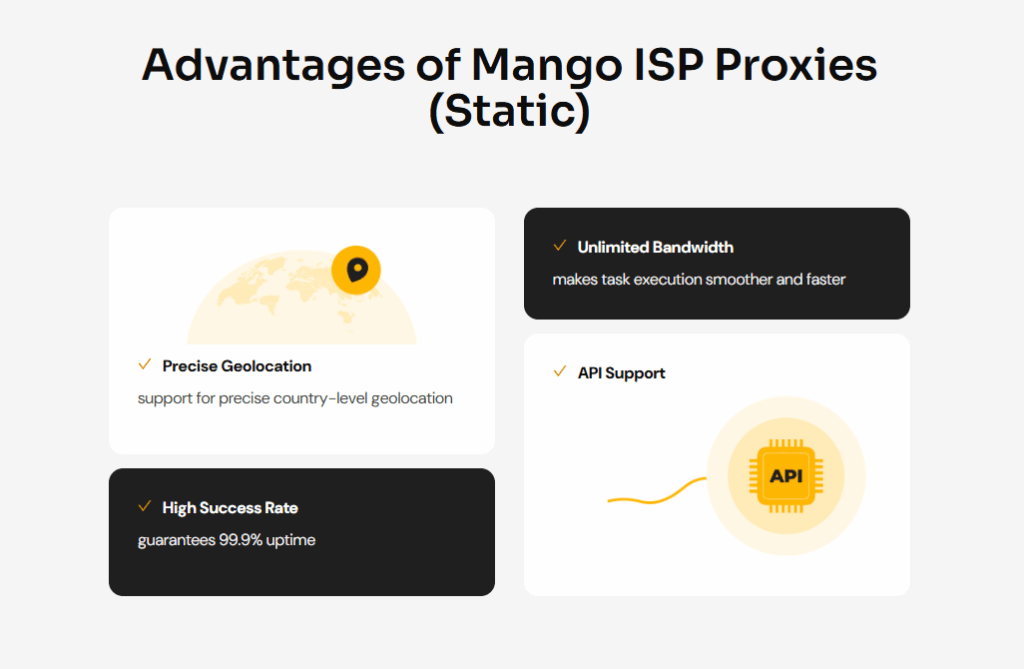
For example, when using static ISP proxies, a single IP may gradually become overloaded. This does not cause immediate restrictions but reduces trust over time. Such proxies are often used for long sessions, and they can be tested in MangoProxy – for example, by applying the promo code AKKAUNTI to get an 8% discount on static ISP proxies.
A more устойчивый approach is to combine different proxy types and distribute tasks between them. This allows for more even load distribution and reduces risks.
Proxies as Part of a System
It’s important to treat proxies not as a standalone tool, but as part of an infrastructure that works together with accounts, scenarios, and APIs.
In such a system, what matters most is how everything is organized:
- separating different types of activity
- avoiding overlap between scenarios
- controlling load
That’s why solutions like MangoProxy are used as part of an architecture where proxy types and task distribution can be managed flexibly.
This approach is especially important for long-term operations and scaling, where system behavior becomes more visible to anti-fraud mechanisms.
Practical Takeaways
Account stability is built over time, not instantly. That’s why short tests create a false sense of reliability.
It’s important to understand that identical behavioral patterns can break even high-quality IPs. Overloading and lack of distribution only amplify this effect.
More stable results are achieved when:
- different scenarios are separated
- proxy types are used deliberately, not randomly
Key takeaway: stability is the result of architecture, not just tool selection.
Conclusion
Stability issues are rarely caused solely by proxy quality. In most cases, they result from how the system is structured.
Proxies are part of the infrastructure, and how they are integrated into the overall logic determines the outcome. If behavior, load, and distribution are properly managed, the system remains stable for much longer.

Frequently asked questions
Here we answered the most frequently asked questions.
Why does everything work at first and then get worse?
Because the system gradually collects behavioral data and starts detecting repeating patterns.
Does changing IP help?
Partially. If the structure of actions doesn’t change, the problem remains.
What matters more — proxies or logic?
Logic. Behavior plays a bigger role than the IP itself.
Can one IP be used for multiple accounts?
Yes, but it increases the likelihood of signal overlap and reduces stability.