
How to Choose a Reliable Proxy Provider: 10 Criteria That Really Matter
Published: ≈ 6 min read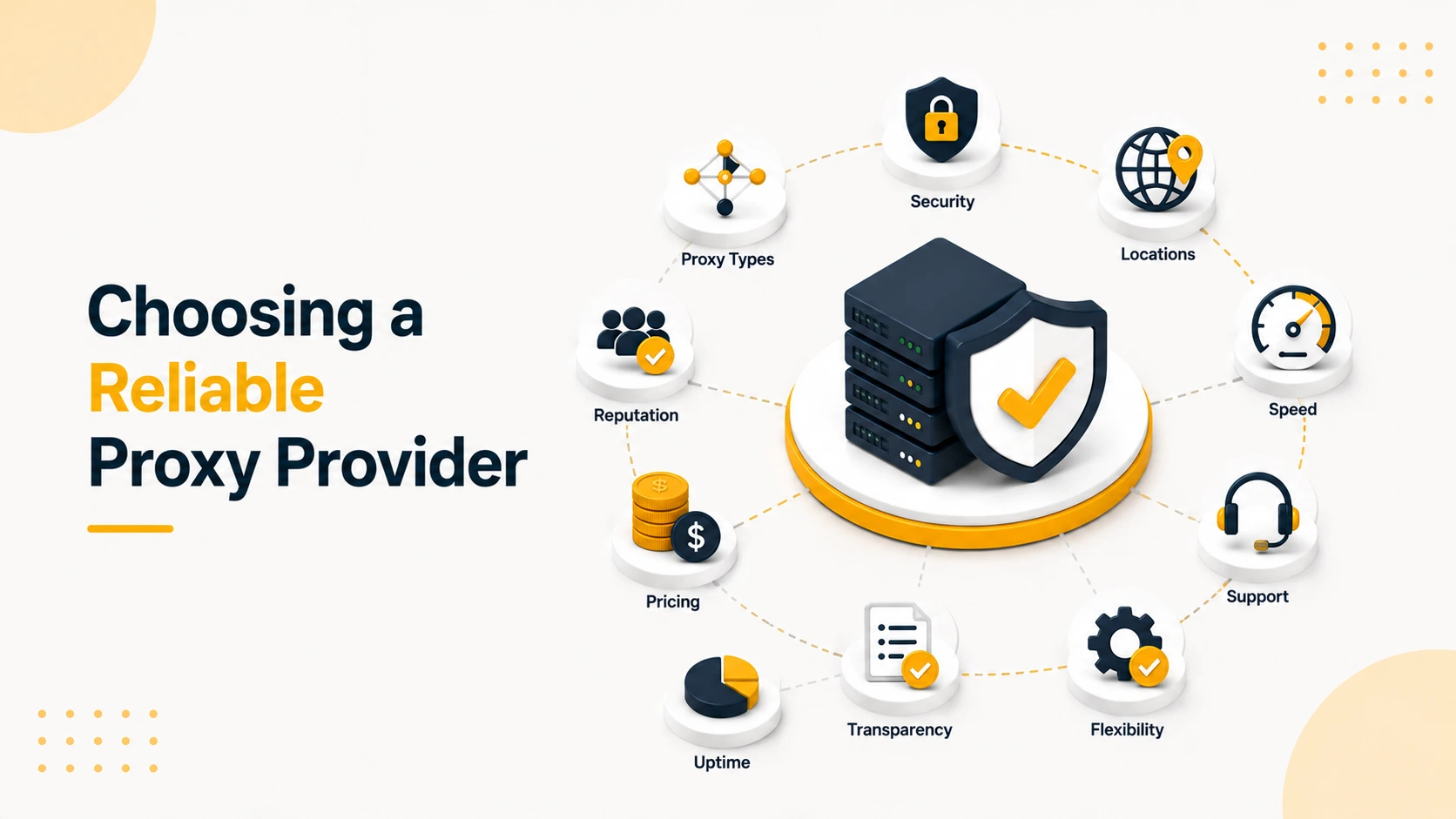
The proxy market continues to grow rapidly. Today, dozens of providers offer residential, ISP, datacenter, and mobile proxies, promising high speeds, millions of IP addresses, and near-perfect uptime.
However, impressive numbers on a website don’t always reflect real-world performance. To avoid overpaying and choose a service that truly fits your needs, it’s important to evaluate a provider based on several key criteria.
| Criterion | Why It Matters | What to Check |
| IP pool size | A larger pool provides greater flexibility | Number of IPs and available countries |
| Proxy types | Different tasks require different proxies | Residential, ISP, Mobile, Datacenter |
| Speed | Affects overall performance | Speed tests, latency |
| Uptime | Reduces downtime | SLA, uptime statistics |
| Location coverage | Access to target regions | List of available countries |
| Supported protocols | Ensures compatibility | HTTP(S), SOCKS5 |
| IP rotation | Important for bots and web scraping | Sticky / Rotating sessions |
| Pricing | It’s not just about the price, but also the billing model | Per GB or per IP |
| Support | Helps resolve issues quickly | 24/7 availability |
| Reputation | Reflects real user experience | Reviews and comparisons |
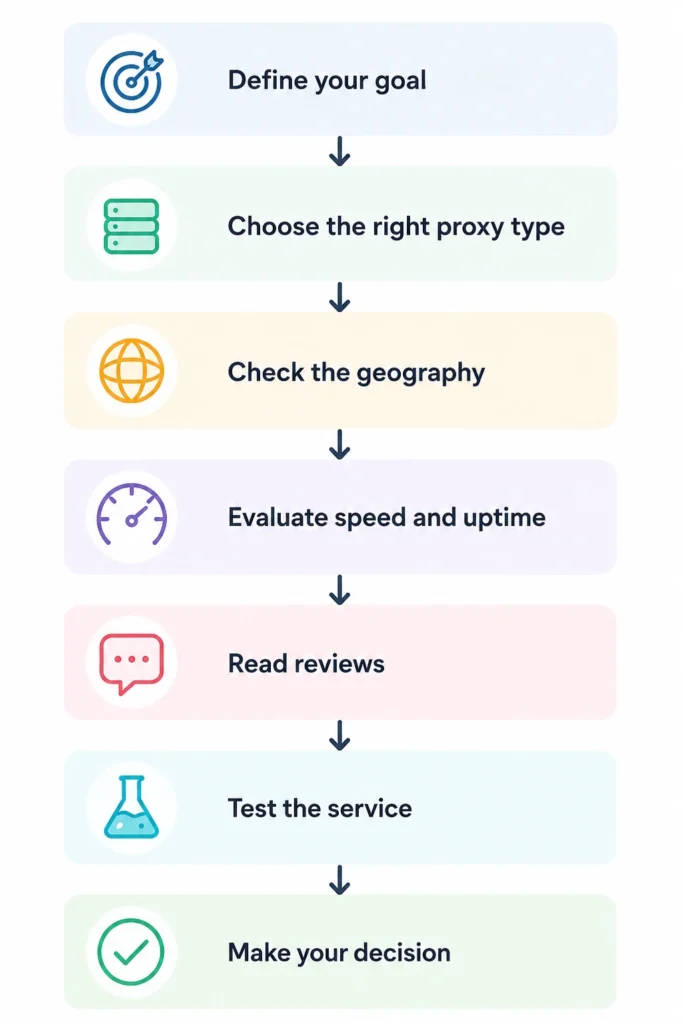
1. Define Your Use Case
Before choosing a provider, ask yourself one simple question: What do you need proxies for?
For example:
- managing multiple accounts;
- web scraping;
- SEO monitoring;
- ad verification;
- automation;
- marketplace management;
- application testing.
Different use cases require different types of proxies, so there is no one-size-fits-all solution.
2. Choose the Right Proxy Type
Each proxy type has its own strengths.
Residential proxies are suitable for most tasks where high anonymity and IP addresses from real users are important.
ISP proxies combine the stability of datacenter infrastructure with the trust level of IP addresses assigned by internet service providers.
Datacenter proxies offer high speed and cost efficiency.
Mobile proxies are ideal for tasks that require IP addresses from mobile carriers.
A reliable provider should offer multiple proxy types instead of limiting customers to just one option.
3. Evaluate Location Coverage and IP Pool Size
The number of available countries and IP addresses directly affects your flexibility.
If you work with local services, advertising platforms, or search engine results, make sure your target locations are actually available.
It’s also worth checking whether the provider allows you to select a specific city, ASN, or mobile carrier if your projects require it.
4. Evaluate Speed and Stability
High speed is important, but stable connections are even more critical.
If connections frequently drop or IP addresses become unavailable, even the largest IP pool won’t deliver reliable performance.
Whenever possible, test the service using a free trial or trial plan before making a purchase.
5. Review the Pricing Model
Different providers use different billing models:
- pay per traffic usage;
- pay per IP address;
- pay per port;
- subscription-based pricing.
Make sure you understand which pricing model is the most cost-effective for your specific use case.
6. Check Available Features
Modern proxy services offer much more than just IP addresses.
Useful features include:
- sticky sessions;
- automatic IP rotation;
- API access;
- support for HTTP, HTTPS, and SOCKS5;
- IP whitelisting;
- usage statistics.
The more functionality a provider offers, the easier it will be to scale your projects in the future.
7. Read Independent Reviews and Comparisons
Don’t rely solely on information published on a provider’s official website.
It’s useful to explore independent platforms that regularly publish reviews, comparisons, and testing results for proxy providers. These resources offer expert opinions and allow you to compare services using consistent evaluation criteria.
Some well-known resources include:
- TopProxyLab – an independent platform that publishes proxy provider rankings and reviews. It compares residential, mobile, and datacenter proxies based on speed, stability, pricing, and overall performance to help users find the best solution for different use cases.
- Proxyway – one of the best-known resources focused on proxies and online privacy tools. It offers in-depth provider reviews, comparison tests, research articles, and recommendations for various proxy-related tasks.
- ProxiesLab – a specialized platform for comparing proxy providers through service reviews, comparison tables, and practical guides. It also publishes educational content about proxy configuration and usage for web scraping, automation, SEO, and other applications.
- ProxyCorner – an informational resource that helps users compare proxy providers based on proxy types, geographic coverage, pricing, performance, and additional features. It also regularly publishes industry articles and practical recommendations.
- BestProxyCompare – a proxy comparison platform featuring reviews of popular providers, pricing information, supported proxy types, and feature comparisons, making it easier to evaluate services side by side.
It’s best to consult several sources, as each platform uses its own evaluation methodology.
8. Evaluate Customer Support
Even the most reliable proxy service may require assistance from time to time.
Before purchasing, pay attention to:
- response time;
- availability of live chat;
- quality of the documentation;
- availability of setup guides and a knowledge base.
Responsive support is especially important for large-scale or business-critical projects.
9. Research the Provider’s Reputation
Don’t rely solely on testimonials published on the provider’s website.
Look for discussions on industry forums, professional communities, Telegram channels, Reddit, and social media. This will help you understand how consistently the service performs and how the company handles customer issues.
At the same time, don’t base your opinion on a single review – it’s the overall reputation that matters.
10. Don’t Choose Based on Price Alone
The cheapest option is not always the best value.
If proxies are unstable, have a limited IP pool, or suffer from poor performance, the time and productivity lost may cost far more than the price difference.
When comparing providers, evaluate the overall package: network quality, available features, customer support, reputation, and how well the service matches your requirements.
Conclusion
Choosing a proxy provider is about much more than comparing prices. The most important factors include proxy types, infrastructure quality, network stability, available features, and the provider’s reputation.
Use multiple independent sources, read reviews and test results, compare technical specifications, and, whenever possible, try the service before purchasing. Taking a comprehensive approach will help you choose a proxy solution that delivers reliable performance both now and in the long term.
Frequently asked questions
Here we answered the most frequently asked questions.
How do I choose a reliable proxy provider?
First, determine what you need proxies for. Then compare providers based on IP pool size, geographic coverage, speed, stability, available features, pricing, customer support, and independent reviews. Whenever possible, test the service before making a purchase.
Why is the IP pool size important?
Should I choose a proxy provider based on price alone?
No. A lower price doesn’t always mean better value. A limited IP pool, unstable connections, or poor performance can lead to additional costs and reduced efficiency. It’s better to evaluate a provider based on the overall quality of its service.
Where can I find independent proxy provider reviews?
For an objective evaluation, it’s worth using independent platforms that publish proxy provider reviews and comparisons. Some of the best-known resources include TopProxyLab, Proxyway, ProxiesLab, ProxyCorner, and BestProxyCompare. Comparing information from several sources will give you a more complete picture of a provider’s reliability.