
What Is ASN and Why It Matters for Internet Routing
Quick Answer
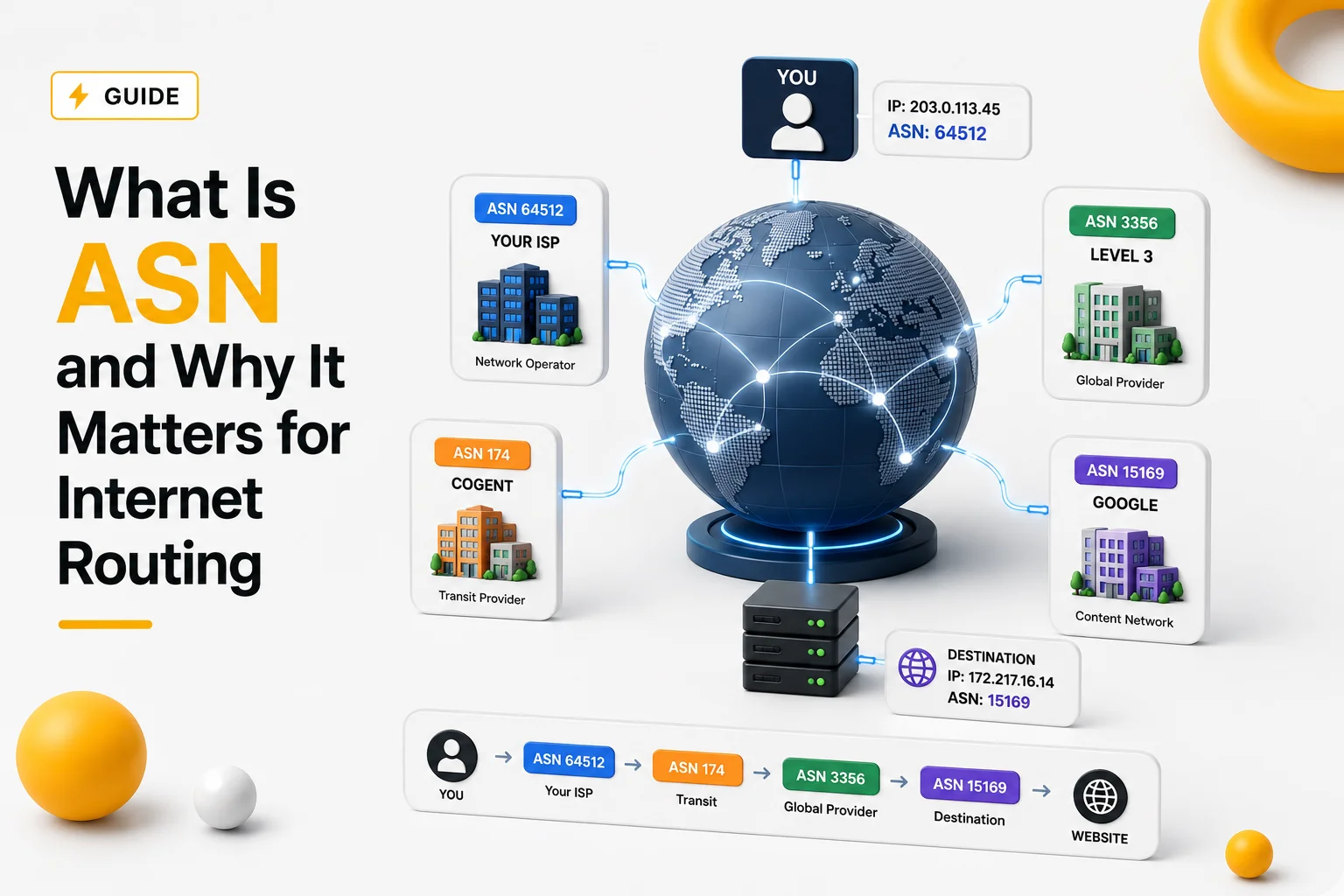
An ASN (Autonomous System Number) identifies a network or internet provider that controls routing policies and traffic infrastructure. ASNs affect internet routing, IP reputation, latency, CDN behavior and proxy detection.
Key Takeaways
- ASNs identify independent internet networks
- Internet traffic moves between ASNs constantly
- ASN reputation affects trust and detection systems
- Routing quality depends heavily on ASN infrastructure
- Proxy providers often operate through multiple ASNs
What an ASN Actually Is
The internet is not one single network.
Instead, it is a massive collection of interconnected networks communicating with each other globally.
Each major network is identified by an ASN:
👉 Autonomous System Number.
An ASN represents an organization or provider that controls its own routing infrastructure and internet traffic policies.
Examples include:
- cloud providers
- internet service providers
- hosting companies
- CDN platforms
- enterprise infrastructure networks
Why ASNs Exist
The internet requires a structured way to exchange traffic between independent networks.
ASNs allow networks to:
- announce IP ranges
- exchange routing information
- control traffic paths
- optimize connectivity
Without ASNs, large-scale internet routing would become impossible to coordinate efficiently.
How Internet Traffic Moves Between ASNs
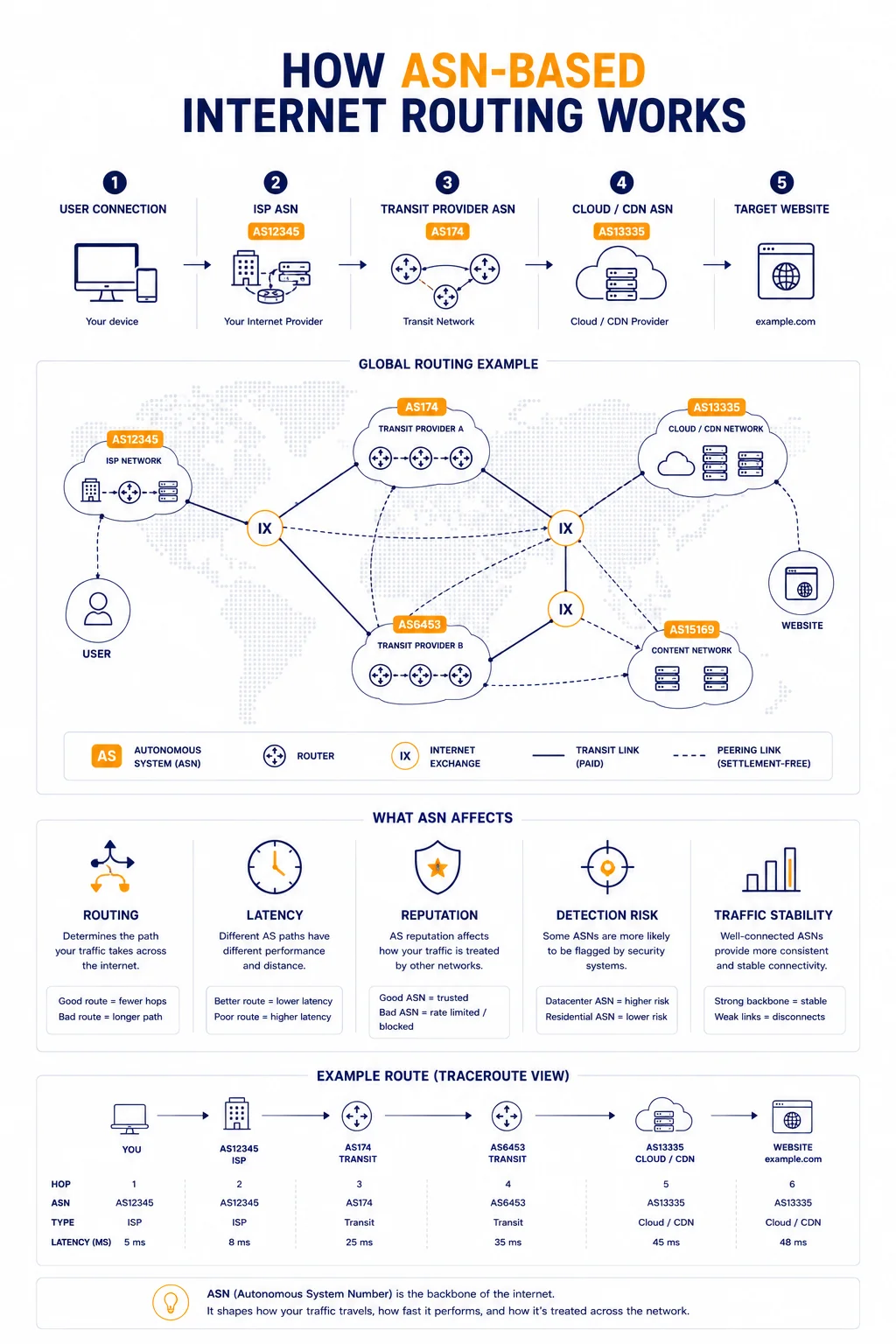
When you open a website, traffic often passes through multiple autonomous systems before reaching the destination.
Example flow:
User ISP ASN
↓
Transit Provider ASN
↓
Cloud Infrastructure ASN
↓
Target Website ASN
Every ASN along the route influences:
- latency
- routing stability
- congestion behavior
- packet delivery quality
Why ASN Reputation Matters
Not all ASNs are treated equally across the internet.
Some ASNs develop reputations for:
- spam traffic
- bot activity
- abuse
- malicious automation
Others are considered highly trusted infrastructure providers.
This reputation affects how websites and platforms treat incoming traffic.
Why Websites Analyze ASN Information
Modern anti-bot systems often inspect ASN data during request analysis.
For example:
- residential ISP ASNs may appear more natural
- cloud datacenter ASNs may trigger stricter filtering
- suspicious ASNs may receive additional verification challenges
This is one reason why infrastructure identity matters heavily for proxies and automation systems.
For related context, see How Websites Detect Proxy Traffic.
Residential vs Datacenter ASN Differences
One of the biggest distinctions in internet infrastructure is:
Residential ASN
Usually associated with:
- internet providers
- consumer broadband networks
- mobile carriers
Traffic often appears more “human” because it originates from normal ISP environments.
Datacenter ASN
Usually associated with:
- cloud providers
- hosting companies
- virtual servers
These ASNs often generate:
- automation traffic
- APIs
- scraping infrastructure
As a result, websites frequently monitor datacenter ASNs more aggressively.
Why ASNs Affect Routing Quality
Different ASNs operate different infrastructure quality levels.
Some networks have:
- excellent peering relationships
- optimized routing
- low congestion
- strong global coverage
Others may experience:
- unstable routes
- overloaded infrastructure
- latency spikes
- regional bottlenecks
This is why identical websites may perform differently depending on the ASN path.
Why ASN Selection Matters for Proxies
Proxy infrastructure heavily depends on ASN diversity and routing quality.
Using multiple ASNs helps:
- distribute traffic
- reduce detection concentration
- improve route diversity
- stabilize performance
This is especially important for:
- scraping systems
- automation platforms
- distributed infrastructure
Why Some ASNs Trigger More Captchas
Websites often assign risk scores to traffic sources.
Certain ASNs become strongly associated with:
- bots
- aggressive scraping
- automated traffic
This may increase:
- CAPTCHA frequency
- verification challenges
- rate limiting
- temporary blocks
For related context, see How Websites Detect Bots vs Real Users.
How ASN Information Helps Diagnose Network Problems
ASN analysis is extremely useful during troubleshooting.
Engineers often inspect:
- which ASN owns the route
- where latency increases
- where packet loss appears
- where congestion occurs
This helps identify infrastructure bottlenecks much faster.
Why CDNs and Cloud Platforms Depend on ASNs
Content delivery networks constantly optimize traffic between autonomous systems.
Good peering relationships allow:
- lower latency
- faster routing
- better regional performance
Poor ASN connectivity may create:
- unstable routes
- congestion
- inconsistent loading speeds
Real Infrastructure Example
Imagine two proxy IPs located in the same country.
IP A belongs to:
- a trusted residential ISP ASN
IP B belongs to:
- a heavily abused cloud datacenter ASN
Even with similar speed and latency:
- websites may trust IP A more
- IP B may trigger more detection systems
The difference comes largely from ASN reputation and traffic history.
How Engineers Check ASN Information
Infrastructure teams commonly inspect:
- ASN ownership
- peering relationships
- routing paths
- reputation history
- network region coverage
ASN analysis helps explain many routing and performance anomalies.
How to Check Which ASN Owns an IP
ASN ownership can be identified using IP intelligence tools.
Useful diagnostics include:
• IP Lookup – identifies ASN ownership and network details
• My IP – quickly checks your current public IP address
• IP Trace – analyzes routing paths and latency behavior
Combining these tools provides a clearer understanding of how traffic moves across the internet.
Why ASN Diversity Matters for Large Infrastructure
Large-scale systems often avoid depending on a single ASN.
Multiple ASNs help improve:
- redundancy
- route diversity
- failover stability
- geographic resilience
This is common in:
- CDN infrastructure
- enterprise networking
- proxy systems
- cloud routing environments
Glossary
- ASN
Autonomous System Number identifying an independent internet network. - Routing
The process of directing internet traffic across networks. - Peering
Direct traffic exchange relationships between networks. - Datacenter ASN
An ASN associated with cloud or hosting infrastructure.

Frequently asked questions
Here we answered the most frequently asked questions.
What does ASN mean?
ASN stands for Autonomous System Number.
Why do websites care about ASNs?
Because ASN reputation helps estimate traffic trustworthiness and infrastructure type.
Can ASN affect proxy detection?
Yes. Many anti-bot systems analyze ASN reputation and traffic behavior.
Why do residential ASNs appear more trusted?
Because they are usually associated with normal ISP consumer traffic instead of cloud automation infrastructure.