
IPv4 Exhaustion: Why IPv4 Addresses Became So Valuable

Quick Answer
IPv4 addresses became scarce because IPv4 uses a finite 32-bit address space, while demand for Internet connectivity continued to grow. The theoretical space contains 4,294,967,296 possible addresses, but not all of them can be assigned as ordinary public Internet addresses.
Over time, the large free pools managed by IANA and the Regional Internet Registries were depleted or placed under restrictive allocation policies. Existing IPv4 addresses did not disappear. They continue to work and can remain in use, be returned, recovered, transferred or provided through time-limited commercial arrangements.
IPv4 also remains necessary for reaching clients, services and infrastructure that do not support IPv6. This produces the combination behind its economic value:
Finite Supply + Restricted New Availability + Continued Operational Demand
IPv6 provides a much larger address space, but moving the entire Internet to a different protocol requires changes across networks, applications, devices and services. IPv4 and IPv6 therefore continue to operate alongside each other.
A simplified conceptual model is:
Finite IPv4 Address Space
↓
Allocation + Internet Growth
↓
Free-Pool Depletion
↓
Scarcity of Newly Available IPv4
↓
Conservation / Sharing / Redistribution / IPv6
This is a conceptual model, not a sequence that every network must follow.
Key Takeaways
- IPv4 uses 32-bit addresses, providing 2^32, or 4,294,967,296, theoretical address combinations.
- The theoretical total is not the same as the number of usable public IPv4 addresses.
- IPv4 exhaustion refers to the depletion or severe restriction of unallocated address pools.
- Exhaustion does not mean that existing IPv4 addresses disappeared or stopped working.
- IANA exhausted its normal central free pool in 2011, but Regional Internet Registries reached their own exhaustion or restricted-allocation milestones at different times.
- CIDR, private addressing, NAT and CGNAT helped networks use limited public IPv4 resources more efficiently.
- Transfers and leasing redistribute access to address space that was already allocated.
- IPv4 remains useful because much of the Internet still requires IPv4 compatibility.
- IPv6 is the long-term address-space response, but it does not communicate natively with IPv4-only systems.
- IPv4 is not economically valuable because it is technically superior to IPv6. Its value comes from scarcity combined with continuing operational demand.
- IPv4 scarcity can affect hosting, ISP, datacenter and proxy infrastructure, but it is not the only factor behind the availability or price of those services.
How Many IPv4 Addresses Exist?
IPv4 addresses are 32 bits long.
Each bit can have one of two values, producing:
2^32 = 4,294,967,296
This is the number of possible 32-bit combinations. It is often rounded to approximately 4.3 billion addresses.
However, it would be incorrect to describe all 4.3 billion as usable public IPv4 addresses.
Parts of the IPv4 address space have specific purposes or restrictions. Examples include:
- private addressing;
- loopback;
- link-local communication;
- multicast;
- documentation networks;
- Shared Address Space;
- protocol assignments;
- other special-purpose ranges.
The IANA IPv4 Special-Purpose Address Registry records many of these designated ranges.
For example, private IPv4 ranges can be reused independently inside different networks. A laptop in one home and a server inside a private business network can both use an address such as 192.168.1.10 without requiring two globally unique public addresses.
These internal addresses are valuable for local networking, but they are not ordinary globally routable public IPv4 addresses.
The safe conclusion is:
IPv4 provides 4,294,967,296 theoretical address values, but the pool available for normal public allocation is smaller.
A complete calculation of “usable public IPv4” is not straightforward because it depends on technical reservations, registry status, routing, policy and the intended meaning of usable.
What Is IPv4 Exhaustion?
IPv4 exhaustion is the depletion or severe restriction of unallocated IPv4 address pools available through IANA and the Regional Internet Registries.
It does not mean that IPv4 addresses stopped existing.
It also does not mean that networks can no longer send IPv4 traffic.
The distinction is:
IPv4 Exhaustion ≠ Disappearance of IPv4
Instead:
IPv4 Exhaustion = Scarcity of Readily Available Unallocated IPv4
Already allocated addresses can continue to:
- identify Internet-facing interfaces and services;
- carry traffic;
- remain registered to existing resource holders;
- be reassigned within authorized networks;
- be returned to a registry;
- enter a recovered-address pool;
- move through policy-compliant transfers;
- be provided under commercial usage arrangements;
- operate alongside IPv6.
IANA Free-Pool Exhaustion
IANA sits at the top of the global Internet number-resource distribution structure.
A simplified model is:
IANA → Regional Internet Registries → Networks and Organizations → Downstream Use
This is intentionally simplified. The exact meaning of allocation, assignment and reassignment depends on the applicable registry and policy.
On 3 February 2011, IANA allocated the last five /8 blocks from its normal unallocated IPv4 pool to the five Regional Internet Registries. The Number Resource Organization described this as depletion of the global free pool. NRO: Free Pool of IPv4 Address Space Depleted
This was a global allocation milestone. It did not mean that each RIR immediately ran out of its remaining regional inventory.
Regional RIR Exhaustion
After the IANA milestone, each RIR continued managing its own IPv4 resources under regional policies.
The regions did not reach the same stage on the same date:
- APNIC reached its final /8 on 15 April 2011 and activated its restrictive final-block policy. This was a restricted-allocation milestone, not the disappearance of all APNIC-managed IPv4. APNIC: IPv4 Address Pool Reaches Final /8
- ARIN announced depletion of its IPv4 free pool on 24 September 2015.
- RIPE NCC made its final allocation from the remaining available pool on 25 November 2019. It can still distribute addresses returned by organizations or recovered through other processes. RIPE NCC exhaustion announcement
- LACNIC assigned its last available IPv4 block in August 2020 and subsequently operated a waiting-list mechanism for recovered resources. LACNIC Annual Report 2020
- AFRINIC operates under its exhaustion-phase rules and continues to apply restricted allocation sizes. This is different from declaring that no IPv4 resources of any kind remain available. AFRINIC policy implementation report
These examples show why “the date IPv4 ran out” is an oversimplification.
There was a global IANA milestone, followed by different regional exhaustion, final-block and restricted-allocation stages.
Existing Allocated Space
Most working IPv4 addresses are not being requested as untouched numbers from a global free pool. They are already part of allocations, assignments and operational networks.
Exhaustion does not invalidate those relationships.
A company that received address space years ago may continue using it. An ISP can continue assigning or sharing addresses from its existing resources. Returned or recovered space may become available again according to registry policy.
Recovered Space
Address space can be returned, deregistered or recovered under applicable processes.
A registry may place such space into:
- a waiting list;
- a recovered-resource pool;
- a reserved pool;
- another restricted distribution process.
The availability and eligibility rules differ by region. Recovered space should not be described as a new unlimited free pool.
Transfers
An IPv4 transfer is an RIR-recognized change in a registration or resource-holder relationship under an applicable transfer policy.
A transfer can redistribute address space that has already been allocated. It does not expand the IPv4 protocol or create additional 32-bit combinations.
Transfer terminology should also not be reduced to the sale of physical property. Internet number resources involve registry, policy, contractual and operational relationships that can differ by region.
Commercial Leasing
Commercial IPv4 leasing is a time-limited usage relationship.
A lease can allow another organization to use address space without necessarily changing the organization recognized by the relevant registry as the resource holder.
The important distinction is:
Transfer:
RIR-Recognized Change in Registration / Holder Relationship
Lease:
Time-Limited Usage Relationship; Registered Holder May Remain Unchanged
A lease does not create new IPv4 addresses either. It changes who can use already allocated capacity under a particular arrangement.
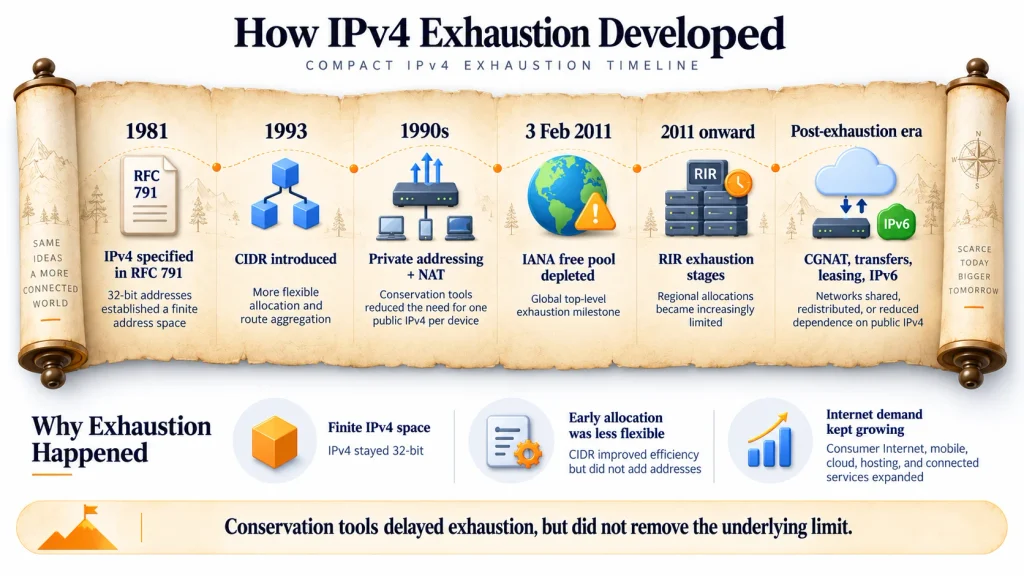
How IPv4 Exhaustion Developed
IPv4 exhaustion was not one sudden technical failure. It developed as Internet demand grew within a fixed address space.
Compact IPv4 Exhaustion Timeline
| Period | Milestone | Why It Matters |
| 1981 | IPv4 was specified with 32-bit source and destination addresses in RFC 791 | Established the finite address space |
| 1993 | Classless Inter-Domain Routing was introduced | Enabled more flexible allocation and route aggregation |
| 1990s | Private addressing and NAT became important conservation tools | Reduced the need for one public IPv4 per local device |
| 3 February 2011 | IANA’s normal central free pool was depleted | Marked the global top-level exhaustion milestone |
| 2011 onward | RIRs entered final-block, restricted-allocation or exhaustion stages at different times | Made new regional allocations increasingly limited |
| Post-exhaustion era | CGNAT, transfers, leasing and IPv6 deployment continued to expand | Allowed networks to share, redistribute or reduce dependence on public IPv4 |
Early Allocation Was Less Flexible
Early Internet address distribution used classful network boundaries.
Organizations could receive address blocks in fixed sizes that did not always closely match their actual needs. A block might be much larger than required, while the next smaller class might be insufficient.
CIDR replaced this rigid model with variable-length prefixes.
Instead of relying only on a few fixed address classes, networks could receive and announce prefixes that more closely matched operational requirements. RFC 4632 documents the CIDR architecture and its role in addressing allocation and routing scalability.
CIDR made allocation more efficient and helped slow exhaustion.
It did not increase the number of bits in an IPv4 address.
Internet Demand Continued to Grow
The address space was designed before the modern scale of:
- consumer Internet access;
- mobile connectivity;
- cloud infrastructure;
- large hosting platforms;
- always-connected devices;
- global business networks;
- Internet-connected services and equipment.
Not every device requires its own permanent public IPv4. Private addressing and translation reduced that requirement substantially.
Nevertheless, networks still need public IPv4 capacity for Internet access, public services, translation gateways and compatibility with the existing IPv4 Internet.
Conservation delayed the practical effects of exhaustion, but it did not remove the underlying limit.
Why Did IPv4 Addresses Become Valuable?
IPv4 addresses acquired economic value because a finite and increasingly restricted resource remained operationally useful.
The core relationship is:
Finite Supply + Restricted New Availability + Continued Operational Demand
None of these factors explains the market alone.
A finite resource has little economic value if nobody needs it. Strong demand does not create scarcity if supply can expand freely. IPv4 combines a hard technical limit with continued real-world demand.
1. The Address Space Cannot Expand
IPv4 has a fixed 32-bit address field.
Organizations can divide, share, transfer and reuse parts of the address space, but they cannot expand IPv4 beyond its mathematical limit while still using the same protocol.
NAT does not add new public addresses.
A transfer does not add new public addresses.
Leasing does not add new public addresses.
These mechanisms change how the existing space is used or who can use it.
2. New Allocations Are Restricted
Before exhaustion, eligible networks could request address resources from the appropriate registry under the policies in effect at that time.
Today, ordinary new IPv4 capacity is limited by:
- exhausted free pools;
- final-block policies;
- maximum allocation sizes;
- waiting lists;
- recovered-resource availability;
- transfer eligibility;
- regional policy differences.
This means a growing organization cannot assume that a sufficiently large new IPv4 block will be available directly from its RIR when needed.
3. Existing Infrastructure Still Uses IPv4
IPv4 remains embedded in:
- access networks;
- hosting environments;
- cloud services;
- business systems;
- customer devices;
- network equipment;
- security policies;
- allowlists;
- monitoring systems;
- third-party integrations.
An organization may support IPv6 and still need IPv4 to communicate with IPv4-only systems.
That compatibility requirement preserves demand for public IPv4 capacity.
4. Public Reachability Still Matters
Some services must accept traffic from the public Internet.
Examples can include:
- web infrastructure;
- mail systems;
- authoritative DNS;
- APIs;
- remote-access endpoints;
- hosting platforms;
- customer servers;
- translation services;
- network gateways.
Not every service requires a unique public IPv4. Name-based hosting, load balancers, reverse proxies, NAT and other architectures can reduce address consumption.
However, many infrastructure designs still require some amount of public IPv4 capacity.
5. Renumbering and Migration Have Operational Costs
Changing an address is not always as simple as editing one field.
An IPv4 address may appear in:
- DNS records;
- access-control lists;
- third-party allowlists;
- monitoring platforms;
- customer integrations;
- certificates or application configurations;
- security policies;
- network documentation;
- incident-response systems;
- partner environments.
Moving a service to another prefix can require coordination across several organizations.
Similarly, deploying IPv6 can require:
- network planning;
- equipment and software validation;
- security-policy updates;
- staff training;
- monitoring changes;
- application testing;
- coordination with customers and providers.
These operational costs help preserve demand for working IPv4 resources even where IPv6 is available.
6. Existing Space Can Be Redistributed
Once new free-pool allocations became scarce, already allocated IPv4 space became more important.
Transfers can move registry-recognized resource relationships under applicable policy. Leasing and other usage arrangements can provide temporary access without necessarily changing the registered holder.
This creates commercial activity around existing capacity.
The activity does not mean every IPv4 address has one universal price. Economic terms can vary based on the prefix, region, resource status, block size, operational history, contract and intended use.
This article therefore does not present current prices or market forecasts.
Technical Utility vs Economic Scarcity
IPv4’s technical usefulness and its economic scarcity are related, but they are not the same thing.
Technical Utility
IPv4 can provide:
- compatibility with IPv4-only clients and services;
- public reachability;
- integration with existing applications;
- operation within established network environments;
- access to infrastructure that has not fully adopted IPv6.
These benefits explain why networks still need IPv4.
Economic Scarcity
Economic scarcity comes from:
- the fixed 32-bit supply;
- depletion or restriction of free pools;
- continued demand;
- limited availability through RIR processes;
- redistribution through transfers;
- commercial usage arrangements;
- the cost of replacing or renumbering existing infrastructure.
The distinction matters because scarcity does not make IPv4 technically superior.
IPv6 provides a much larger address space and was designed as the successor to IPv4. IPv4 remains economically valuable because it is limited and still widely needed, not because scarcity makes it a better protocol.
How Networks Responded to IPv4 Scarcity
No single mechanism solved IPv4 exhaustion.
Different technical and operational responses address different parts of the problem.
CIDR Made Allocation More Efficient
Classless Inter-Domain Routing allows address space to be divided into variable-length prefixes.
This helped reduce the waste created by rigid classful allocation boundaries. It also supported route aggregation, which addressed a related Internet routing scalability problem.
CIDR changed how efficiently IPv4 space could be allocated and routed.
It did not change:
IPv4 = 32 Bits
Therefore, CIDR delayed exhaustion but could not eliminate the finite-space constraint.
Private Addressing and NAT Reduced Public Address Demand
RFC 1918 reserves three address blocks for private networks:
- 10.0.0.0/8;
- 172.16.0.0/12;
- 192.168.0.0/16.
These addresses can be reused inside unrelated networks because they do not have globally unique public meaning.
A home, office and datacenter can each use the same private range internally.
Network Address Translation can then map traffic between private and public address contexts. Network Address and Port Translation can allow several internal connections to share a smaller number of public IPv4 addresses.
A simplified model is:
Multiple Private Devices → NAT → One or More Public IPv4 Addresses
This dramatically reduces the requirement for every local device to have its own public IPv4.
But NAT does not create new public address space. The network still needs a public IPv4 resource on the Internet-facing side of the translation.
CGNAT Shares IPv4 Across Subscriber Connections
Carrier-Grade NAT moves public IPv4 sharing into a service-provider network.
The high-level model is:
Multiple Subscriber Connections → Shared Public IPv4 Resources
CGNAT allows providers to support more subscriber connections with a limited public IPv4 pool.
Its relevance to exhaustion is simple: scarcity created pressure to share public address resources more widely.
The detailed mechanism – including translation state, source ports, inbound connectivity and subscriber-level attribution – belongs to Carrier-Grade NAT Explained.
CGNAT is one operational response to scarcity. It does not create new IPv4 addresses and is not used by every network.
Transfers Redistribute Existing Address Space
An IPv4 transfer can change the RIR-recognized registration or holder relationship under an applicable policy.
Conceptually:
Existing Registered IPv4 Resource
↓
Policy-Compliant Transfer
↓
New Recognized Resource Relationship
Transfers can move already allocated resources toward organizations that currently need them.
They do not increase the global number of IPv4 addresses.
Exact eligibility, documentation and terminology differ between RIRs. Those details are outside this article’s scope.
Leasing Provides Time-Limited Usage
Commercial leasing can provide temporary rights to use IPv4 address space.
Conceptually:
Existing IPv4 Resource
↓
Time-Limited Commercial Usage Relationship
↓
Operational Use by Another Party
The RIR-recognized holder may remain unchanged.
Leasing should not be confused with a registry-recognized transfer. It also should not be confused with a DHCP lease, which is a protocol mechanism for temporarily assigning network configuration to a device or interface.
Registry records, commercial usage rights, routing authorization and network operation can involve different organizations.
The full lease lifecycle, LOA, ROA and BGP relationships are outside the scope of this article.
IPv6 Provides a Larger Address Space
IPv6 uses 128-bit addresses and provides a vastly larger address space than IPv4. RFC 8200 defines the current IPv6 specification.
IPv6 addresses the underlying mathematical limitation instead of only conserving or redistributing the IPv4 supply.
That makes broader IPv6 deployment the long-term architectural response to IPv4 exhaustion.
However, IPv6 does not make existing IPv4-only infrastructure disappear. Networks still need ways to serve users and systems operating on either protocol.
Why Has IPv6 Not Instantly Replaced IPv4?
IPv6 exists, works and continues to be deployed.
The reason it has not instantly displaced IPv4 is not that IPv6 failed. The transition requires independent organizations across the Internet to update interconnected systems.
IPv4 and IPv6 Are Different Protocols
An IPv6-only host cannot assume that it can communicate directly with an IPv4-only host.
Connectivity between the two may require:
- dual-stack operation;
- protocol translation;
- proxies or gateways;
- tunneling;
- other transition mechanisms.
The correct architecture depends on the network.
The Existing IPv4 Base Is Large
Many networks contain systems built around IPv4 assumptions.
These may include:
- older applications;
- embedded devices;
- customer equipment;
- third-party integrations;
- access-control policies;
- monitoring tools;
- operational processes;
- external services that remain IPv4-only.
Replacing or upgrading one part of the path does not guarantee that every other part supports IPv6.
Dual Stack Requires Operating Both Protocols
A dual-stack network supports IPv4 and IPv6 simultaneously.
This can improve compatibility during the transition, but it also means operating two protocol environments.
Teams may need to manage:
- addressing plans;
- routing;
- DNS;
- access controls;
- monitoring;
- troubleshooting;
- application testing;
- security policies
for both IPv4 and IPv6.
Dual stack is an important transition model, but it is not a universal requirement for every network.
Migration Has Costs and Dependencies
IPv6 deployment can require technical work across infrastructure, applications and organizational boundaries.
A network may be ready for IPv6 while:
- an upstream provider is not;
- a customer system is IPv4-only;
- an application dependency lacks IPv6 support;
- a security appliance has not been validated;
- a business partner uses IPv4 allowlists;
- an external service is reachable only over IPv4.
These dependencies encourage coexistence rather than a single global cutover.
Transition Mechanisms Preserve IPv4 Access
Networks can deploy IPv6 while still providing access to IPv4 destinations through translation or other transition systems.
This reduces the need to assign a unique public IPv4 to every client, but the transition infrastructure may still require some public IPv4 capacity.
IPv6 deployment can therefore reduce dependence on IPv4 without eliminating every IPv4 requirement immediately.
No technical basis supports the claim that IPv4 must remain necessary forever. The safe conclusion is that the transition is incremental and uneven.
For a focused comparison of the two protocols in proxy environments, see IPv4 vs IPv6 Proxies.
Does IPv4 Scarcity Determine IP Reputation?
No.
IPv4 scarcity describes availability. IP reputation concerns historical behavior, network context and the way a particular destination evaluates traffic.
Scarce address space may be:
- reused;
- reassigned;
- transferred;
- leased;
- routed by another network;
- used for a different service over time.
An address can therefore have operational history that predates its current use.
However:
Scarcity itself does not create good or bad IP reputation.
An older IPv4 address is not automatically more trustworthy. A transferred or leased address is not automatically suspicious. Different websites can also treat the same address differently.
The broader reputation model belongs to How IP Reputation Works.
Why IPv4 Scarcity Matters for Hosting and Proxy Infrastructure
Public IPv4 scarcity can affect services that depend on public address capacity, including:
- hosting platforms;
- ISP infrastructure;
- datacenter networks;
- cloud environments;
- static Internet endpoints;
- translation gateways;
- proxy services.
The effect depends on the architecture.
A shared service may support many customers through a limited number of public addresses. Another service may require dedicated addresses for operational isolation, allowlisting or direct reachability.
For proxy infrastructure, available address capacity can influence how static endpoints and network resources are provisioned. But scarcity alone does not determine:
- proxy type;
- connection quality;
- reputation;
- geographic accuracy;
- availability;
- provider pricing;
- suitability for a specific target.
Different providers can also have different sourcing, hosting and network relationships.
This is a general infrastructure explanation. It does not describe Mango Proxy’s suppliers, resource registrations, leasing arrangements, routing or internal architecture.
Practical Examples
Example 1: A Home Network Uses One Public IPv4
A household contains laptops, phones, televisions and other devices.
The devices use private IPv4 addresses behind a router. NAT allows their outbound connections to share one public IPv4.
Private Devices → Home Router NAT → Public IPv4 → Internet
This reduces demand for public address space.
It does not add another address to the global public IPv4 supply.
Example 2: An ISP Shares Public IPv4 Resources
An ISP does not have enough public IPv4 addresses to assign one exclusively to every subscriber connection.
It deploys provider-scale address sharing:
Multiple Subscriber Connections → CGNAT → Shared Public IPv4 Resources
This extends the usefulness of the ISP’s available pool.
It can also change inbound connectivity and the meaning of an externally observed IP, but those mechanisms are separate from the exhaustion question.
Example 3: A Hosting Company Needs Additional Capacity
A hosting company wants to add more Internet-facing endpoints.
Its relevant RIR cannot simply provide a large unrestricted block from a normal free pool. The company may need to consider:
- more efficient use of its existing space;
- shared frontend infrastructure;
- returned or waiting-list resources;
- a policy-compliant transfer;
- a commercial usage arrangement;
- expanded IPv6 deployment;
- a combination of these approaches.
None of these options creates new IPv4 numbers. They conserve, redistribute or reduce dependence on the existing space.
Example 4: A Service Deploys IPv6 but Keeps IPv4
A service makes its website reachable over IPv6.
Some customers, integrations or monitoring systems remain IPv4-only. The service therefore continues offering IPv4 connectivity while also supporting IPv6.
This is not evidence that IPv6 deployment failed.
It shows why protocol coexistence preserves demand for IPv4 during an incomplete transition.
Understand the Layer Before Evaluating the Resource
When evaluating IPv4 availability, avoid treating several different questions as one.
Ask:
- Is the address space unallocated, recovered or already registered?
- Is access being provided through assignment, transfer, hosting or a commercial usage arrangement?
- Which organization controls registration?
- Which network operates the resource?
- Does the service require public IPv4, or can it use IPv6 or shared infrastructure?
- Is the concern availability, technical compatibility, operational control or reputation?
Separating these layers produces a clearer analysis than saying that an address is simply “owned,” “new,” “scarce” or “expensive.”
Recommended future visual placement: after this section.
Finite IPv4 Space
↓
Internet Growth
↓
Free Pools Shrink
↓
branches:
- CIDR
- NAT / CGNAT
- Transfers / Leasing
- IPv6
Label: Conceptual model; these are different responses, not one mandatory sequence.
Final Thoughts
IPv4 exhaustion is not the end of IPv4.
It is the transition from broadly available unallocated resources to a world where most useful IPv4 space is already registered, assigned or operating inside existing networks.
The underlying limit is mathematical:
IPv4 = 32 Bits
2^32 = 4,294,967,296 Possible Values
The practical shortage is more complicated because not every value is an ordinary public address and because availability depends on registry status, policy and existing use.
CIDR helped allocate the space more efficiently. Private addressing, NAT and CGNAT allowed public addresses to be shared. Transfers and leasing redistributed access to existing resources. IPv6 created a much larger address space for long-term growth.
Each response addresses a different part of the problem.
IPv4 became economically valuable because limited new availability collided with continuing operational demand. Networks still need compatibility with IPv4-only clients, services and infrastructure, while migration and renumbering require coordination and cost.
That does not make IPv4 technically better than IPv6.
It makes existing public IPv4 capacity a finite resource that remains useful during a long, uneven protocol transition.
Glossary
IPv4
Internet Protocol version 4. It uses 32-bit addresses.
IPv4 Address Space
The set of possible 32-bit IPv4 address values.
IPv4 Exhaustion
The depletion or severe restriction of unallocated IPv4 pools. It does not mean that existing IPv4 addresses stopped working.
IANA
The Internet Assigned Numbers Authority. At a high level, it manages global Internet number-resource registries and distributes resources to Regional Internet Registries under applicable policies.
Regional Internet Registry / RIR
An organization that manages Internet number resources for a geographic service region. The five RIRs are AFRINIC, APNIC, ARIN, LACNIC and RIPE NCC.
Free Pool
Address space available for allocation under the relevant registry’s policies. The exact composition and rules depend on the registry and period.
Allocation
A registry or provider-level distribution of address space for further network use. Exact terminology differs by policy.
Assignment
Address space provided for use by a network, organization, service or end site. The exact definition depends on the applicable registry and policy.
Private IPv4 Address
An address from an RFC 1918 range intended for private-network use rather than ordinary global Internet routing.
Public IPv4 Address
An IPv4 address that can participate in public Internet routing when properly registered, announced and operationally reachable.
CIDR
Classless Inter-Domain Routing. It allows variable-length IP prefixes and route aggregation.
NAT
Network Address Translation. A function that translates between address contexts.
CGNAT
Carrier-Grade NAT. A provider-operated NAT function that can share public IPv4 resources across multiple subscriber connections.
Recovered Space
Previously allocated or assigned space that becomes available to a registry again under its recovery and distribution processes.
IPv4 Transfer
An RIR-recognized change in a registration or resource-holder relationship under an applicable transfer policy.
Commercial IPv4 Leasing
A time-limited commercial relationship allowing address-space use without necessarily changing the RIR-recognized resource holder.
Dual Stack
An environment that supports both IPv4 and IPv6.
IPv6
The successor Internet Protocol with 128-bit addresses and a much larger address space.
Renumbering
Changing the IP addresses used by a network, service or set of systems.

Frequently asked questions
Here we answered the most frequently asked questions.
What is IPv4 exhaustion?
IPv4 exhaustion is the depletion or severe restriction of unallocated IPv4 address pools. It affects the availability of new allocations but does not cause existing IPv4 addresses to disappear or stop working.
How many IPv4 addresses exist?
IPv4 uses 32-bit addresses, producing 2^32, or 4,294,967,296, possible values. Not all of them are usable as ordinary public addresses because parts of the space are private, reserved or designated for special purposes.
Did the Internet completely run out of IPv4 addresses in 2011?
No. IANA depleted its normal global free pool in 2011 by distributing its final /8 blocks to the Regional Internet Registries. The RIRs then continued managing their regional inventories and reached their own restricted-allocation or exhaustion stages at different times.
Why do existing IPv4 addresses still work?
Exhaustion concerns availability from free pools, not the validity of already allocated space. Existing addresses can remain registered, routed and used by networks and services.
Why are IPv4 addresses valuable?
They combine limited supply and restricted new availability with continued demand from IPv4-compatible infrastructure, clients and services. Their value comes from scarcity plus operational utility, not from being technically superior to IPv6.
Are all 4.3 billion IPv4 addresses publicly usable?
No. The figure represents all theoretical 32-bit combinations. Private, loopback, multicast, link-local, documentation, Shared Address Space and other special-purpose ranges are not ordinary publicly assignable IPv4 capacity.
Did CIDR solve IPv4 exhaustion?
No. CIDR made allocation and routing more efficient, helping delay exhaustion. It did not increase the 32-bit IPv4 address space.
Does NAT create more IPv4 addresses?
No. NAT allows multiple internal devices or connections to share a smaller number of public IPv4 addresses. It conserves public resources without creating additional public addresses.
How does CGNAT help with IPv4 exhaustion?
CGNAT allows a service provider to share public IPv4 resources across multiple subscriber connections. This extends the usefulness of a limited public pool but does not increase the number of IPv4 addresses.
What is the difference between an IPv4 transfer and leasing?
A transfer is an RIR-recognized change in a registration or holder relationship under an applicable policy. Commercial leasing is a time-limited usage relationship that may leave the registered holder unchanged.
Why can’t everyone simply switch to IPv6?
IPv4 and IPv6 are different protocols. Networks must still reach clients and services that support only IPv4, while migration can require updates to applications, devices, security rules, monitoring and third-party integrations. Transition mechanisms and dual-stack operation allow gradual coexistence.
Is IPv6 unused?
No. IPv6 is actively deployed and provides the long-term architectural response to IPv4’s limited address space. Deployment is uneven, so IPv4 and IPv6 continue to operate together.
Will IPv4 always remain valuable?
That cannot be guaranteed. Demand can change as IPv6 adoption, network architectures and compatibility requirements evolve. IPv4 should not be presented as an investment with guaranteed appreciation.
Does a scarce IPv4 address have better reputation?
No. Scarcity does not create reputation. An address’s treatment can depend on previous activity, current traffic, network context and the policies of individual destinations.
Does IPv4 scarcity directly determine proxy prices?
No. Public IPv4 availability can be one infrastructure consideration, but proxy pricing can also depend on network type, location, sourcing, bandwidth, traffic limits, hosting, operations and service design.