
How IP Reputation Works and Why It Affects Website Access
Published: ≈ 6 min read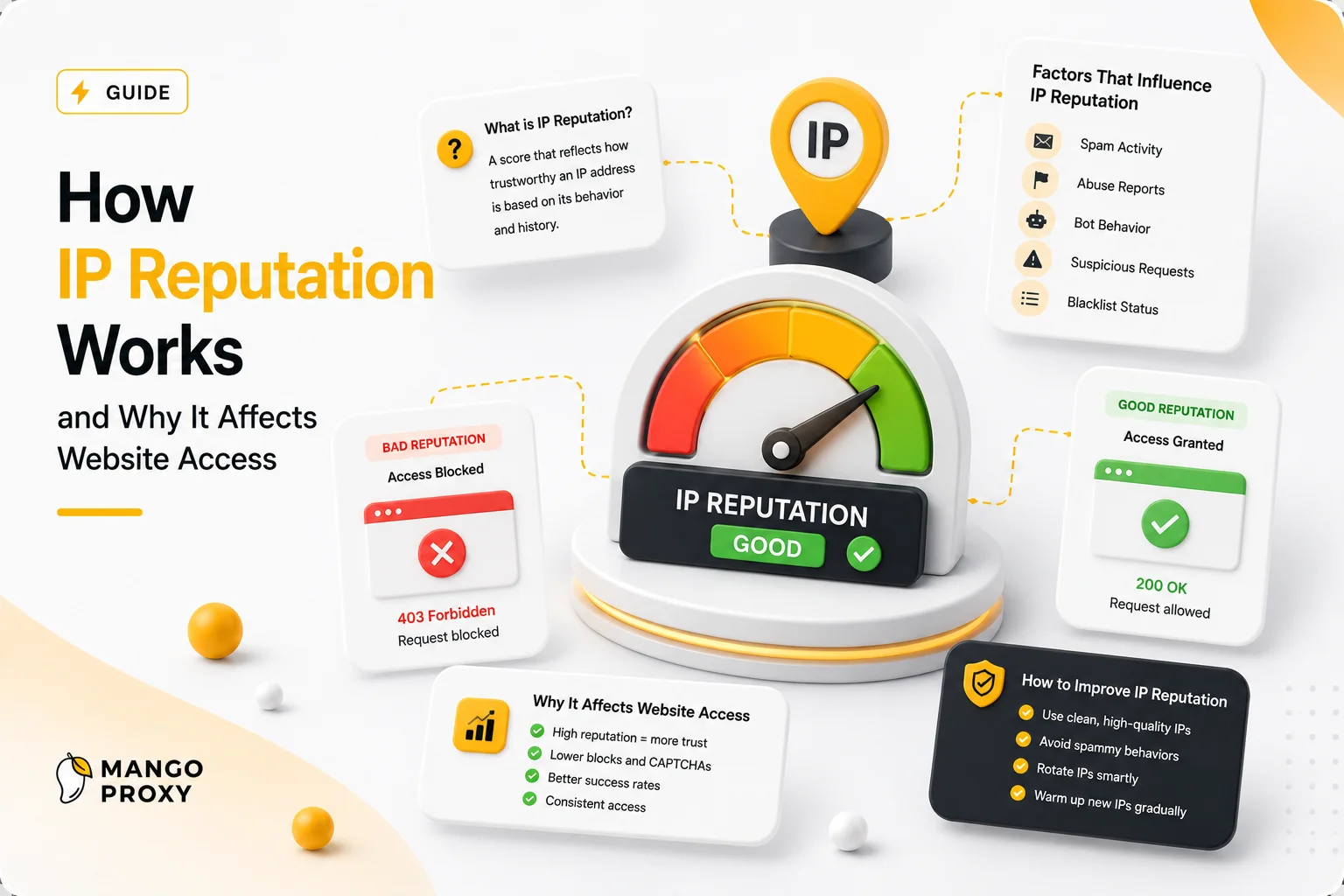
Quick Answer
IP reputation is a trust score assigned to an IP address or network based on its historical behavior. Websites use reputation systems to determine whether traffic appears trustworthy, suspicious or potentially abusive before granting access.
Key Takeaways
- IP reputation helps websites evaluate incoming traffic
- Poor reputation may trigger CAPTCHAs, blocks and restrictions
- Reputation is influenced by previous activity, ASN and network quality
- Residential, mobile and datacenter IPs often have different trust levels
- Modern detection systems analyze much more than just reputation alone
Why Websites Need IP Reputation Systems
Every large website receives traffic from millions of IP addresses daily.
Some visitors are normal users.
Others may be:
- bots
- scrapers
- spammers
- attackers
- automated systems
Analyzing every request individually would be expensive and inefficient.
Instead, websites often use reputation systems to quickly estimate how trustworthy incoming traffic appears before deeper inspection begins.
What Is IP Reputation
IP reputation is a score or risk assessment assigned to an IP address.
Think of it as a digital history record.
An IP that consistently generates normal browsing activity may develop a positive reputation.
An IP associated with spam, abuse or suspicious automation may receive a lower trust score.
Many security systems use reputation as one of the first signals during traffic evaluation.
How Reputation Scores Are Created
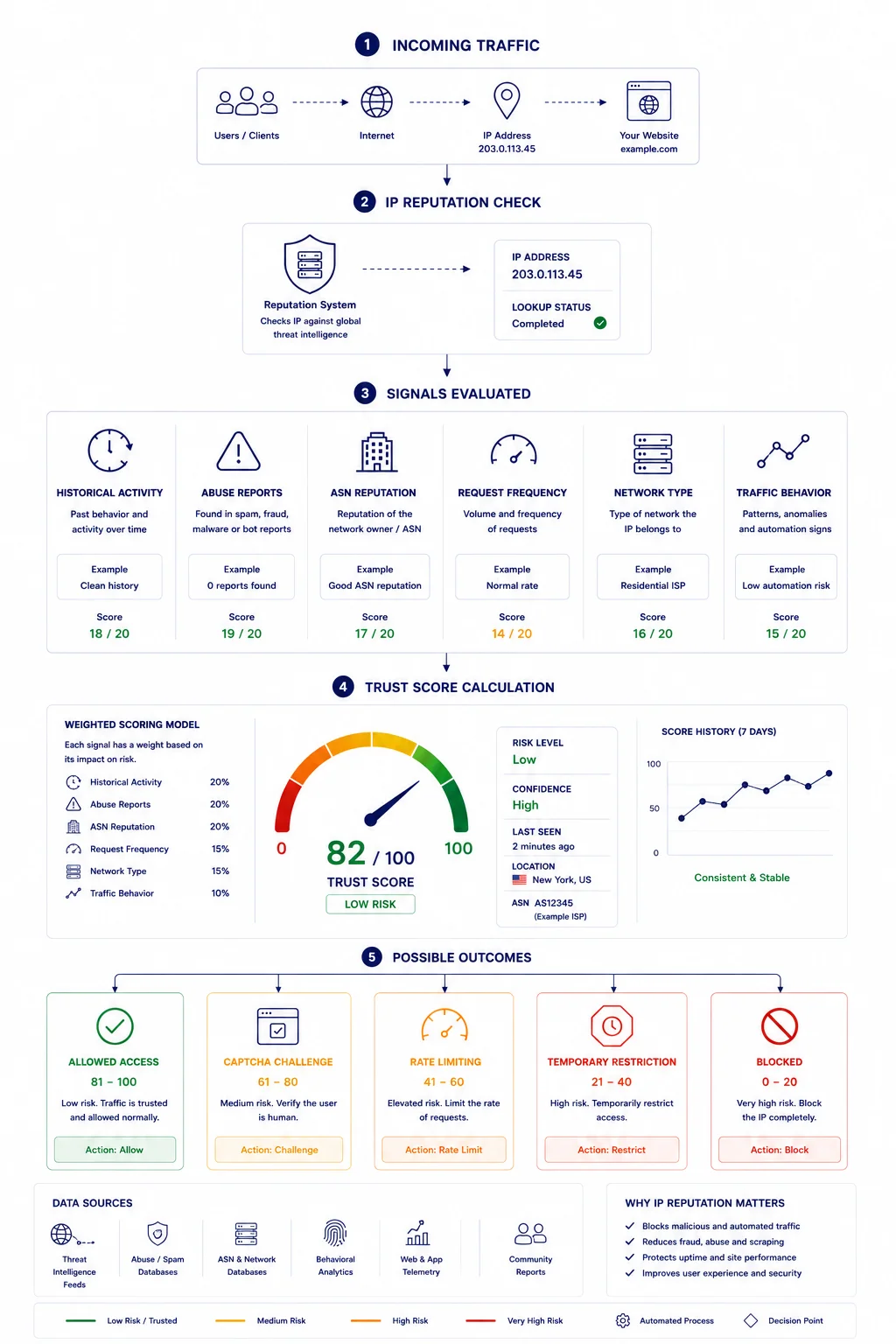
Most reputation systems combine multiple signals.
Typical inputs include:
- historical activity
- abuse reports
- spam complaints
- request frequency
- ASN reputation
- network type
- behavioral patterns
Rather than relying on a single event, reputation usually develops over time.
Why Websites Care About Reputation
Reputation helps websites make faster security decisions.
For example:
Incoming Request
↓
Reputation Check
↓
Trust Score
↓
Allow / Challenge / Block
A trusted IP may receive normal access.
A low-reputation IP may receive:
- CAPTCHAs
- rate limits
- verification challenges
- temporary restrictions
Why Two IPs Can Be Treated Differently
Imagine two visitors accessing the same website.
User A:
- residential ISP connection
- clean browsing history
- stable traffic patterns
User B:
- heavily abused cloud infrastructure
- suspicious request history
- known automation environment
Even if both users perform identical actions, the website may evaluate them very differently.
Why Datacenter IPs Often Have Lower Trust
Datacenter networks host:
- cloud servers
- virtual machines
- automation tools
- scraping infrastructure
Because these environments generate large amounts of automated traffic, some websites apply additional scrutiny automatically.
This does not mean datacenter IPs are bad.
It simply means they appear more frequently in automated workflows.
Why Residential IPs Usually Have Stronger Reputation
Residential IP addresses originate from consumer internet providers.
These networks typically contain:
- home users
- mobile subscribers
- everyday browsing traffic
As a result, many websites initially associate residential infrastructure with lower risk.
For related context, see What Is a Residential IP and Why Websites Trust It More.
Why ASN Reputation Matters
Modern reputation systems often evaluate entire networks rather than individual IPs.
If a large percentage of traffic from a specific ASN generates abuse, websites may reduce trust for that network.
This means reputation often exists on multiple levels:
- IP reputation
- subnet reputation
- ASN reputation
For related context, see What Is ASN and Why It Matters.
Why Reputation Is Not Permanent
One of the biggest misconceptions is that reputation never changes.
In reality:
- reputation improves
- reputation declines
- reputation evolves continuously
A clean IP may eventually become problematic.
A previously abused IP may recover over time.
Most modern systems constantly update trust assessments based on new observations.
Why IP Rotation Can Affect Reputation
Many automation systems rotate IP addresses regularly.
This can be beneficial when used carefully.
However, aggressive rotation may create unusual patterns.
For example:
Session Start
↓
Germany
↓
Japan
↓
Brazil
↓
United States
Rapid geographic jumps rarely resemble human behavior.
Detection systems may view such activity as suspicious regardless of IP quality.
Why Reputation Alone Does Not Determine Access
Years ago, reputation carried enormous weight.
Today, websites use additional signals.
Common examples include:
- browser fingerprints
- DNS consistency
- session behavior
- request timing
- device characteristics
An IP with a strong reputation can still trigger challenges if other signals appear abnormal.
For related context, see How Websites Detect Bots vs Real Users.
DNS Consistency and Reputation
DNS infrastructure plays a growing role in traffic evaluation.
Consider this example:
Visible IP:
United States
DNS Resolver:
Different Country
This mismatch creates inconsistency.
Even if the IP itself has a good reputation, conflicting DNS signals may reduce trust.
For related context, see What Is a DNS Leak and Why It Matters for Privacy and Proxies.
Why Websites Sometimes Show CAPTCHAs
Many CAPTCHAs are reputation-driven.
When systems detect elevated risk, they may require additional verification before granting access.
Common triggers include:
- low-trust IP ranges
- suspicious traffic patterns
- fingerprint mismatches
- unusual behavior
CAPTCHAs often act as a middle step before a complete block.
How Reputation Affects Web Scraping
Web scraping environments frequently encounter reputation-related challenges.
A poor reputation may lead to:
- more CAPTCHAs
- faster rate limits
- blocked requests
- incomplete data collection
This is one reason infrastructure quality matters significantly for large-scale scraping operations.
Why Reputation Influences Proxy Performance
Proxy performance is not determined solely by speed.
A fast IP with poor reputation may perform worse than a slower IP with stronger trust.
Factors that influence effective performance include:
- access success rate
- CAPTCHA frequency
- block rate
- trust score
- routing stability
For related context, see Proxy Success Rate Explained: Why Requests Fail and How to Fix It.
Real Infrastructure Example
Imagine an e-commerce platform receiving two requests.
Request A:
- residential ISP
- consistent DNS
- stable browser behavior
- normal session timing
Request B:
- abused datacenter range
- fingerprint inconsistencies
- unusual traffic frequency
Even before the website evaluates page activity, Request A may already receive a significantly higher trust score.
Why Reputation Systems Keep Evolving
Attackers continuously adapt.
As a result, reputation systems also evolve.
Modern platforms increasingly combine:
- IP intelligence
- behavioral analysis
- machine learning
- network reputation
- fingerprint evaluation
This creates a more accurate assessment of incoming traffic than IP analysis alone.
Additional Tools for Network Diagnostics
Understanding reputation often requires visibility into your network infrastructure.
Useful tools include:
• My IP – view your current public IP address and location
• IP Lookup – identify ASN ownership and network information
• DNS Leak Test – verify DNS consistency and resolver visibility
• IP Trace – analyze routing paths and network behavior
• Proxy Checker – test proxy connectivity and accessibility
Using these tools together provides a clearer picture of how websites may evaluate your traffic.
Glossary
- IP Reputation
A trust score associated with an IP address based on historical activity and observed behavior.
- ASN
An Autonomous System Number representing a network that controls routing infrastructure.
- CAPTCHA
A challenge system used to distinguish legitimate users from suspicious traffic.
- Residential IP
An IP address assigned by a consumer internet provider.
Frequently asked questions
Here we answered the most frequently asked questions.
What is IP reputation?
IP reputation is a trust score used by websites and security systems to evaluate incoming traffic.
Why does reputation matter?
A poor reputation may increase CAPTCHAs, restrictions and access challenges.
Can IP reputation change?
Yes. Reputation constantly evolves based on new traffic behavior and observations.
Do residential IPs have better reputation?
In many cases, residential infrastructure receives higher initial trust than heavily used datacenter networks.