
Why Websites Block IP Addresses and How Detection Systems Work

Quick Answer
Websites block IP addresses to protect infrastructure from abuse, bots, spam, scraping and suspicious traffic patterns. Modern detection systems analyze IP reputation, ASN, DNS behavior, browser fingerprints and traffic consistency before deciding whether to allow access.
Key Takeaways
- Websites block IPs to reduce abuse and automated attacks
- IP reputation strongly affects trust scores
- Detection systems analyze much more than just the IP address
- ASN, DNS and browser fingerprints all influence detection
- Residential and datacenter traffic are often treated differently
Why Websites Block IP Addresses
Modern websites constantly receive enormous amounts of automated traffic.
Some traffic is legitimate.
Some traffic includes:
- scraping
- spam
- credential stuffing
- fake registrations
- abuse automation
- bot attacks
Blocking suspicious IPs helps websites:
- reduce infrastructure load
- protect user accounts
- defend APIs
- prevent fraud
- slow down attackers
This is why nearly every large platform operates some form of anti-abuse system.
Why IP Addresses Matter to Detection Systems
An IP address acts as a visible identity layer for internet traffic.
Websites analyze IPs to estimate:
- location
- provider type
- traffic reputation
- infrastructure behavior
- previous abuse history
An IP address alone does not identify a person directly, but it provides important infrastructure context.
You can inspect your visible public IP using My IP.
What Is IP Reputation
Websites often maintain internal trust scores for IP ranges.
Some IPs become associated with:
- spam traffic
- aggressive scraping
- automated abuse
- suspicious behavior
Other IP ranges develop strong reputations for:
- stable browsing behavior
- consumer ISP traffic
- trusted infrastructure
This is called IP reputation.
Why Datacenter IPs Get Blocked More Often
Datacenter infrastructure is heavily used for:
- automation
- bots
- scraping
- cloud workloads
As a result, many anti-bot systems apply stricter filtering to datacenter IP ranges automatically.
This does not mean datacenter IPs are bad.
It simply means they statistically generate more automated traffic.
Why Residential IPs Often Appear More Trusted
Residential IPs originate from consumer ISP infrastructure.
These networks usually represent:
- home internet users
- mobile subscribers
- normal browsing activity
As a result:
- websites often assign lower initial suspicion
- traffic appears more organic
- routing behavior looks more natural
For related context, see What Is a Residential IP.
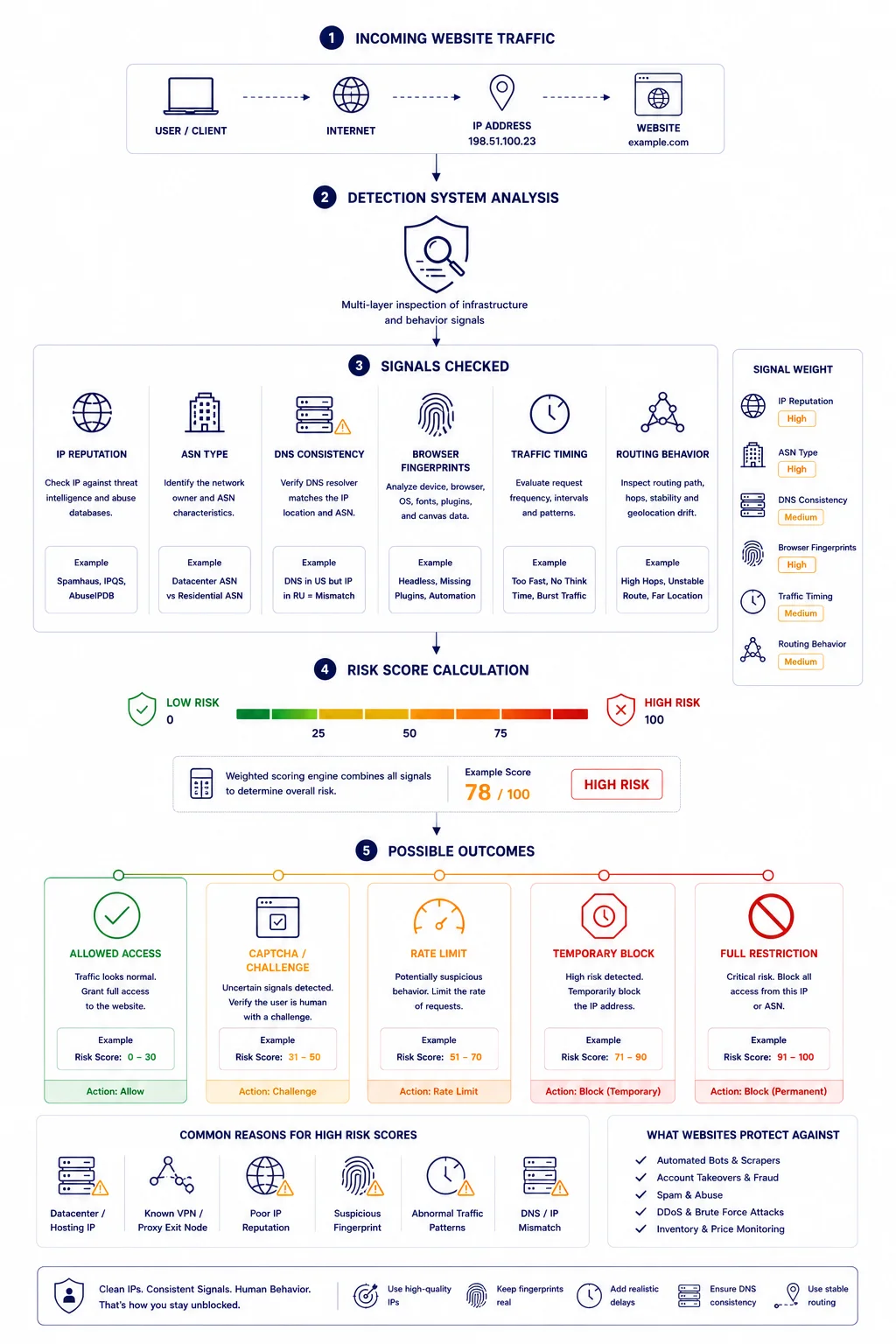
Why Websites Analyze ASN Information
Modern anti-bot systems rarely inspect IPs alone.
They also analyze:
- ASN ownership
- provider category
- routing consistency
- historical abuse patterns
For example:
Residential ISP ASN → lower suspicion
Cloud Datacenter ASN → higher scrutiny
This is why ASN reputation matters heavily for proxies and automation.
For related context, see What Is ASN and Why It Matters.
Why DNS Leaks Increase Detection Risk
Even when an IP address changes successfully, DNS requests may still expose the original network infrastructure.
Example:
Visible IP:
US proxy
DNS requests:
Local ISP elsewhere
This inconsistency may trigger suspicion immediately.
For related context, see What Is a DNS Leak.
Why Browser Fingerprints Matter
Websites also analyze browser-level signals.
Common fingerprinting signals include:
- screen resolution
- timezone
- fonts
- WebGL behavior
- browser plugins
- TLS characteristics
This allows websites to recognize repeated environments even when IP addresses change.
For related context, see Proxy Fingerprinting Explained.
Why CAPTCHA Systems Appear
CAPTCHAs are usually triggered when detection systems observe:
- unusual traffic volume
- automation-like behavior
- unstable sessions
- suspicious fingerprints
- low-trust IP ranges
CAPTCHAs are often designed to slow automation rather than block traffic completely.
Why Websites Block Aggressive Request Patterns
Traffic timing matters heavily.
Detection systems frequently monitor:
- request frequency
- repeated actions
- navigation patterns
- session timing
- concurrency behavior
Even high-quality IPs may trigger restrictions under unrealistic traffic patterns.
Why Rotating IPs Too Aggressively Can Look Suspicious
Many users assume rotating IPs constantly improves stealth.
In reality, unrealistic rotation behavior may increase detection risk.
Example:
Session starts:
Germany
5 seconds later:
Japan
10 seconds later:
Brazil
This rarely resembles normal human browsing behavior.
Stable infrastructure often performs better than excessive rotation.
Why Websites Block Entire ASN Ranges Sometimes
Large attacks often originate from concentrated infrastructure providers.
As a result, websites occasionally block:
- entire cloud providers
- hosting ranges
- abusive ASNs
This may affect legitimate users sharing the same infrastructure.
Why API Systems Often Apply Stricter Filtering
APIs are common abuse targets.
Platforms frequently protect APIs using:
- rate limits
- behavioral analysis
- IP reputation scoring
- ASN filtering
- token validation
API protection is usually stricter than standard website browsing protection.
Why Geography and Routing Consistency Matter
Detection systems increasingly analyze whether infrastructure signals align logically.
They compare:
- IP geolocation
- DNS location
- ASN region
- routing behavior
- browser timezone
Large inconsistencies may increase suspicion.
You can analyze routing paths using IP Trace.
Why Websites Sometimes Block Users Incorrectly
Detection systems are imperfect.
Legitimate users may still trigger restrictions because of:
- shared infrastructure
- overloaded IP ranges
- VPN usage
- carrier NAT systems
- temporary reputation problems
This is why false positives occasionally happen.
Real Infrastructure Example
Imagine two users visiting the same platform.
User A:
- residential ISP connection
- stable DNS behavior
- normal browsing timing
User B:
- heavily abused datacenter ASN
- DNS mismatch
- automation-like request intervals
Even if both users behave similarly, the platform may trust User A much more.
Why Detection Systems Keep Evolving
Modern anti-bot systems continuously adapt because automation techniques evolve constantly.
Detection now combines:
- network analysis
- infrastructure intelligence
- browser behavior
- machine learning models
- traffic reputation systems
This is why simple IP changes alone rarely bypass sophisticated detection consistently.
Additional Tools for Network Diagnostics
Understanding why websites block traffic often requires infrastructure diagnostics.
Useful tools include:
• My IP – checks your visible public IP address
• IP Lookup – identifies ASN ownership and provider information
• DNS Leak Test – checks DNS, WebRTC and IPv6 consistency
• Proxy Checker – verifies proxy connectivity and responsiveness
Combining these diagnostics helps identify infrastructure inconsistencies that may increase detection risk.
Glossary
- IP Reputation
A trust score associated with an IP address or network range. - ASN
An autonomous system controlling internet routing infrastructure. - Fingerprinting
The process of identifying environments using browser and network characteristics. - CAPTCHA
A challenge-response system designed to slow automated traffic.

Frequently asked questions
Here we answered the most frequently asked questions.
Why do websites block IP addresses?
Usually to reduce abuse, bots, spam, scraping or suspicious automation behavior.
Why are datacenter IPs blocked more often?
Because they statistically generate more automated traffic than residential ISP infrastructure.
Can changing an IP bypass detection?
Sometimes, but modern systems also analyze fingerprints, DNS behavior and traffic patterns.
Why do CAPTCHAs appear more frequently on some networks?
Because detection systems may assign lower trust scores to certain IP ranges or traffic behaviors.v6 exposure.