
Proxy Success Rate Explained: Why Requests Fail and How to Fix It
Published: ≈ 5 min read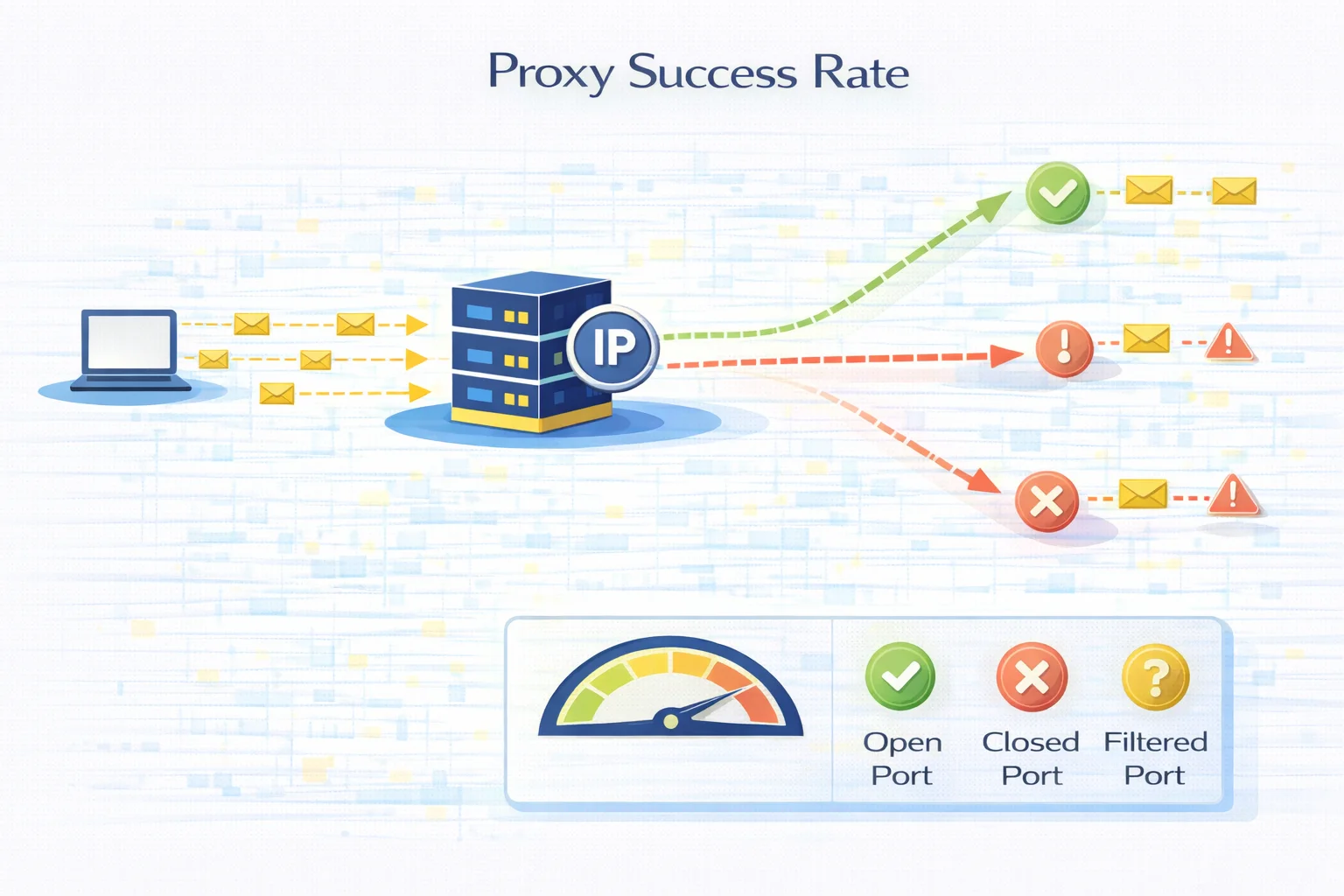
What Is Proxy Success Rate
Proxy success rate measures how many requests successfully reach the target website and return a valid response.
It is usually expressed as a percentage.
For example:
| Requests Sent | Successful Requests | Success Rate |
| 1000 | 980 | 98% |
| 1000 | 930 | 93% |
| 1000 | 870 | 87% |
In large automation systems this metric is one of the most important indicators of proxy quality.
Even a small drop in success rate can significantly reduce scraping performance or automation throughput.
If your infrastructure processes thousands of requests per minute, a drop from 98% to 90% success rate can mean hundreds of failed requests every minute.
Why Proxy Requests Fail
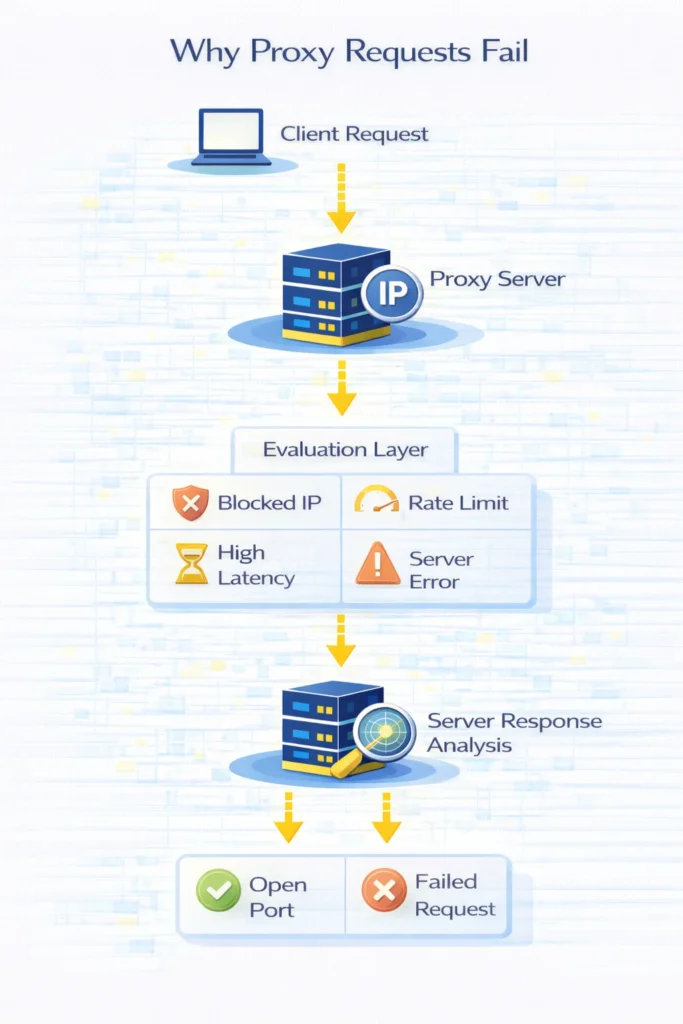
Proxy requests can fail for many reasons. In most cases the problem is not a single issue but a combination of factors affecting the network.
The most common causes include:
- overloaded proxy infrastructure
- blocked or flagged IP addresses
- rate limiting from target websites
- slow proxy response times
- unstable routing between servers
Understanding these causes helps developers diagnose failures faster and optimize proxy usage.
The Most Common Reasons for Low Proxy Success Rate
Blocked or Flagged IP Addresses
Websites monitor incoming traffic and often maintain databases of suspicious IP addresses.
If a proxy IP has been used for aggressive scraping or automated activity in the past, the server may reject requests from that address.
Typical symptoms include:
- 403 Forbidden
- CAPTCHA challenges
- connection resets
IP reputation plays a major role in long-term request success.
Rate Limiting
Many platforms restrict the number of requests a client can send within a certain period.
If too many requests are sent from the same IP address, the website may temporarily block or slow down incoming traffic.
This usually appears as:
- 429 Too Many Requests
- temporary throttling
- delayed responses
These protections are common in:
- search engines
- social networks
- e-commerce platforms
Slow Proxy Response Time
High latency can also cause request failures.
When responses take too long to arrive, the server may close the connection before the request is completed.
This often results in errors such as:
Understanding latency is important when diagnosing request failures.
See also Proxy Latency Explained.
Small Proxy IP Pool
Using too few proxy IPs for large request volumes can quickly overload infrastructure.
When thousands of requests are routed through a limited number of addresses, the system may trigger rate limits or detection mechanisms.
Typical signs of an overloaded IP pool include:
- increasing error rates
- unstable connections
- sudden drops in success rate
Increasing the size of the proxy pool often resolves this issue.
What Is a Good Proxy Success Rate
The acceptable success rate depends on the workload.
Below are typical benchmarks used in automation systems.
| Success Rate | Infrastructure Quality |
| 99-98% | excellent |
| 97-95% | stable |
| 94-90% | acceptable |
| below 90% | problematic |
Most professional scraping systems aim for 95-99% success rate.
Anything below 90% usually indicates infrastructure problems or aggressive detection mechanisms.
How Developers Measure Proxy Success Rate
Before deploying proxies into production environments, developers usually run performance tests.
Typical evaluation steps include:
- testing proxy connectivity
- measuring latency
- sending batch requests
- calculating success rate
- identifying failing endpoints
Testing helps detect unstable proxies before they affect automation pipelines.
You can quickly test proxies using Proxy Checker.
How to Improve Proxy Success Rate
Improving request success usually requires adjustments in infrastructure and request strategy.
The most effective techniques include:
Increase the Proxy Pool
A larger pool distributes requests across more IP addresses and reduces detection risks.
Reduce Request Frequency
Spacing requests more naturally helps avoid rate limiting.
Monitor Proxy Performance
Regularly testing proxies helps detect slow or unstable nodes early.
Checking your connection through My IP can also confirm whether requests are routed correctly.
Use Reliable Proxy Infrastructure
Stable proxy networks with good routing and high uptime significantly improve success rates in large-scale automation systems.
Proxy Success Rate vs Latency
Latency and success rate are closely related.
Slow proxies often cause failed requests because responses arrive too late.
| Metric | Impact |
| Latency | affects request speed |
| Success Rate | measures reliability |
| Uptime | determines availability |
Balancing these metrics helps maintain stable automation workflows.
Glossary
- Success rate
The percentage of successful requests compared to the total number of attempts. - Latency
The time required for a request to travel through the network and return a response. - Rate limiting
A mechanism that restricts how many requests a client can send within a specific time period. - IP reputation
A score reflecting how trustworthy an IP address appears based on previous activity.
Frequently asked questions
Here we answered the most frequently asked questions.
What success rate should proxies have
High quality proxy infrastructure typically maintains success rates above 95%.
Why do proxies fail
Proxy requests can fail due to blocked IP addresses, rate limiting, network instability or slow response times.
Does latency affect success rate
Yes. High latency increases the probability of timeouts and gateway errors.
How can I test proxy success rate
Developers usually measure success rate by sending batches of requests and calculating the percentage of successful responses.
Good point about success rate being more important than speed. A fast response doesn’t help much if half the requests fail and have to be retried.