
Proxy Latency Explained: What It Is and How to Reduce Response Time
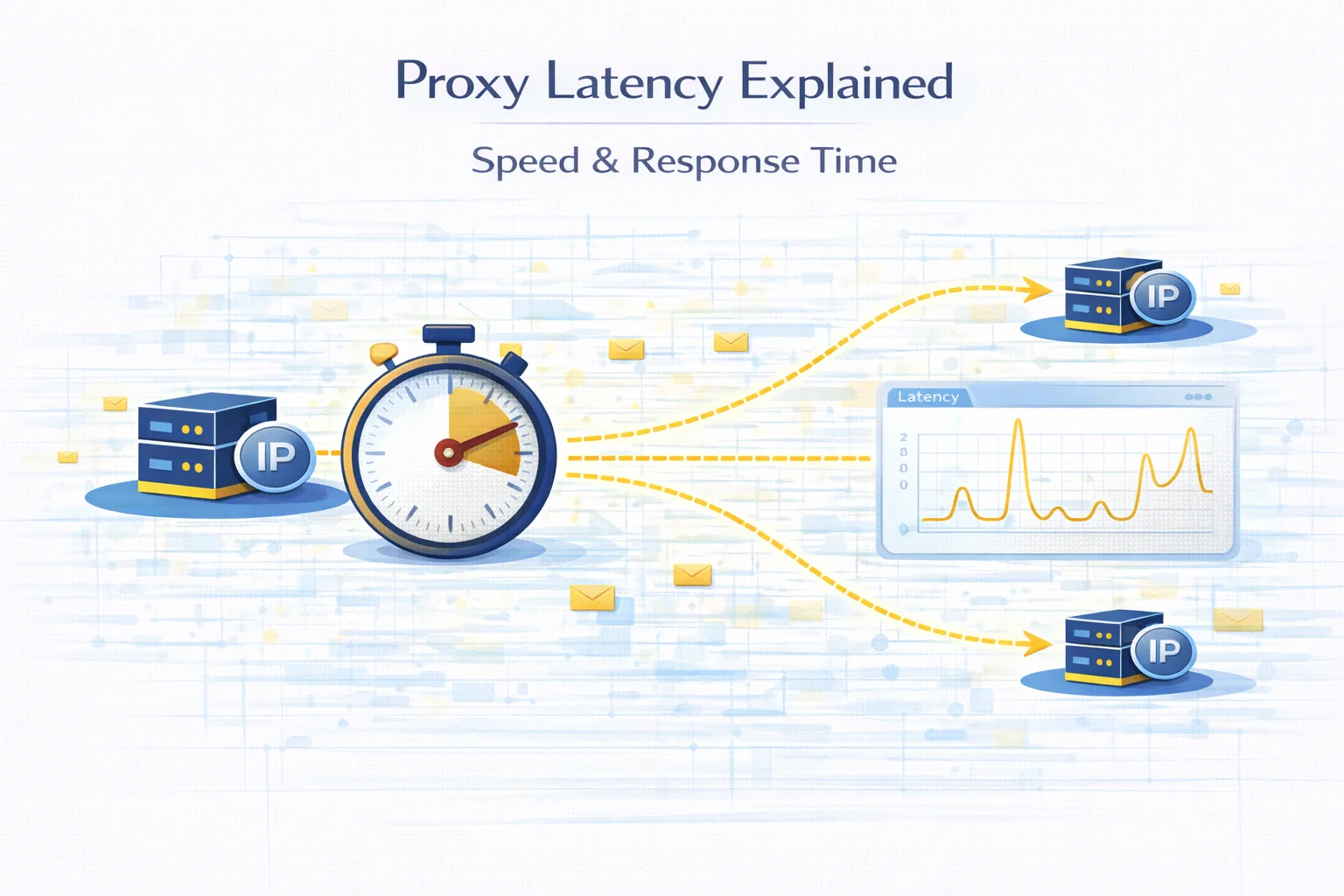
When working with proxies in automation, web scraping or large-scale data collection, connection speed becomes one of the most important performance factors.
A proxy may technically function correctly, but if requests travel too slowly through the network the entire workflow becomes inefficient. Scripts may pause while waiting for responses, requests may fail and some platforms may even terminate the connection.
This delay in communication is called proxy latency.
Understanding how latency works helps developers choose the right proxy infrastructure, diagnose network problems and improve the stability of automated systems.
Before running large proxy pools, many engineers test endpoints using tools like Proxy Checker to measure connection performance and detect slow nodes.
What Is Proxy Latency
Proxy latency describes the time required for a network request to travel through a proxy server and return a response.
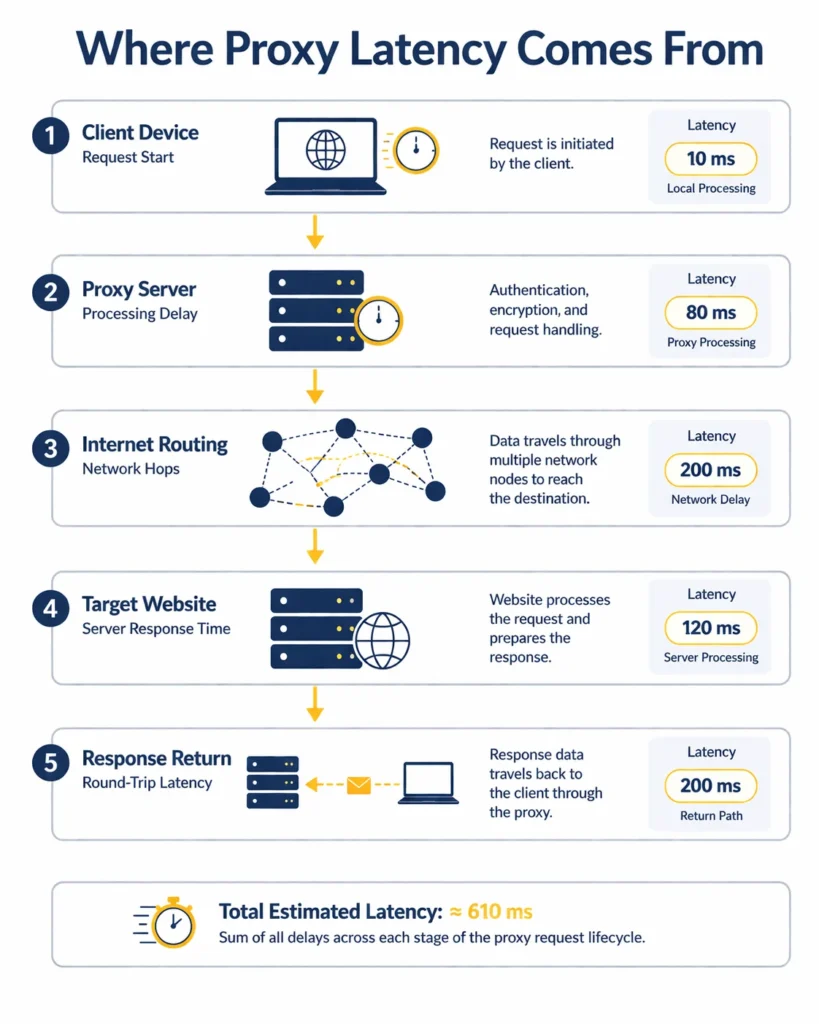
In a typical scenario the request follows this path:
Client → Proxy Server → Target Website → Proxy Server → Client
Each stage introduces a small delay. The total delay between sending the request and receiving the response is called latency.
Latency is usually measured in milliseconds (ms) and reflects how responsive the network connection is.
Unlike bandwidth, which measures how much data can be transferred, latency measures how quickly communication begins.
Even a small increase in response delay can significantly affect scraping pipelines, automation scripts or API integrations.
To confirm that traffic is actually routed through a proxy, developers often verify the visible address using What Is My IP.
Why Proxy Latency Matters
Proxy response time has a direct impact on how efficiently automated systems operate.
If latency becomes too high, every request takes longer to complete. When thousands of requests are involved, these small delays accumulate quickly.
High latency may lead to:
- slower scraping speeds
- unstable automation workflows
- increased request failures
- connection timeouts
In some situations servers may close connections before a response is returned. This can produce errors such as 504 Gateway Timeout When Using Proxies.
Routing instability may also cause gateway errors like HTTP 502 Bad Gateway When Using Proxies.
Monitoring response times and replacing slow endpoints helps prevent these issues.
Typical Latency by Proxy Type
Different proxy infrastructures introduce different network delays because they rely on different routing environments.
| Proxy Type | Typical Latency | Network Characteristics |
| Datacenter proxies | 10–50 ms | High-speed server networks |
| ISP proxies | 30–100 ms | Residential ASN with datacenter hardware |
| Residential proxies | 80–300 ms | Real user connections |
| Mobile proxies | 200–800 ms | Cellular carrier networks |
Datacenter proxies typically offer the lowest response times because they operate inside optimized server infrastructure.
ISP proxies combine residential IP ownership with datacenter performance, offering a balance between authenticity and speed.
Residential and mobile proxies introduce additional routing layers because traffic passes through consumer devices or mobile carriers.
If performance is critical for your workflows, selecting the right proxy infrastructure is important. Many developers compare different proxy types before deciding to buy proxies suitable for their automation environment.
Key Factors That Influence Proxy Latency
Several technical factors determine how quickly proxy requests are processed.
Geographic distance
The physical distance between the client, proxy server and target website influences routing speed. Shorter routes generally produce faster responses.
Network congestion
When too many requests pass through the same proxy infrastructure, response time may increase due to resource competition.
Internet routing paths
Internet providers determine how traffic travels across networks. Some routes are optimized while others introduce additional network hops.
Proxy authentication
Authentication layers add extra connection steps before traffic is forwarded. While the delay is small, it still contributes to overall latency.
Target server performance
Sometimes slow responses are caused by the destination website rather than the proxy network.
To better understand IP origin and network provider, developers often analyze the address using IP Lookup.
How to Measure Proxy Latency
Testing proxy response time before deploying infrastructure is a common best practice.
A typical proxy testing workflow includes several steps.
Test proxy availability
Start by verifying that proxy endpoints respond correctly. A tool such as Proxy Checker can test connection status and measure response time.
Slow or inactive proxies should be removed from the proxy pool.
Confirm IP routing
Next confirm that traffic is routed through the proxy network. This can be done using What Is My IP to check the public IP address visible to websites.
Verify proxy location
When geographic targeting is important, developers validate proxy location and network ownership. This information can be obtained using IP Lookup.
Evaluate response time
Finally measure latency and compare multiple proxy endpoints. The fastest proxies typically produce the most stable automation environments.
Proxy Latency vs Network Speed
Latency and bandwidth are often confused, but they represent different aspects of network performance.
| Metric | What It Measures |
| Latency | Time before a server begins responding |
| Bandwidth | Maximum data transfer capacity |
| Throughput | Actual data transfer speed during operation |
A proxy may have high bandwidth but still feel slow if the initial response time is long.
For scraping and automation tasks, low latency often matters more than raw bandwidth.
How to Reduce Proxy Latency
Several strategies can help improve proxy performance.
Choose nearby proxy locations
Selecting proxies geographically closer to the target website reduces routing distance and network delay.
Use reliable proxy infrastructure
Server-based proxy networks typically provide faster response times than consumer connections.
Regularly test proxy performance
Running periodic checks using Proxy Checker helps identify slow or overloaded endpoints.
Avoid unnecessary proxy rotation
Aggressive rotation strategies may introduce proxies from distant regions, increasing network delay.
Monitor connection stability
Continuous monitoring helps detect degraded proxy nodes before they impact production systems.
Latency and Proxy Connection Errors
Slow proxy connections increase the likelihood of network errors.
When response time becomes too long, servers or proxy gateways may terminate the request before the response arrives.
Common issues related to slow proxy routing include:
- 403 Forbidden When Using Proxies
- 429 Too Many Requests
- 503 Service Unavailable When Using Proxies
- 504 Gateway Timeout When Using Proxies
If these errors appear frequently, reviewing Proxy Errors Explained: Complete Troubleshooting Guide can help diagnose infrastructure problems.
Key Takeaways
Proxy latency represents the delay between sending a request and receiving a response through a proxy server.
Low latency improves scraping efficiency, automation stability and API performance.
Datacenter and ISP proxies typically provide faster response times, while residential and mobile proxies may introduce additional delay due to consumer network routing.
Developers usually monitor proxy response time using tools like Proxy Checker, verify routing with What Is My IP and analyze network information using IP Lookup.
Selecting reliable proxy infrastructure and continuously monitoring performance helps maintain stable proxy operations.
Glossary
Latency
The delay between sending a network request and receiving a response.
Round-Trip Time (RTT)
The total time required for a request to travel from client to server and back.
Proxy Server
An intermediary server that forwards internet traffic between a client and a destination website.
Bandwidth
The maximum amount of data that can be transferred through a network connection.
ASN
Autonomous System Number identifying the organization responsible for an IP network.

Frequently asked questions
Here we answered the most frequently asked questions.
What is good proxy latency?
Latency below 100 milliseconds is generally considered fast for most proxy infrastructures.
Why are residential proxies slower?
Residential proxies route traffic through real user networks, which introduces additional routing layers.
How can I test proxy response time?
You can measure latency using proxy testing tools such as Proxy Checker.
Does latency affect web scraping?
Yes. High latency slows down scraping pipelines and increases the risk of timeout errors.
Peak-hour traffic bottlenecks at local ISP exchange points usually hurt latency far more than server processing load