
HTTP 502 Bad Gateway When Using Proxies (Complete Guide)
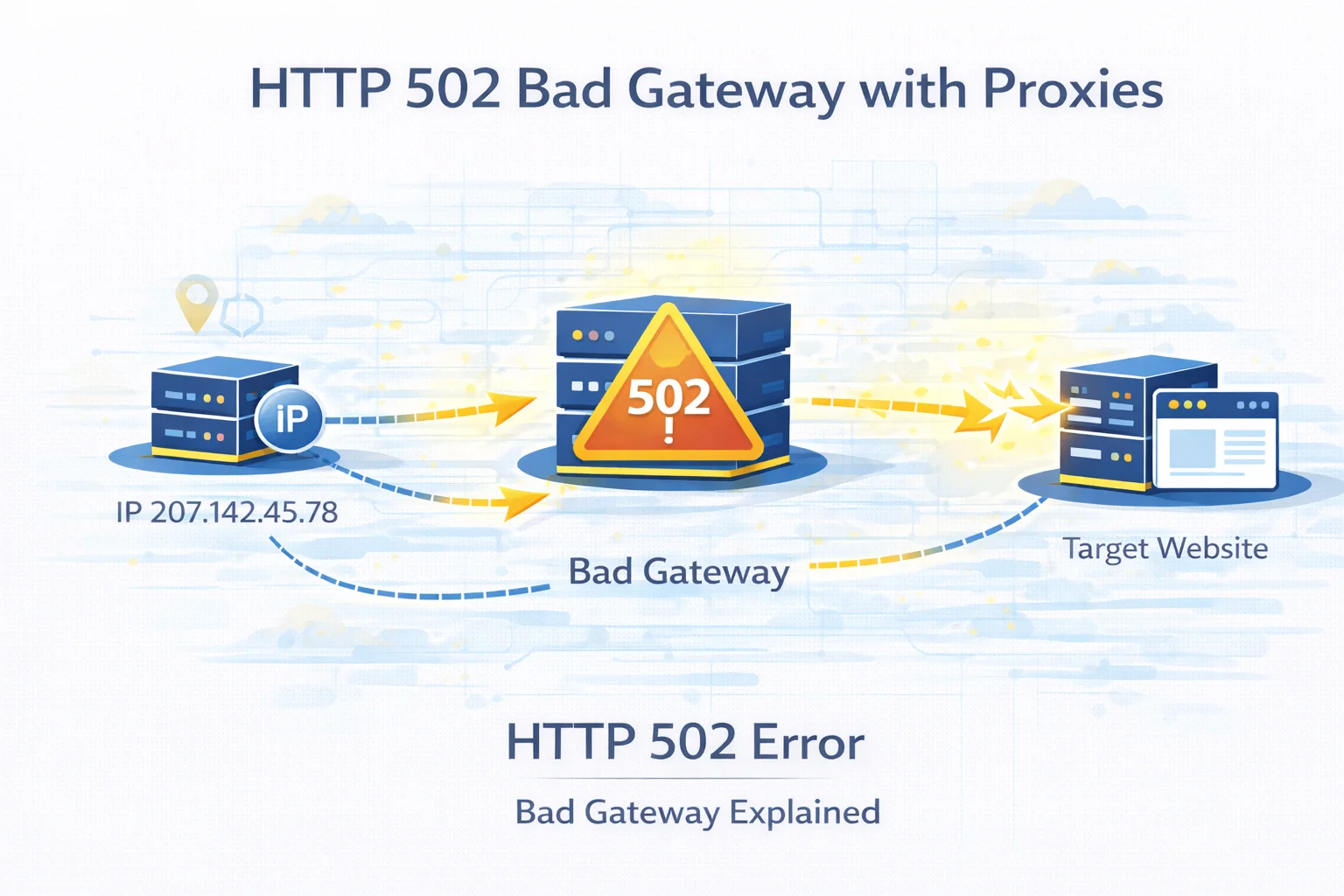
Proxy infrastructure plays an important role in modern automation workflows. Developers rely on intermediary servers to distribute traffic, collect public data, test applications from different locations and operate large-scale monitoring systems.
However, routing requests through additional network layers sometimes introduces new types of technical errors. One of the most frequently encountered issues is the HTTP 502 Bad Gateway error.
This response usually appears when a server responsible for forwarding a request cannot receive a valid response from another server further in the chain. In environments where traffic passes through proxy gateways, several systems may be involved before the request reaches the final website.
Understanding how these gateway failures occur helps developers quickly identify the source of the problem and restore stable connections.
Quick Answer
A 502 Bad Gateway error appears when a gateway server receives an invalid response from an upstream server.
When proxies are involved, this can happen because of:
- overloaded proxy nodes
- unstable upstream websites
- network routing interruptions
- blocked proxy IP addresses
- incorrect proxy configuration
To fix the issue, developers must determine which layer in the request chain failed.
Key Takeaways
- HTTP 502 indicates a communication failure between servers
- proxy routing introduces additional gateway layers
- upstream servers may temporarily fail or reject traffic
- overloaded proxy nodes can produce gateway errors
- distributing requests across multiple endpoints improves reliability
How Gateway Errors Appear in Proxy Environments
When a direct connection is used, the communication path is relatively simple.
Client → Website
However, when proxies are introduced, the path often becomes more complex.
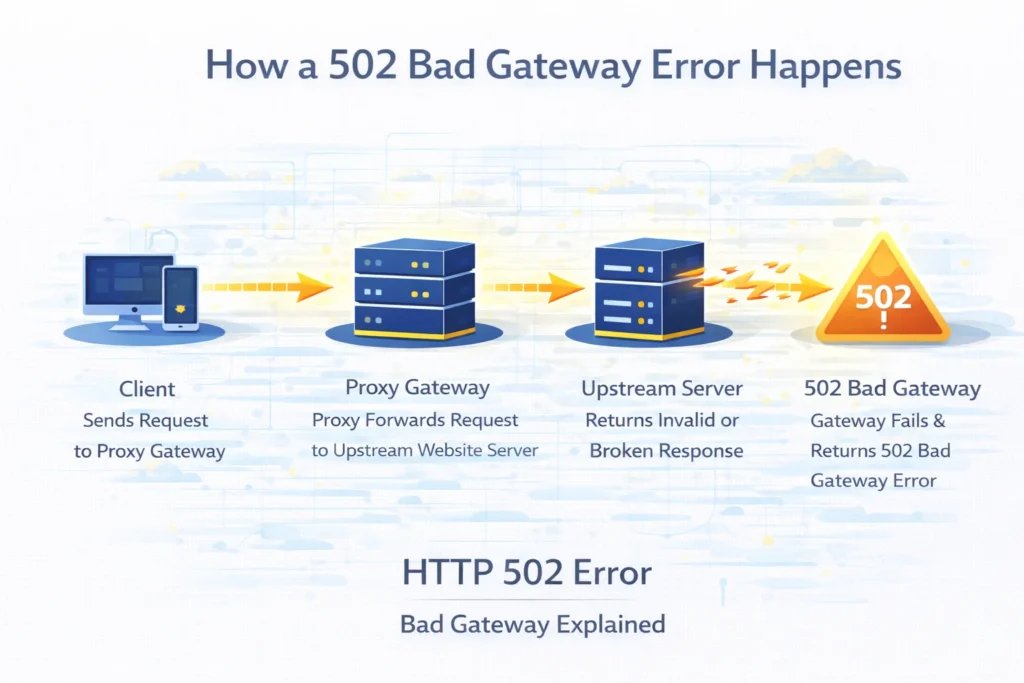
Client → Proxy Gateway → Proxy Node → Target Website
Each additional layer must successfully forward and process the request. If one component fails to communicate with the next server in the chain, the gateway may return a 502 Bad Gateway response.
This is why distributed scraping or automation systems sometimes encounter these errors more frequently than normal browsing.
What the 502 Status Code Actually Means
HTTP status codes in the 5xx range indicate server-side problems.
Unlike client-side errors such as 403 or 404, these responses occur after the request successfully reaches a server but fails during processing.
A 502 error specifically means that an intermediary server received an unexpected or invalid response from the upstream server it attempted to contact.
In proxy infrastructures this intermediary is often a proxy gateway or routing node.
Most Common Causes of 502 Errors With Proxies
Several different factors may trigger a Bad Gateway response.
| Cause | Description |
| upstream server failure | the destination website temporarily stops responding |
| proxy node overload | proxy infrastructure receives more requests than it can process |
| network instability | packet loss or unstable connections interrupt communication |
| blocked proxy IP | the destination server rejects traffic from the proxy |
| misconfigured proxy settings | incorrect credentials, ports or routing configuration |
Because multiple systems participate in the request process, troubleshooting requires isolating the failing component.
Upstream Server Problems
Sometimes the proxy infrastructure is working correctly, but the target website experiences issues.
Examples include:
- temporary server outages
- backend application errors
- infrastructure scaling problems
- high traffic spikes
When this happens, the gateway server cannot obtain a valid response from the upstream server and returns a 502 error.
In such cases the issue often resolves automatically once the website becomes available again.
Proxy Node Overload
Large automation systems can generate thousands of requests per minute. If too many requests pass through a limited number of proxy nodes, those servers may become overloaded.
Symptoms of proxy node overload include:
- intermittent gateway errors
- slower response times
- unstable request success rates
Distributing traffic across multiple endpoints helps reduce load on individual proxy nodes.
Incorrect Proxy Configuration
Configuration mistakes are another frequent cause of gateway errors.
Typical problems include:
- wrong proxy host or port
- incorrect authentication format
- unsupported protocol configuration
- invalid endpoint address
Even small configuration errors may prevent the proxy server from properly forwarding requests.
A related issue is explained in 407 Proxy Authentication Required.
Anti-Bot Protection and Proxy Blocking
Many websites actively monitor incoming traffic patterns to detect automation systems.
If a proxy IP address is flagged as suspicious, the server may terminate the connection or send an invalid response.
This can occasionally result in a 502 error instead of a traditional block page.
Signals that may trigger protection systems include:
- abnormal request frequency
- repeated access patterns
- traffic from hosting networks
- missing browser behavior signals
More details are covered in Proxy Detection Guide.
Network Instability
Communication between servers relies on stable network routes.
If the connection between proxy nodes and upstream servers becomes unstable, packets may be lost or delayed. When the gateway fails to receive a valid response within the expected time frame, it may generate a Bad Gateway error.
These situations are more common in globally distributed infrastructures where multiple network paths are involved.
How to Fix 502 Bad Gateway Errors
Resolving gateway errors usually requires identifying which component in the request chain failed.
Check Proxy Connectivity
Start by verifying that the proxy endpoint responds correctly.
You can check how your connection appears to websites using the What Is My IP tool.
If the network identity looks incorrect, the proxy configuration may be wrong.
Verify Proxy Configuration
Confirm the following parameters:
- proxy host
- port number
- authentication credentials
- protocol compatibility
Incorrect configuration settings often cause gateway failures.
Reduce Request Frequency
High request rates can overload proxy infrastructure or trigger protection systems.
Introducing delays between requests helps stabilize traffic.
| Request Strategy | Stability |
| constant high frequency | unstable |
| moderate pacing | stable |
| adaptive timing | most reliable |
Rotate Proxy Endpoints
Using a single proxy endpoint concentrates traffic through one node. Rotating endpoints distributes traffic across multiple servers and reduces overload risks.
This technique is widely used in scraping systems and automation pipelines.
Test the Target Website Directly
If the website itself is experiencing problems, the proxy layer cannot resolve the issue.
Testing the site without a proxy connection helps determine whether the upstream server is functioning correctly.
When 502 Errors Are Temporary
Not all gateway failures indicate a persistent problem.
Temporary 502 errors may occur because of:
- server restarts
- infrastructure scaling events
- temporary network congestion
- maintenance operations
Retrying the request after a short delay often resolves these situations.
Final Thoughts
The HTTP 502 Bad Gateway error usually indicates a communication failure between servers rather than a problem with the client application itself.
Because proxy environments introduce additional gateway layers, these failures can occur at multiple points in the network chain.
By analyzing proxy configuration, request patterns and upstream server availability, developers can quickly identify the cause and restore stable request routing.
Glossary
Bad Gateway
An HTTP status code indicating that a gateway server received an invalid response from an upstream server.
Proxy Gateway
An intermediary server that routes traffic between the client and destination websites.
Upstream Server
The server that ultimately processes the forwarded request.
Traffic Distribution
The process of spreading requests across multiple network identities.
Proxy Node
A server responsible for forwarding client traffic to destination websites.

Frequently asked questions
Here we answered the most frequently asked questions.
Why does a proxy return a 502 Bad Gateway error?
This usually happens when the proxy gateway fails to receive a valid response from the upstream server handling the request.
Can overloaded proxy servers cause 502 errors?
Yes. When proxy nodes receive more traffic than they can process, communication failures may occur.
How can I test whether my proxy configuration works correctly?
Tools like What Is My IP and IP Lookup help verify how your connection appears to websites.
Are 502 errors related to scraping activity?
Sometimes. Large volumes of automated requests can overload proxy nodes or trigger server protection systems.
Catching HTTP 502 in the retry middleware and instantly swapping the residential endpoint fixes almost all dropped pipe runs