
Browser Profile Troubleshooting After a Proxy Change: What Changed, What Didn’t, and What to Check Next
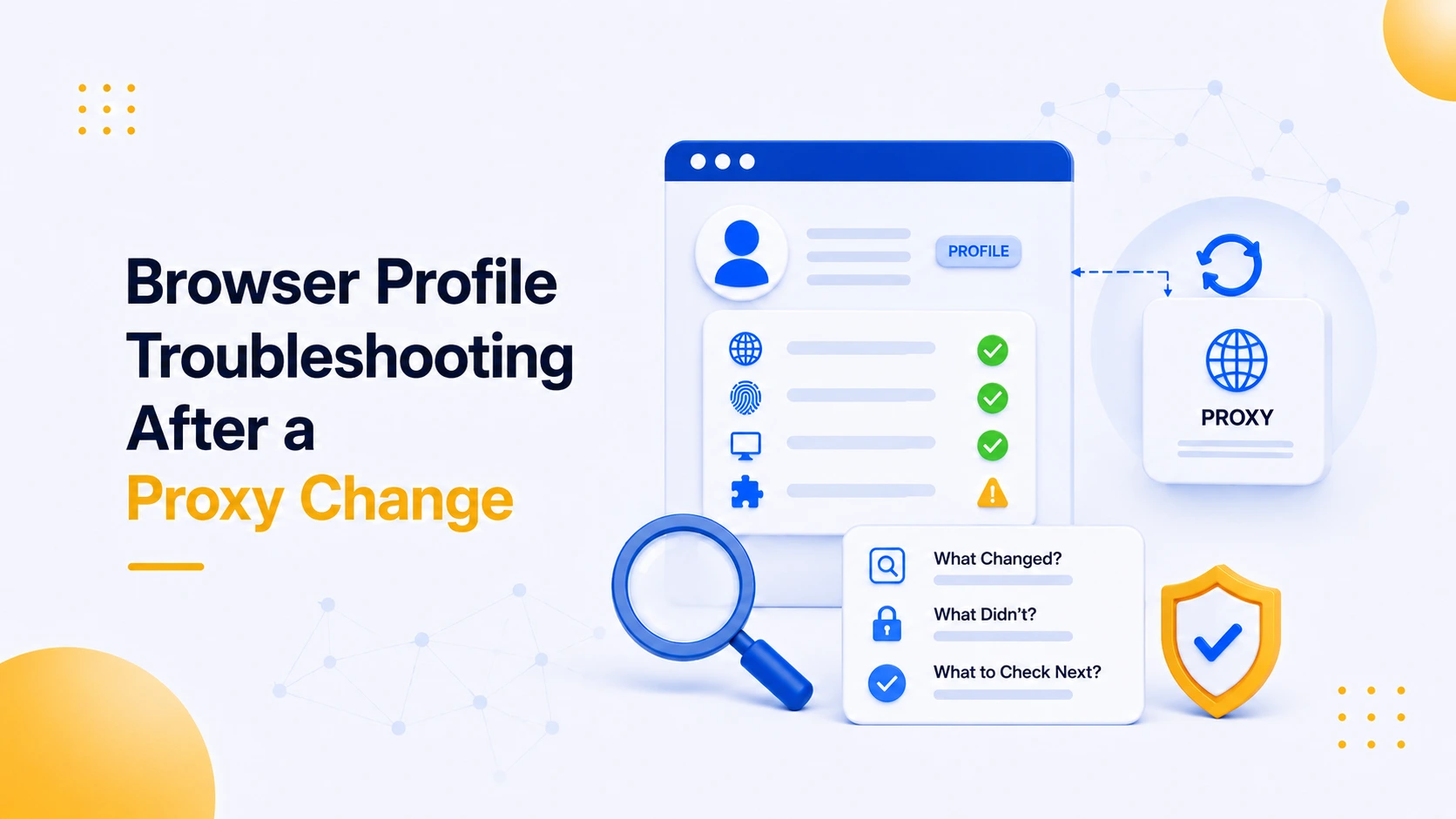
Using MangoProxy and Web4 Browser to make an IP change useful for troubleshooting—not the start of another round of guesswork
You changed the proxy.
The new IP is live. The connection works. But the problem you were trying to fix is still there.
This is usually where troubleshooting starts to drift.
Try another IP. Change the region. Clear the cookies. Adjust a browser setting. Relaunch the profile. Try again.
Eventually, something may improve. The problem is that after five changes, nobody can say which one actually mattered.
A proxy change is much more useful when you treat it as a test:
A good proxy change should narrow the diagnosis, not restart it.
So once the new IP is active, resist the urge to change something else immediately.
First ask:
What changed? What didn’t? And what did the result actually tell me?
That is the question this guide is designed to answer.
It does not try to predict how a particular platform will score an account, and it does not assume that every browser-profile problem comes from the proxy or the fingerprint. The goal is simpler: make each change give you enough information to choose the next one intelligently.
Start before the proxy change
The easiest way to make a proxy test useless is to forget what things looked like before you ran it.
You do not need a full technical audit. You just need a baseline you can compare against.
Start with the actual symptom.
“The profile is unstable” is too vague.
“The current proxy stops responding after launch” is useful.
“The new IP is correct, but the login session still behaves the same way” is useful.
“The profile shows the wrong network location” is useful.
Once the symptom is specific, capture a few things before changing anything:
| Record before the change | Why it matters |
| Profile name or ID | Makes sure you are comparing the same environment |
| Public IP | Establishes the network baseline |
| Country / region | Makes a location change easy to spot |
| Proxy type or session mode | Tells you whether rotation is expected |
| Login / session status | Gives you a browser-state reference |
| Relevant profile settings | Helps catch changes that happen alongside the proxy |
| Exact symptom | Keeps the test focused |
| Timestamp | Makes later review and team handoff much easier |
The point is not to document everything.
It is to make sure that, after the change, you can answer:
What is different now?
A proxy change is not a browser-profile reset
This distinction is built into how browsers work.
Chromium describes a proxy server as an “intermediary used for network requests.” In other words, proxy configuration affects how network requests are routed. (Chromium proxy documentation)
Profile data lives elsewhere. Chromium’s own documentation says the user data directory contains profile data such as history, bookmarks, and cookies, with each profile stored in its own subdirectory. (Chromium user data directory documentation)
Chrome also notes that cookies are commonly used to manage user sessions and store personalization preferences. (Chrome DevTools cookie documentation)
That gives us an important troubleshooting boundary:
Changing the network is not proof that the browser profile was rebuilt.
It does not mean the opposite either. Some fingerprint or antidetect browsers may adjust related settings automatically when a proxy changes.
So do not assume.
Check.
IP changes are getting easier—which makes it easier to change them too often
MangoProxy recently added a One-Click IP Change feature. Once the proxy connection and dedicated IP-change URL are configured, users can rotate the IP directly from compatible antidetect-browser interfaces without rebuilding the proxy connection or repeatedly editing the profile settings. (MangoProxy One-Click IP Change)
Operationally, that is convenient.
For troubleshooting, it creates a new temptation:
change → check → rotate again → check again → try one more.
But making a variable easier to change does not make repeated changes more informative.
A useful troubleshooting change should reduce uncertainty.
If it only gives you another configuration to look at, you have gained very little.
After the IP changes, compare the delta
Once the new IP is active, stop for a moment.
Compare the new state with the baseline instead of immediately trying something else.
Post-proxy-change delta
| Check | Before | After | What the comparison tells you |
| Public IP | IP A | IP B | Whether the exit actually changed |
| Country / region | Region A | Region B | Whether the network location changed as intended |
| Proxy / session state | State A | State B | Whether the intended replacement or rotation happened |
| Profile ID | Profile A | Profile A | Whether you are still testing the same browser profile |
| Cookies / local state | State A | Same / changed | Whether browser-side state persisted |
| Relevant browser settings | Value A | Same / changed | Whether anything else moved with the network change |
| Original symptom | Present | Gone / same / different | What the proxy test actually taught you |
That last row matters more than all the others.
A new IP is not just a configuration change.
In a troubleshooting process, it is a piece of evidence.
If the problem disappears, keep following the network lead
Suppose you replace the proxy, confirm the new exit, and the original problem disappears without deliberately changing anything else.
That does not prove the previous proxy was the only cause.
It does make the network a stronger lead.
At that point, it makes sense to keep checking things such as the previous endpoint, authentication, connection quality, region, session behavior or rotation configuration.
This is where MangoProxy should stay at the center of the investigation.
MangoProxy currently publishes a network of 90M+ IP addresses across 200+ locations, with residential, static, datacenter and mobile proxy options. Those are MangoProxy’s own published product figures, not independent measurements. (MangoProxy locations)
For troubleshooting, though, pool size is not the key question.
The key question is:
Did the network change fix what you were testing?
If it did, keep investigating the network before rebuilding the browser environment.
Still seeing a network problem?
If the new IP did not become active, the connection still fails, the wrong location appears, or rotation is not behaving as intended, fix the network first.
Explore MangoProxy proxy options →
If the problem is exactly the same, stop treating the proxy as the only hypothesis
This result is just as useful.
Suppose:
- the old IP is gone;
- the new IP is confirmed;
- the connection works;
- the intended network region is active;
but the original profile problem has not changed at all.
You have not proven that the proxy is irrelevant.
You have not proven that the fingerprint is responsible either.
You have learned something much narrower—and much more useful:
Changing the network once did not remove the symptom under the conditions you tested.
That is the point where a fourth or fifth proxy often gives you less new information than inspecting the existing browser profile.
Look at what the profile is still carrying
Web4 Browser currently supports 28+ fingerprint configuration items, including Canvas, WebGL, AudioContext, fonts, language, time zone and resolution. Its profiles also keep independent proxies, cookies and user-data directories. (Web4 Browser help)
Web4’s environment-management documentation also states that cookies, history and local storage are isolated by profile, alongside fingerprint configuration, tags and local data. (Web4 Browser fingerprint environment)
The important point is not the number of settings.
It is that the IP is only one part of the profile.
Once the proxy is confirmed, ask what the existing profile still contains:
- Did the same cookies remain?
- Is the login state unchanged?
- Is local storage still present?
- Were any browser settings edited during the proxy change?
- Was the profile cloned, recreated or moved?
- Did another operator change something at the same time?
Do not clear or regenerate everything just because those controls are available.
First establish whether they actually changed.
For a closer look at this side of the workflow, see Web4 Browser profile-environment management.
If the problem changes but does not disappear, you may be dealing with more than one variable
This is often the most useful outcome.
Maybe the proxy replacement fixes the connection problem, but the login issue remains.
Maybe the new region appears correctly, but a browser-side warning is unchanged.
Maybe the profile behaves differently, but not in the way you expected.
Do not rush to finish the job by changing three more settings.
Go back to the comparison:
- What improved?
- What stayed the same?
- What did you intentionally change?
- Did anything else change automatically?
A troubleshooting step does not have to solve everything to be useful.
Sometimes its value is simply showing you that two separate problems were being treated as one.
Change one thing, then learn from it
Consider two troubleshooting sessions.
In the first
The operator replaces the proxy, changes the time zone and language, clears cookies, modifies fingerprint settings and relaunches the profile.
The problem disappears.
Good operational result, perhaps.
Weak diagnostic result.
There are now several plausible explanations and no clean way to separate them.
In the second
The operator records the baseline, changes only the proxy, verifies the new IP and tests the same symptom again.
The problem remains.
That feels less satisfying, but it tells you more:
The network change alone did not remove the original symptom under the conditions tested.
Now the next move can be deliberate instead of random.
That is the habit worth building:
Every troubleshooting change should reduce uncertainty.
When should you change the proxy again?
Sometimes another network action is exactly the right next move.
| What you observe | Change or investigate the proxy again? | Why |
| The new IP never became active | Yes | The network change did not complete |
| Proxy authentication fails | Yes | The problem is still connection-related |
| The connection remains unavailable | Yes | Network troubleshooting is not finished |
| The wrong region appears | Yes | The active network does not match the intended task |
| Rotation or session behavior is wrong | Yes | The proxy configuration still needs attention |
| The workflow intentionally requires another rotating IP | Yes | Rotation is part of the task |
| New IP works, but the original profile issue remains | Not yet | You need a new hypothesis before repeating the same test |
| No reproducible network issue remains | Usually no | Another network change adds a variable without a clear reason |
MangoProxy’s One-Click IP Change is useful precisely because the network endpoint can be rotated without rebuilding the rest of the proxy setup. (MangoProxy One-Click IP Change)
The important word is controlled.
Change the IP.
Verify it.
See what the result tells you.
Then decide whether the next test still belongs to the proxy.
Know when to stop touching the proxy
If the new IP is active, the connection works, the intended region is correct, rotation behaves as expected, and the same profile problem remains, “try another proxy” should stop being the automatic next step.
That does not mean the proxy has been proven innocent.
It means:
You have already tested that hypothesis once. You need new information before testing it again.
That small distinction saves a lot of pointless configuration churn.
For teams, record the reason for the change—not just the new IP
Troubleshooting gets harder when several people touch the same set of profiles.
The person seeing the problem today may have no idea what somebody changed yesterday.
A tiny change log is usually enough:
| Field | Example |
| Time | 14:10 UTC |
| Profile | Market-US-07 |
| Symptom | Proxy connection timing out |
| Old IP | IP A |
| New IP | IP B |
| Reason | Test a different network endpoint |
| Other settings changed | None |
| Result | Connection restored; login issue remains |
| Next step | Keep current proxy; inspect profile state |
The most useful field is not the IP.
It is Reason.
Without that, a team knows what happened but not what someone was trying to learn.
Web4’s profile-management documentation includes grouping, tags, notes and isolated local profile data specifically to make handoff, troubleshooting and review easier to manage across teams. (Web4 Browser fingerprint environment)
MangoProxy + Web4 Browser: make the change easy to trace
For this workflow, the partnership is more useful when you stop thinking of it simply as:
proxy provider + fingerprint browser.
MangoProxy helps you make and verify the network change.
Web4 Browser gives you a persistent profile to compare before and after that change.
That leads to a much cleaner workflow:
| Moment | MangoProxy | Web4 Browser |
| Before the test | Record the current network | Identify the profile being tested |
| Make one change | Replace or rotate the IP | Keep the comparison profile intact |
| Verify | Confirm the new endpoint | Check whether profile-side state changed |
| Re-test | See whether the network change affected the symptom | Inspect persistent state if it did not |
| Team handoff | Document the proxy action | Preserve profile context and notes |
| Next step | Change the network again only for a reason | Change profile settings only for a reason |
Neither product has to pretend to solve every problem.
That is what makes the combination useful.
New IP is working, but the original problem is still there?
That is a good moment to stop adding network variables and look at what the profile retained.
See Web4 Browser profile-environment management →
The entire process, shortened to one checklist
- Define the exact symptom.
- Record the current profile and network baseline.
- Change only the proxy if that is the variable you are testing.
- Confirm the new IP is actually active.
- Re-test the same symptom.
- Compare what changed with what stayed the same.
- Use the result to update the diagnosis.
- If the symptom remains, stop assuming the proxy is the only variable.
- Inspect persistent profile state before making another change.
- Record the result before testing anything else.
The useful part is not that there are ten steps.
It is that each step earns the next one.
Final takeaway: a proxy change is a test, not a reset button
Changing the proxy may be exactly the right move.
But its real troubleshooting value is not simply that you get another IP.
You get another piece of evidence.
There was a state before the change.
You intentionally changed one thing.
There is a state after the change.
Now compare them.
If the network was the problem and the change fixed it, keep following the network lead.
If the network is now correct and the same symptom remains, stop cycling through IPs and inspect what the browser profile retained.
If the result is ambiguous, keep the current state long enough to learn from it instead of immediately adding another variable.
The rule is simple:
Change one thing. Verify the result. Learn before you change the next thing.
Or, even shorter:
A good proxy change should narrow the diagnosis, not restart it.
MangoProxy makes the network change easier to control. (MangoProxy One-Click IP Change)
Web4 Browser makes the profile around that change easier to isolate and manage. (Web4 Browser help)
The value is not that you can change more things.
It is that you can tell what the change actually taught you.
Start with the part the evidence points to
If the evidence still points to the network:
If the network is already verified and the next question is inside the profile:
Explore Web4 Browser profile-environment management →
Publication note
MangoProxy’s partner article supplied to Web4 states that Web4 Browser users can receive 8% off MangoProxy Static ISP proxies with promo code WEB4. Because promotional terms can change, reconfirm the code and its validity with MangoProxy before publication.
Key source links

Frequently asked questions
Here we answered the most frequently asked questions.
Does changing a proxy reset the browser profile?
No. A proxy change affects the network connection, while cookies, local storage, login sessions, and other profile data may remain unchanged.
What should I check after changing the proxy?
What if the new IP works but the problem remains?
If the network is working correctly and the same issue remains, inspect the browser profile, including cookies, local storage, login state, and relevant fingerprint settings.
Should I keep changing proxies during troubleshooting?
Only when there is a clear network-related reason. Repeated proxy changes can add variables without helping identify the actual cause of the problem.