
Risk Scoring Systems Explained: How Websites Decide to Trust or Block Users
Quick Answer
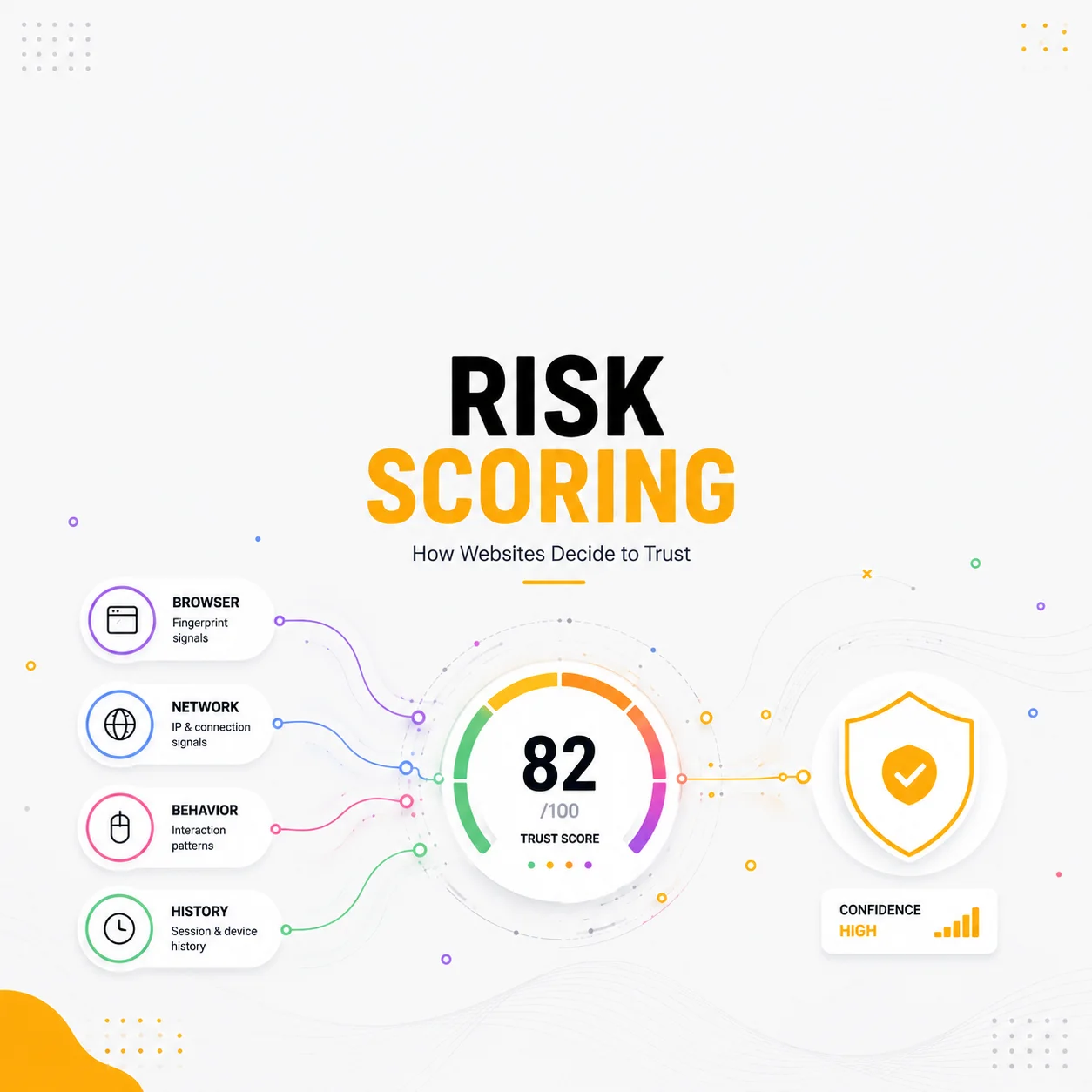
Risk scoring is the process of combining dozens of browser, network, behavioral, and historical signals into a single trust assessment. Rather than making decisions based on one characteristic-such as an IP address or browser fingerprint-modern websites evaluate the overall level of confidence that a browsing session represents legitimate activity.
Key Takeaways
- Modern websites rarely trust or block users based on a single signal.
- Risk scoring combines technical, behavioral, and historical information.
- Browser fingerprints are only one component of the overall score.
- User behavior provides additional context for trust evaluation.
- Risk scores continuously evolve throughout a browsing session.
- Decisions are based on probability rather than certainty.
Why Websites Use Risk Scores
Modern websites receive millions of requests every day.
Some requests come from:
- legitimate customers;
- search engines;
- internal services;
- monitoring systems;
- automated software;
- malicious actors.
Treating every request equally would either reduce security or create unnecessary friction for legitimate users.
Instead of asking:
“Is this user good or bad?”
modern security systems ask:
“How much confidence do we have that this session is trustworthy?”
That confidence is represented as a risk score.
Rather than relying on one technical signal, websites combine many independent observations into a broader assessment of browser trust.
As explained in Behavioral Detection Explained, browser behavior is only one part of this process. Risk scoring brings together all available signals to support a more balanced decision.
What Is a Risk Scoring System?
A risk scoring system evaluates multiple characteristics of a browsing session and estimates the likelihood that the activity is legitimate.
Instead of producing a simple allow or block result immediately, the system continuously updates its assessment as new information becomes available.
The score may change during a session as the browser:
- authenticates successfully;
- navigates through the website;
- performs additional interactions;
- builds a history of consistent activity.
This allows websites to make decisions based on the complete context of the session rather than isolated events.
How Risk Scoring Works
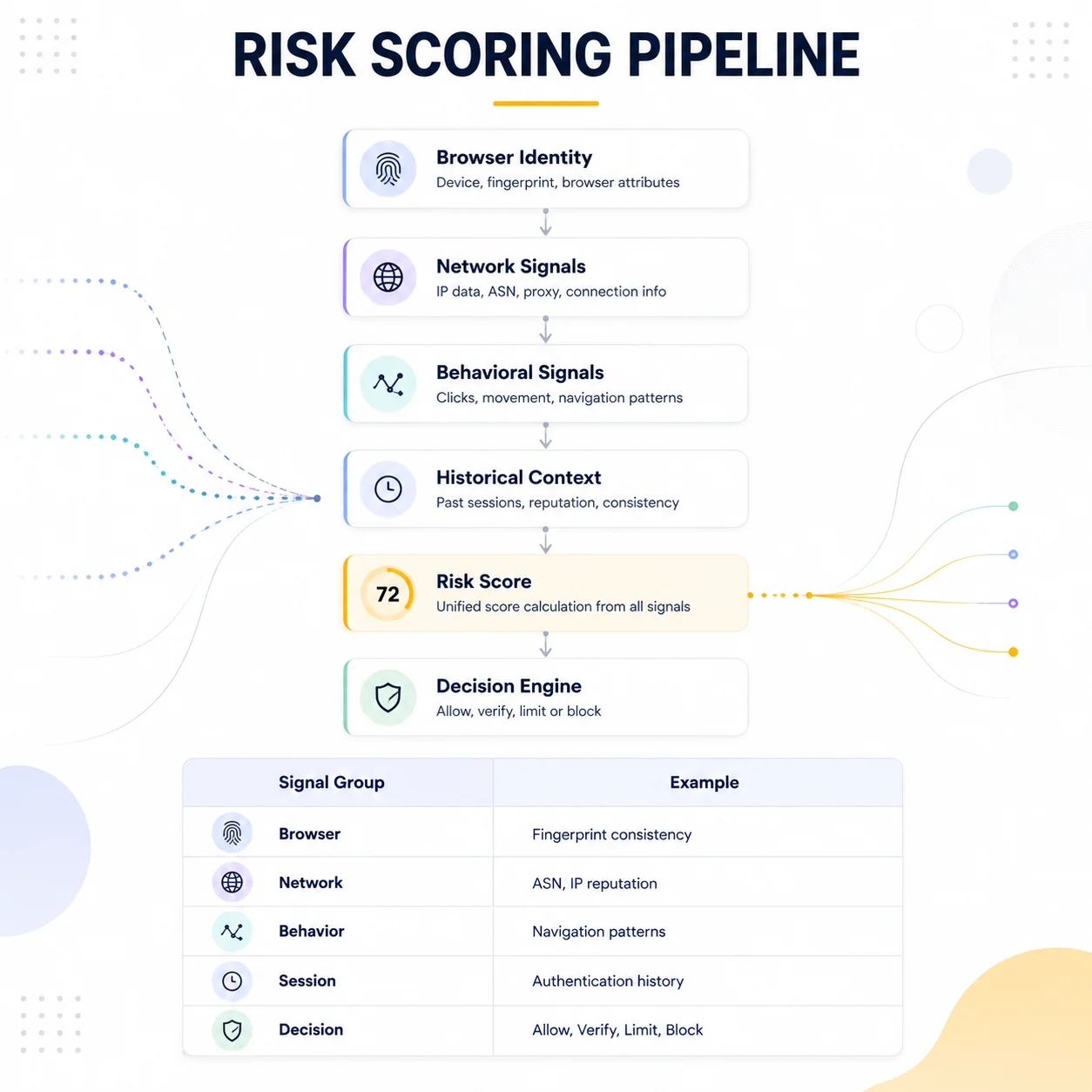
Modern risk scoring combines many independent categories of information.
Browser Session
│
▼
Browser Identity
│
▼
Network Signals
│
▼
Behavioral Signals
│
▼
Historical Context
│
▼
Risk Score
│
▼
Website Decision
Each category contributes additional evidence.
No single signal determines the final outcome.
Instead, the overall score reflects the combined confidence that the browsing session appears consistent with legitimate user activity.
What Signals Influence a Risk Score?
Risk scoring systems evaluate many independent signals simultaneously.
These signals generally fall into several broad categories.
| Signal Category | Examples |
| Browser Identity | Browser fingerprint, browser version, device characteristics |
| Network | IP reputation, ASN, geolocation consistency, DNS configuration |
| Session | Authentication history, session continuity, cookie persistence |
| Behavior | Navigation flow, interaction timing, browsing patterns |
| Historical Context | Previous successful logins, account reputation, long-term consistency |
Each category contributes additional evidence.
Rather than assigning absolute meaning to one characteristic, the system evaluates how well all signals fit together.
This layered approach makes modern trust evaluation significantly more reliable than older security models that relied primarily on IP addresses or browser fingerprints.
Risk Scores Continuously Change
A common misconception is that websites calculate a risk score only once.
In reality, modern systems continuously reassess trust throughout an active session.
For example, the score may improve as a user:
- successfully authenticates;
- continues browsing normally;
- performs expected interactions;
- maintains a consistent browser environment.
Conversely, trust may decrease if multiple independent signals become inconsistent during the same session.
Risk evaluation is therefore an ongoing process rather than a single security check.
Website Decisions Are Not Simply “Allow” or “Block”
A high or low risk score does not automatically determine the outcome of a browsing session.
Modern websites often respond in different ways depending on the estimated level of risk.
Browser Session
│
▼
Risk Score
│
├─────────────► Allow
├─────────────► Additional Verification
├─────────────► CAPTCHA
├─────────────► Rate Limiting
└─────────────► Block Request
This graduated response allows websites to balance security with user experience.
Instead of blocking every uncertain request, they may request additional verification or temporarily restrict certain actions while continuing to monitor the session.
Why This Matters for Browser Automation
For browser automation engineers, risk scoring illustrates an important reality:
No single browser characteristic determines whether a session is trusted.
A browser may have:
- a stable fingerprint;
- consistent behavior;
- long-lived session storage;
- predictable network characteristics;
yet websites still evaluate the overall combination of these signals.
As discussed in Behavioral Detection Explained, browser trust is built through consistency across multiple independent layers rather than by optimizing one technical parameter.
Network consistency also contributes to this broader trust model. Depending on the use case, Residential Proxies, Static ISP Proxies, Datacenter Proxies, or Mobile Proxies each provide different network characteristics that align with different workloads. Before you buy proxies, consider how your automation project balances session persistence, network stability, throughput, and geographic coverage.
When validating the network layer, tools such as IP Lookup, IP Trace, DNS Leak Test, and Proxy Checker can help confirm that the browser environment presents consistent network characteristics throughout long-running sessions.
Production Tips
Risk scoring systems are designed to evaluate overall trust, not to make decisions based on a single browser characteristic.
Trust Is Built Over Time
Modern websites continuously reassess browser trust throughout an active session.
Successful authentication, consistent navigation, and stable browser characteristics can gradually strengthen trust, while multiple conflicting signals may reduce confidence.
Trust should be viewed as an evolving assessment rather than a fixed status.
Individual Signals Rarely Determine the Outcome
A browser fingerprint, an IP address, or one behavioral event rarely decides whether access is allowed.
Instead, websites combine independent categories of information into a broader trust model.
This layered approach helps reduce both false positives and false negatives.
Consistency Across Browser and Network Layers Matters
Risk scoring evaluates how well different signals align with each other.
A stable browser profile, persistent sessions, predictable network characteristics, and coherent browsing behavior together create a stronger trust profile than optimizing any single component in isolation.
Depending on the workload, this may involve Residential Proxies for residential browsing scenarios, Static ISP Proxies for persistent authenticated sessions, Datacenter Proxies for high-performance infrastructure, or Mobile Proxies for mobile network environments.
Before you buy proxies, define which type of network consistency best matches your automation workflow.
Verify Your Environment
Browser trust extends beyond browser configuration.
The surrounding network environment should also remain predictable.
Useful Mango tools include:
- Proxy Checker to verify proxy availability and response quality.
- DNS Leak Test to confirm DNS consistency.
- IP Lookup to inspect ASN and IP metadata.
- IP Trace to understand routing paths.
- My IP to verify the browser is using the expected public IP address.
Together, these tools help validate the browser and network identity that websites evaluate.
Final Thoughts
Modern web security has moved far beyond simple IP filtering or browser fingerprint checks.
Today’s websites evaluate trust through risk scoring systems that continuously combine browser identity, network characteristics, behavioral patterns, authentication history, and historical context into a single assessment.
Rather than making binary decisions based on one signal, these systems estimate the overall confidence that a browsing session represents legitimate activity. This layered approach allows websites to improve security while reducing unnecessary friction for genuine users.
For developers and automation engineers, the most important lesson is that browser trust is built through consistency. Stable browser environments, predictable network characteristics, coherent browsing behavior, and persistent session history all contribute to a stronger trust profile over time.
Understanding risk scoring also completes the broader picture of modern browser identification. Browser fingerprints, behavioral detection, and network signals are not separate technologies-they are complementary components of the same trust model used by today’s most sophisticated web platforms.
Glossary
Risk Score
A dynamic assessment representing the estimated level of trust associated with a browsing session.
Trust Model
A framework that combines multiple browser, behavioral, network, and historical signals to evaluate session legitimacy.
Historical Context
Information collected from previous interactions, such as successful logins, consistent browser usage, or long-term account activity.
Browser Identity
The collection of technical characteristics that describe a browser, including browser fingerprints, storage, hardware information, and software configuration.
Network Identity
Characteristics associated with a browser’s network connection, including IP information, ASN, DNS configuration, and routing.
Trust Evaluation
The continuous process of assessing browser legitimacy using multiple independent sources of information.
Risk Signals
Individual technical or behavioral observations that contribute to the overall trust assessment without independently determining the final decision.
Frequently asked questions
Here we answered the most frequently asked questions.
Does a high risk score always mean a user will be blocked?
No. A higher risk score may lead to additional verification, CAPTCHA challenges, temporary rate limits, or closer monitoring. Blocking is only one possible response.
Can a legitimate user receive a higher risk score?
Yes. Changes such as switching devices, connecting from a new network, updating a browser, or logging in from an unfamiliar location can temporarily affect trust. Modern systems usually continue evaluating the session as more information becomes available.
Is browser fingerprinting the same as risk scoring?
No. Browser fingerprinting is one source of information. Risk scoring combines browser fingerprints with behavioral signals, network characteristics, authentication history, and historical context to produce a broader trust assessment.
Why don't websites rely only on IP addresses?
IP addresses provide only limited information. Today, users frequently change networks, use mobile connections, work remotely, or browse through enterprise infrastructure. Modern security systems therefore evaluate many independent signals rather than depending on IP reputation alone.