
Static vs Rotating Proxies Explained: Choosing the Right Routing Strategy
Published: ≈ 4 min read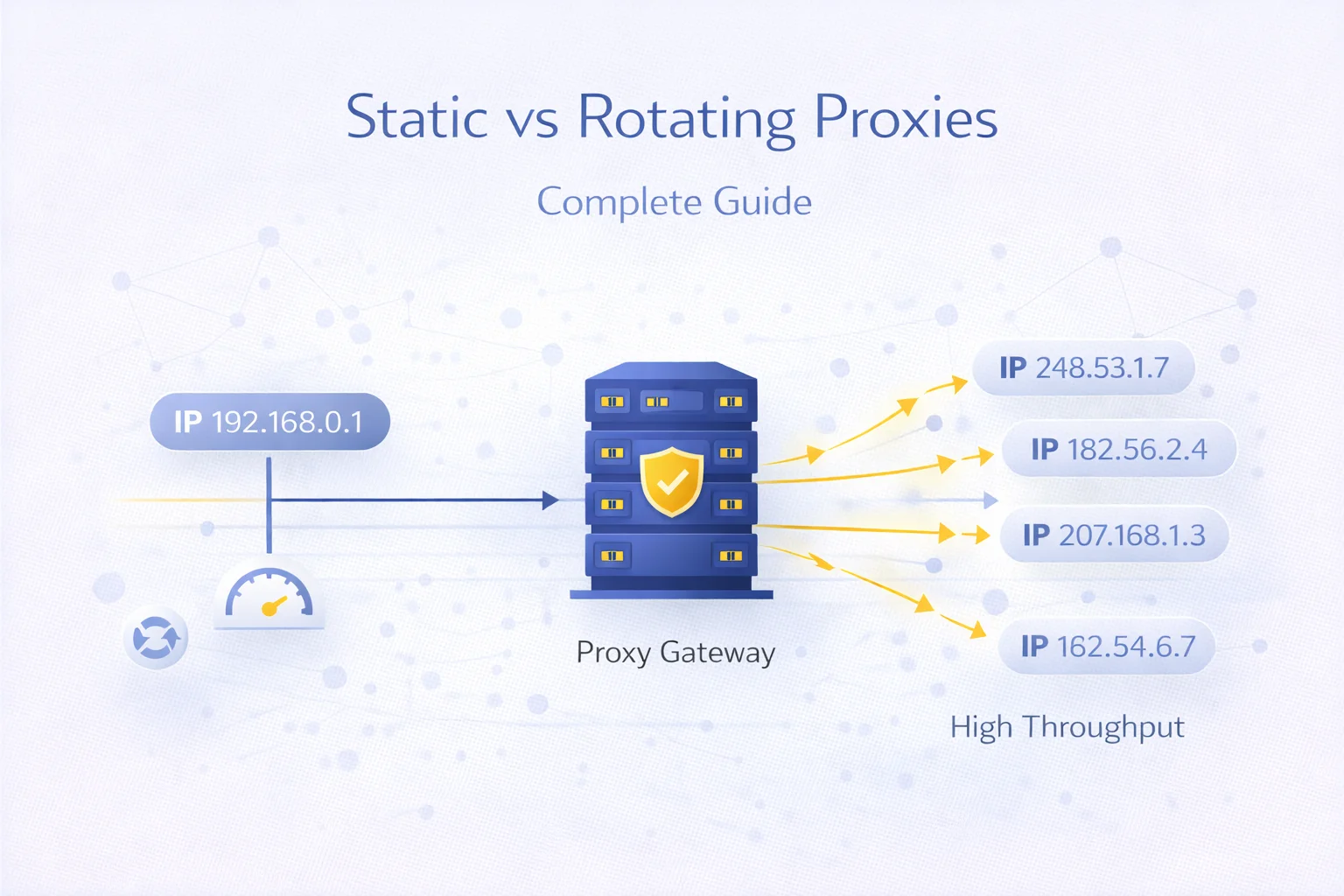
Proxy routing strategies play a critical role in modern automation, data collection and platform interaction workflows. Instead of focusing only on proxy location or infrastructure type, many teams design execution environments based on how IP identity behaves during task execution.
Two primary routing models dominate proxy deployments: static routing and rotating routing. Understanding how these models function helps organizations balance performance, access reliability and session continuity.
This guide explains how static and rotating proxies work, how they differ across proxy types and when each model should be used.
Key Takeaways
- static proxies maintain consistent IP identity
- rotating proxies distribute requests across IP pools
- rotation improves scalability and reduces rate limits
- static routing improves authentication continuity
- hybrid routing strategies provide the best stability
What Are Static Proxies
Static proxies provide a fixed IP address that remains unchanged throughout a workflow. This routing model is commonly used in environments where maintaining a stable connection identity is essential.
For example, long-running account sessions or transactional automation flows benefit from predictable routing paths.
Static routing is widely used in ISP proxy environments (see our guide on ISP proxy infrastructure), where IP identity persistence improves session trust.
What Are Rotating Proxies
Rotating proxies dynamically assign different IP addresses during execution. Rotation can occur per request, per session or at defined intervals depending on proxy gateway configuration.
This routing model helps distribute traffic across multiple endpoints and reduce concentration signals.
Rotating routing is commonly deployed in residential proxy networks (see our detailed residential proxy guide), where large IP pools enable scalable request distribution.
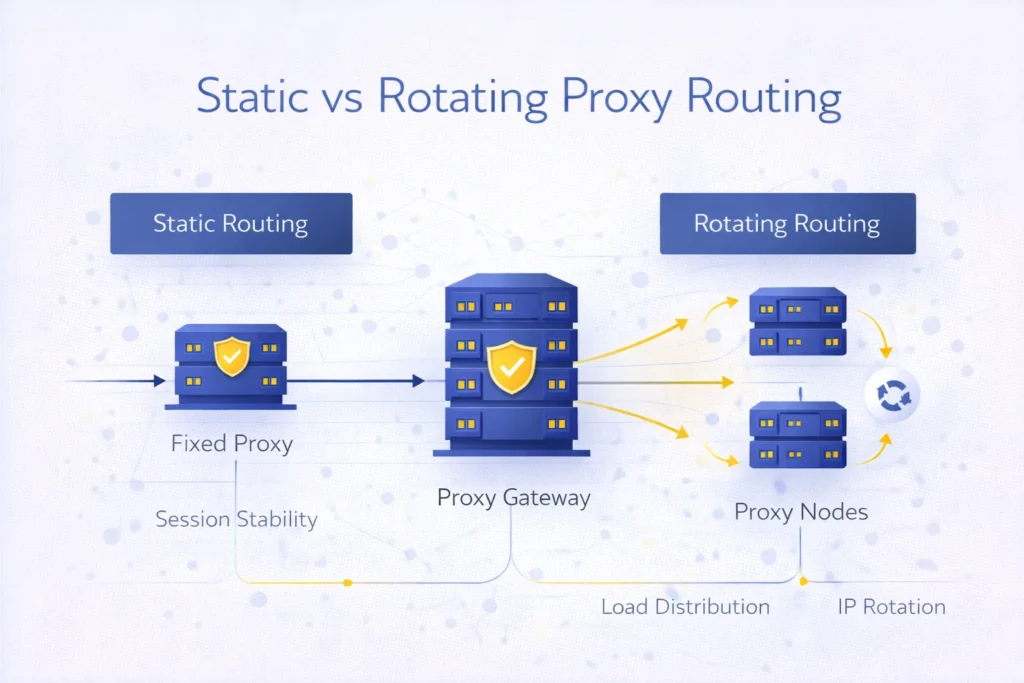
Static vs Rotating Proxy Summary Table
| Feature | Static Proxies | Rotating Proxies |
| Identity | Fixed | Dynamic |
| Concurrency | Limited | High |
| Session stability | Strong | Variable |
| Detection resistance | Lower | Higher |
| Best for | account workflows | scraping |
How Rotation Works Across Proxy Types
Proxy rotation behaves differently depending on infrastructure.
Residential Proxies
Residential proxy gateways often support both sticky sessions and rotating pools.
Sticky routing allows teams to maintain identity continuity, while rotation helps distribute discovery requests.
👉 Learn more in our Residential Proxies Guide
Datacenter Proxies
Datacenter proxy environments typically offer the most flexible rotation control. Teams can deploy both dedicated static IPs and large rotating pools for concurrency scaling.
👉 See the full breakdown in Static vs Rotating Datacenter Proxies Explained.
ISP Proxies
ISP proxies are primarily used in static routing mode because their main advantage is identity persistence.
Manual IP switching is sometimes used when rotation is required.
👉 Read more in ISP Proxies Guide.
Mobile Proxies
Mobile proxy routing introduces natural rotation behavior due to carrier network reassignment.
Rotation may occur automatically when sessions reconnect to cellular infrastructure.
👉 Explore details in Mobile Proxies Explained.
When to Use Static Routing
Static proxy deployment is often suitable when workflows include:
- authenticated sessions
- platform whitelisting
- structured automation pipelines
- checkout or booking flows
Maintaining consistent identity reduces disruption risk.
When to Use Rotating Routing
Rotating proxy strategies are commonly used when:
- collecting large datasets
- testing regional content variations
- interacting with rate-limited APIs
- distributing concurrent requests
Rotation helps reduce request concentration.
Hybrid Proxy Routing Strategies
Modern automation architectures rarely rely on a single routing model.
Example deployment:
- rotating residential proxies → discovery phase
- rotating datacenter pools → bulk extraction
- static ISP proxies → account continuity
- mobile routing → sensitive interactions
This layered routing approach increases operational resilience and execution success rates.
Static and Rotating Proxies at MangoProxy
MangoProxy provides both static and rotating proxy routing environments across multiple infrastructure layers.
These include:
- residential proxy pools
- datacenter proxy clusters
- ISP static routing environments
- mobile proxy networks
Combining these routing modes allows teams to design scalable execution strategies tailored to workload sensitivity.
Glossary
Sticky Session – maintaining the same IP identity temporarily
IP Pool – collection of proxy addresses
Concurrency Scaling – parallel request execution
Routing Strategy – method of traffic distribution
Frequently asked questions
Here we answered the most frequently asked questions.
What is a static proxy?
A static proxy provides a fixed IP address used for consistent routing.
What is a rotating proxy?
A rotating proxy changes IP addresses automatically during execution.
Which proxy type supports rotation best?
Residential and datacenter proxy pools typically offer the most flexible rotation control.
Are static proxies safer for account management?
Yes, stable routing identity often improves session continuity.
Concurrency Scaling – executing requests in parallel
Routing Node – proxy server endpoint
Static IPs prevent security triggers on sensitive logins