
How Proxy Pools Are Built: Architecture, Allocation, and Lifecycle
Published: ≈ 23 min read
Quick Answer
A proxy pool is not simply every IP address a provider owns, leases, sources, or has observed. In practical terms, it is a managed set of proxy-capable resources that are currently eligible for use and can be selected according to availability, targeting, access, and session rules.
Building and operating a pool is therefore a lifecycle, not a one-time import. Resources may be onboarded, validated, enriched with metadata, placed into segments, allocated to requests or sessions, monitored, temporarily excluded, removed, replaced, or returned after revalidation.
The key distinction is:
Raw Inventory → Eligible Pool → Currently Available Resources → Resources Matching User Filters → Allocated / Observed Resources
Each layer answers a different question. Treating them as the same number leads to incorrect conclusions about pool size, availability, rotation, and quality.
Key Takeaways
- A proxy pool is a managed selection system, not just a stored list of IP addresses.
- Raw inventory can contain resources that are not eligible or available at a particular moment.
- Geography, ASN, network type, access rules, and session conditions can narrow the set available to one user.
- Rotating allocation selects from matching resources; it does not universally guarantee a never-before-seen IP on every request.
- Sticky assignment tries to preserve an allocation under provider-specific rules; it is not the same as a browser, account, or application session.
- Monitoring is a continuous feedback loop that can change pool membership and availability over time.
- Advertised pool size cannot be compared correctly without the provider’s measurement window, uniqueness rules, eligibility definition, geography, availability scope, and methodology.
What Is a Proxy Pool?
For this article, a proxy pool means:
A provider- or client-managed set of proxy-capable exit resources that are eligible for selection under current routing, targeting, availability, access, and session rules.
This is a working definition, not a universal industry standard. Different systems may use proxy pool to mean a list of proxy servers, a group of exit IPs, a collection of peers behind a gateway, or a filtered set of resources available to a particular account.
Internet standards define how proxies and intermediaries participate in network communication, but they do not prescribe one industry-wide pool architecture. RFC 9110 defines HTTP intermediaries such as proxies and gateways, while RFC 1928 specifies the SOCKS5 protocol. Neither specification defines how a commercial provider must source, classify, monitor, segment, or allocate a proxy pool.
The Terms Are Related, but Not Interchangeable
| Term | Meaning in this article |
| IP address | A network address associated with the outward path. It is not automatically the same thing as a server, device, or user session. |
| Proxy server or gateway | A system that accepts a client connection and forwards traffic. One gateway may provide access to multiple exit resources. |
| Endpoint | The address and connection interface a client uses. It may be a specific proxy or a gateway into a larger pool. |
| Exit node or peer | A resource through which traffic leaves toward the destination. Exact terminology and implementation vary by provider. |
| Session | An assignment context used to preserve or control resource selection. It is not automatically the same as a website login, browser profile, cookie jar, or TCP connection. |
| Pool | The managed set from which eligible resources can be selected under current rules. |
This distinction matters because a user can connect to the same gateway endpoint while receiving different exit IPs, or keep the same session identifier while sending multiple connections through one assigned resource. The exact behavior depends on the implementation.
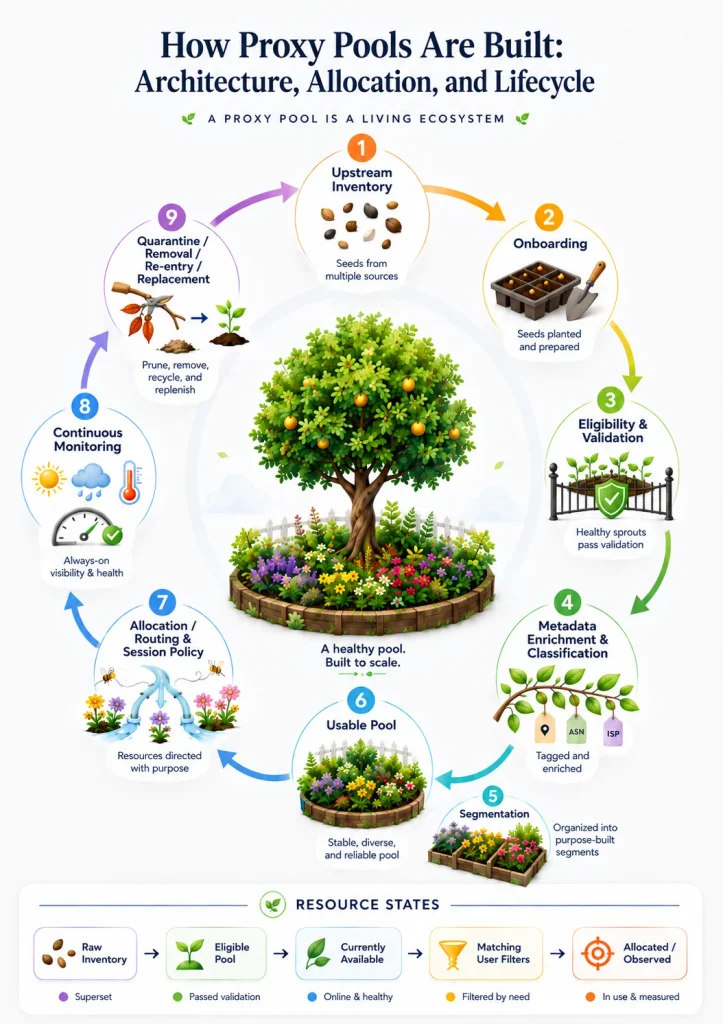
The Five Layers Between Inventory and Observation
The most useful way to understand a proxy pool is to separate five layers that are often collapsed into one headline number.
| Layer | Question it answers | Why it can differ from the previous layer |
| Raw Inventory | Which resources are known to or managed by the system? | Some resources may not yet be validated, classified, authorized, routable, or active. |
| Eligible Pool | Which resources currently satisfy the system’s inclusion rules? | Eligibility can depend on operational, policy, product, or metadata requirements. |
| Currently Available Resources | Which eligible resources can accept or carry traffic now? | Reachability, capacity, routing, peer state, or temporary exclusion can change. |
| Resources Matching User Filters | Which available resources satisfy this request’s geography, network, access, and session conditions? | Filters and permissions reduce the candidate set. |
| Allocated / Observed Resources | Which matching resources were actually assigned and seen during a finite test? | Allocation policy, sticky assignment, reuse, request count, and timing affect observation. |
The transitions do not imply that excluded resources are necessarily poor quality. A resource can be outside a user’s candidate set simply because it belongs to another country, network segment, access group, product, or session context.
A Conceptual Vendor-Neutral Proxy Pool Lifecycle
The following model is a conceptual vendor-neutral lifecycle:
Upstream Inventory → Onboarding → Eligibility & Validation → Metadata Enrichment & Classification → Segmentation → Usable Pool → Allocation / Routing & Session Policy → Continuous Monitoring → Quarantine / Removal / Re-entry / Replacement
It is not a description of Mango Proxy’s internal architecture, and it is not a claim that every provider uses the same sequence, terminology, tests, states, or algorithms. Some implementations combine stages, perform them in parallel, or use different control models.
1. Upstream Inventory
Before a resource can enter a managed pool, the system needs some form of upstream inventory. Depending on the proxy category and implementation, that inventory might represent address allocations, hosted proxy servers, available peers, external connections, or other proxy-capable resources.
Sourcing is only the upstream context here. The origin of residential supply, consent models, leasing relationships, and participant roles are separate subjects. For the underlying request path and residential-network context, see Residential Proxies Explained.
The important point is that presence in upstream inventory does not establish current usability. It only establishes that a resource may be considered for onboarding.
2. Onboarding
Onboarding is the process of introducing a resource into the provider’s or operator’s management system.
Depending on the implementation, this stage may include:
- creating or importing a resource record;
- associating the resource with a gateway, host, peer, or access group;
- attaching authentication or authorization information;
- recording expected protocol and routing properties;
- collecting initial network identity data;
- placing the resource into an unverified or limited state until checks are complete.
Onboarding does not have to be a separate visible workflow. A provider may combine it with validation, provisioning, or classification. The article uses it as a conceptual boundary between known inventory and resources that can be evaluated for use.
3. Eligibility and Validation
Eligibility answers a narrower question than ownership or availability:
Is this resource allowed and technically suitable to participate in a particular pool under the system’s current rules?
A system may consider multiple categories of evidence.
| Possible validation area | What it can establish | What it does not establish |
| Connectivity | The resource responds under the tested conditions | That it will remain reachable indefinitely |
| Protocol behavior | A required proxy protocol works in the tested setup | That every protocol or application is supported |
| Exit observation | Traffic exits through an expected public address or route | That the address will be accepted by every target website |
| Metadata completeness | Required fields are available from the selected sources | That all data providers classify the resource identically |
| Policy or access status | The resource is permitted for a defined pool or account | That it belongs in every product, group, or geography |
| Session compatibility | The resource can participate in a defined assignment model | That the assignment can never be interrupted |
These are possible categories, not a universal checklist. Providers can use different tests, thresholds, retry behavior, and state models. A basic connectivity check also should not be presented as a complete measurement of reputation, target acceptance, or long-term reliability.
4. Metadata Enrichment and Classification
A routing system needs more than a reachable resource if it intends to support filtering or segmentation. It may attach metadata such as:
- country, region, city, or postal area;
- IP prefix or network range;
- Autonomous System Number;
- registered organization or reported ISP;
- connection or network type;
- protocol capabilities;
- access or ownership model;
- internal operational state.
These fields can come from different source classes and should not be treated as equally authoritative.
Regional Internet Registries provide registration data for Internet number resources. For example, ARIN’s RDAP documentation describes lookups for IP networks and ASNs, while RIPE explains an Autonomous System as a group of IP networks operated under a defined routing policy.
Geolocation, ISP, and connection-type fields commonly depend on separate intelligence databases or provider-specific classification. MaxMind’s official documentation states that IP geolocation is inherently imprecise and provides separate country, city, ASN, ISP, and connection-type datasets. Its release notes also document ongoing classification and coverage changes. This means metadata should be treated as sourced, time-sensitive information rather than a permanent property known with identical precision by every system. MaxMind GeoIP documentation, MaxMind 2026 release notes.
An ASN is not the same thing as an ISP label, and neither one independently proves a residential, mobile, ISP-proxy, or datacenter classification. Network-type labels can depend on the classification source and its methodology.
5. Segmentation
Segmentation organizes eligible resources into candidate sets that can be selected efficiently under different requirements.
Possible segmentation dimensions include:
- proxy category or product;
- country or supported regional level;
- ASN, carrier, or reported ISP;
- IPv4 or IPv6;
- shared or dedicated access;
- supported protocol;
- current health or availability state;
- account permissions or routing group;
- session capability;
- internal policy restrictions.
A resource can potentially match several dimensions at once. Segmentation therefore does not have to mean copying the resource into separate physical lists. It can be implemented through metadata indexes, policies, groups, tags, or dynamically evaluated filters.
The exact dimensions and their combinations are provider-specific. A provider that offers country targeting does not automatically offer city, ASN, ISP, or ZIP targeting, and the presence of metadata does not automatically mean the field is exposed as a user-selectable filter.
6. The Usable Pool
The usable pool is the set of resources that have passed the relevant rules and can participate in allocation under some supported conditions.
It is better understood as a changing operational state than as a fixed database table. A resource can be:
- known but not yet eligible;
- eligible but temporarily unavailable;
- available globally but not available for a requested filter;
- available for new allocation but already assigned to a sticky session;
- removed from active selection while still retained in inventory;
- returned after a new validation event.
The usable pool may also differ by user, plan, product, location, or access group. Two customers connecting to the same provider do not necessarily receive candidates from an identical selection set.
7. Allocation, Routing, and Session Policy
Allocation occurs when the system selects a matching resource for a request, connection, or session.
A simplified decision path is:
- Receive a connection through a gateway or explicit endpoint.
- Identify the user’s access scope and requested filters.
- Find eligible and currently available matching resources.
- Apply the relevant rotation or persistence rule.
- Select and assign a resource.
- Route traffic and record the operational outcome as needed.
This sequence does not prescribe a specific algorithm. Selection might be random, weighted, sequential, least-recently-used, capacity-aware, policy-driven, or implemented through another method. No algorithm should be attributed to a provider without official confirmation.
Rotating Allocation
Rotating allocation allows different requests or sessions to receive different exit resources according to the provider’s rules. It does not universally mean that every request must produce a unique IP that has never appeared earlier in the test.
The candidate set may be narrow, the same resource may become eligible again, or the user’s configuration may preserve an assignment. The strategic question of when rotation is appropriate belongs to IP Rotation: How Often You Should Really Change Your Proxies.
Sticky or Persistent Assignment
A sticky or persistent session tells the proxy system to try to preserve an assignment across multiple connections or requests. It does not automatically preserve website cookies, a login state, a browser profile, or application memory. Those belong to different layers.
Persistence can also be conditional. If the assigned resource becomes unavailable or the provider’s session rules expire, the system may return an error, select another resource, or require a new assignment. The behavior must be verified in the relevant provider’s documentation.
Example of one implementation – not an industry-wide rule. Apify documents proxy groups, country parameters, health monitoring, and session IDs that keep the same IP across multiple connections. Bright Data documents selection from available proxies in a configured zone and separate session controls. These examples demonstrate that filters and sessions can affect allocation, but they do not define how Mango Proxy or every provider operates. Apify Proxy documentation, Bright Data rotation documentation.
8. Continuous Monitoring and Pool Churn
Monitoring is not the last one-time step in the lifecycle. It is a feedback loop that can update eligibility, availability, metadata, and routing decisions while the pool operates.
Depending on the system, monitoring may use:
- active connectivity or protocol checks;
- connection outcomes observed during normal traffic;
- route or peer availability signals;
- updated metadata;
- capacity or operational thresholds;
- policy, authorization, or product changes.
The frequency, targets, thresholds, and consequences of these signals vary. A check against one destination does not establish universal reachability, and a successful generic check does not prove that a specific target website will accept the resource.
Conceptually, a resource may move through states such as:
| State change | Possible interpretation |
| Available → temporarily excluded | The system has evidence that the resource should not receive new assignments under current conditions |
| Temporarily excluded → available | Revalidation or changed conditions permit the resource to return |
| Eligible → removed | The resource no longer satisfies an operational, policy, or access requirement |
| Removed → replaced | Another resource enters the relevant segment; it does not have to share the same identity or metadata |
Quarantine is a useful conceptual label for temporary exclusion, but it is not a claim that every provider implements or names such a state. Some systems may disable a resource immediately, keep it unavailable until another event, or use a different lifecycle entirely.
These changes create pool churn: the set of eligible or available resources changes over time. Churn is not inherently positive or negative. Without provider-specific methodology and workload context, its rate cannot be converted into a universal quality judgment.
Recommended future visual placement: after this section. The diagram should show Upstream Inventory → Eligibility & Metadata → Segmented Usable Pool → Allocation / Session, with a separate continuous monitoring loop returning to eligibility and lifecycle states. Caption: Vendor-neutral conceptual lifecycle; implementations vary.
Control Plane and Data Plane, in Simple Terms
Two short concepts help explain the architecture without turning the article into a networking textbook.
- Control plane: the logic and records used to decide which resources are eligible, how they are classified, which filters they match, and how they may be allocated.
- Data plane: the actual path used to carry a client’s traffic through the selected proxy resource to the destination and back.
Metadata enrichment and allocation policy belong mainly to the control plane. Forwarding the request belongs to the data plane. Operational outcomes from the data plane can feed new information back into the control plane.
This separation explains why a resource can exist in inventory but not carry traffic: the system knows about it, but current control rules do not permit or select it.
Advertised Pool Size vs What Is Usable Right Now
Pool-size claims are useful only when the counted unit and methodology are clear.
The same phrase can refer to very different measurements:
Advertised Inventory
↓
Eligible Right Now
↓
Available for the Requested Geography or Network
↓
Matching Current Targeting, Access, and Session Conditions
↓
Actually Observed During a Finite Test
Layer 1: Advertised Inventory
An advertised figure may describe resources known or observed across a reporting window, a global network, a product family, or another provider-defined scope. It should not automatically be read as the number of unique IPs simultaneously available to every customer.
The figure may still be valid for its stated methodology. The problem begins when the methodology is omitted from the comparison.
Layer 2: Eligible Right Now
Some advertised resources may not be eligible at the moment being examined. Possible reasons include onboarding status, failed validation, missing required metadata, access rules, maintenance, or another provider-specific condition.
This reduction does not by itself indicate poor quality. An eligibility system is expected to exclude resources that do not meet its current rules.
Layer 3: Available for the Requested Geography or Network
A global pool can contain resources across many countries and networks, while one request may ask for a single country, city, ASN, ISP, or network type. Only the available resources matching that dimension can enter the next candidate set.
The size of the subset depends on the requested filter and the provider’s actual support. It should not be inferred from the global headline number.
Layer 4: Matching Current Targeting, Access, and Session Conditions
Additional conditions can narrow the candidate set further:
- the user’s product or plan;
- shared or dedicated access;
- an assigned group or zone;
- required protocol;
- sticky-session state;
- account permissions;
- provider-specific routing or policy rules.
Some conditions select a broader candidate set. Others deliberately preserve one assignment and reduce observed diversity.
Layer 5: Actually Observed During a Finite Test
A finite test samples allocation outcomes; it does not enumerate the full candidate set unless the system explicitly provides such a function and the test is designed for it.
The observer may see only a subset because:
- the test sends a limited number of requests;
- sticky assignment intentionally reuses one resource;
- the filters define a narrow segment;
- the allocator can legally select the same resource again;
- availability changes during the test;
- the user does not have access to every provider segment;
- the test records exit IPs but not distinct proxy endpoints or peers;
- some resources never happen to be selected during the observation window.
A small observed set proves only what appeared under those specific conditions. It does not, by itself, prove the total size of the provider’s inventory, an undisclosed availability percentage, or poor network quality.
How to Compare Pool-Size Claims Correctly
Before comparing two figures, verify:
- Measurement window: Is the figure instantaneous, daily, monthly, rolling, or cumulative?
- Uniqueness rules: What counts as one unique resource, and how are repeated observations handled?
- Eligibility definition: Must a resource pass a current check to be counted?
- Geographic scope: Is the figure global, regional, country-specific, or tied to another location level?
- Current availability: Does the metric represent known inventory or resources available for allocation now?
- Access scope: Is the same set available to every user, product, plan, group, and protocol?
- Methodology: Can the provider explain how the figure is collected, refreshed, deduplicated, and reported?
If these definitions differ, the numbers are not directly comparable. This does not mean either figure is false. It means they answer different measurement questions.
What Pool Membership Does Not Prove
Being present in the same proxy pool does not mean that all resources have identical:
- reachability from every location;
- latency or capacity;
- metadata across intelligence databases;
- IP or network history;
- target-specific treatment;
- availability at a future moment;
- suitability for every session or workload.
Operational health and external trust are also different concepts. A proxy can successfully carry a test request and still receive a challenge or restriction from a particular target. The broader distinction is covered in How IP Reputation Works.
Residential classification is not a guarantee that two IPs will receive identical target responses. Individual address history, prefix and ASN context, data-source differences, and target-specific observations can still matter. See Why Websites Trust Some Residential IPs More Than Others for that separate diagnostic question.
The pool-management layer decides which resources can be offered under its own operational rules. It does not reveal a target website’s private decision process or create a universal trust score.
Practical Examples
Example 1: A Large Global Pool Produces a Small Observed Set
Assume a provider reports a large global inventory. A user then applies:
- one country filter;
- one network or ASN requirement;
- a product-specific access scope;
- sticky-session assignment;
- a short test window.
The relevant path becomes:
Global Inventory → Eligible Resources → Available Country/Network Segment → User-Accessible Candidates → Sticky Assignment → Observed Exit IP
Seeing a limited set in this test is expected. The result does not establish how many resources exist globally, how many match another country, or how many would appear without the sticky condition.
The valid conclusion is:
This test observed these resources under this configuration and during this time window.
The invalid conclusion is:
The provider’s entire pool contains only the resources seen in this test.
Example 2: A Resource Leaves and Later Returns to the Usable Pool
Consider a resource that has completed onboarding, passed the relevant checks, received metadata, and entered an eligible segment.
Later, the management system receives evidence that the resource should not receive new assignments. Under one possible implementation, it may be temporarily excluded. If a later validation succeeds and policy still permits its use, it may re-enter the usable pool. Another implementation might remove it and wait for a replacement instead.
The example demonstrates a state transition, not a universal provider workflow. No particular health-check interval, retry count, quarantine duration, or replacement algorithm can be inferred from it.
Evaluate the Pool You Can Actually Use
Before comparing proxy networks, ask for the definition behind the headline number. Confirm the measurement window, counted unit, eligibility rule, geography, access scope, and current-availability methodology.
Then test the configuration your authorized workload will actually use. A representative test answers a more useful question than a global number alone: which resources can this setup allocate under these filters, session rules, and conditions?
Final Thoughts
A proxy pool is best understood as a continuously managed selection system. Raw inventory, eligible resources, current availability, filtered candidates, and observed allocations are separate layers, even when they are described by one word: pool.
This model explains why a user can observe only part of a large network without proving that the rest is missing or unusable. It also explains why an advertised figure cannot be interpreted correctly without its methodology.
The useful question is not only, “How many IPs are in the pool?” It is, “What is being counted, under which rules, during which period, and which part of that inventory can this workload actually reach?”g several variables at once, and choose the next useful test without treating rotation as a guaranteed reset.
Glossary
Proxy Pool
A managed set of proxy-capable resources eligible for selection under defined rules. This is a working definition for this article, not a universal standard.
Raw Inventory
Resources known to or managed by a system before all relevant eligibility and availability decisions are applied.
Eligible Pool
Resources that currently satisfy the inclusion rules for at least one supported allocation context.
Usable Pool
The operational set of eligible resources that can participate in allocation under supported conditions.
Currently Available Resource
An eligible resource that can accept or carry traffic at the relevant moment under the system’s rules.
Proxy Gateway
A connection point that accepts client traffic and can route it through one of multiple proxy resources.
Endpoint
The connection address or interface used by a client. It may identify one proxy or provide access to a gateway-backed pool.
Exit Node / Peer
A provider-specific term for the resource that carries traffic outward toward the destination.
Metadata Enrichment
Attaching sourced network, geographic, operational, or access information to a resource record.
Segmentation
Organizing or filtering resources by attributes such as geography, ASN, network type, protocol, access model, or state.
Allocation
Selecting and assigning a matching resource to a request, connection, or session.
Rotating Allocation
An assignment model that can select different resources for different requests or sessions according to provider rules.
Sticky Session
A provider-side assignment context intended to preserve the same proxy resource across multiple connections or requests under defined conditions.
Health State
An implementation-specific representation of whether a resource is currently suitable for allocation under selected operational checks.
Quarantine
A conceptual temporary-exclusion state. Providers may use another term or no comparable state.
Pool Churn
Change in the pool’s eligible or available membership over time.
Control Plane
The records and logic used to classify resources and make eligibility, policy, and allocation decisions.
Data Plane
The path that carries actual traffic through the selected proxy resource.
Frequently asked questions
Here we answered the most frequently asked questions.
Is a proxy pool just a list of IP addresses?
Not necessarily. A simple client-managed pool can be a list, but a provider-managed pool may include gateways, proxy servers, exit peers, metadata, eligibility states, filters, access rules, and session assignments. An IP address is only one possible identifier within that system.
Is there one strict industry definition of a proxy pool?
No single protocol specification defines a universal commercial proxy-pool architecture. The term is used operationally, and its exact meaning depends on the provider or software. Any article or provider claim should therefore define what the pool contains and how it is measured.
Does advertised pool size mean every IP is online at the same time?
Not automatically. A figure may describe inventory observed across a reporting window, global resources, eligible resources, or another provider-defined scope. Simultaneous availability should not be inferred unless the methodology explicitly supports that interpretation.
Why do I see fewer IPs than the advertised pool size?
Your filters, access scope, session settings, request count, test duration, current availability, and the allocation policy can all narrow what you observe. A finite test normally samples allocation outcomes rather than enumerating an entire global pool.
Does rotating allocation guarantee a different IP for every request?
No universal guarantee can be inferred from the word rotating. The same resource may be selected again, filters may produce a narrow candidate set, or session configuration may preserve an assignment. The exact behavior must be confirmed in the provider’s documentation.
What is the difference between rotation and a sticky session?
Rotation allows assignment to change according to the provider’s policy. A sticky session asks the proxy system to preserve one assignment under defined conditions. It does not automatically preserve website cookies, browser state, an account login, or application memory.
Does a healthy proxy have good IP reputation?
Not necessarily. Health usually describes whether the resource passes selected operational checks. Reputation and target-specific treatment depend on different data and observations. A working proxy can still be restricted by a particular website.
Do all proxy providers quarantine unhealthy resources?
No. Quarantine is a conceptual term in this article. A provider may temporarily exclude, disable, remove, retry, or immediately replace a resource, or use another state model entirely.
How should I compare two proxy pool sizes?
Compare the measurement window, uniqueness rules, counted resource type, eligibility definition, geography, current availability, access scope, and published methodology. If those fields differ or are missing, the two headline numbers are not directly comparable.