
Why Websites Trust Some Residential IPs More Than Others
Published: ≈ 20 min read
Quick Answer
Websites can treat two residential IPs differently because residential is a network classification, not a universal trust certificate.
Two addresses in the same category may have different individual histories, belong to different prefixes or ASNs, appear differently across public data sources, or have different histories with a particular target website. The current endpoint, session, and request context may also affect the final response.
In this article, residential IP trust variance means differences in how a specific target website responds to residential IPs because of address history, network context, target-specific observations, and the current request context.
This is a working analytical phrase for this article. It is not a universal or generally accepted industry term.
Key Takeaways
- Residential classification identifies a type of network context. It does not guarantee trust.
- Individual residential IPs can have different observed histories.
- A target may evaluate an individual IP, a prefix or subnet, and the wider ASN differently.
- Public reputation services and target websites do not necessarily use the same data.
- A clean public check does not prove that every website will accept an IP.
- Some public IPv4 addresses can be shared or reassigned, but this does not apply to every residential IP.
- A controlled comparison can help isolate the IP/network layer, but it cannot reveal a target’s exact internal decision.
- One successful request does not prove good reputation, and one block does not prove bad reputation.
Residential Classification Is a Category, Not a Verdict
A residential classification generally describes the network context associated with an IP address. It does not describe every event previously associated with that address or predict how every website will respond.
For the underlying residential proxy architecture, see Residential Proxies Explained.
The distinction can be summarized as follows:
| Residential classification may indicate | It does not establish |
| The IP’s apparent network type | Universal website trust |
| An associated ISP or organization | A permanently positive history |
| The IP’s approximate location | Acceptance by a specific target |
| The ASN announcing the address | Absence from every private dataset |
| How one database currently categorizes the address | Identical classification by other databases |
| That the address is not classified as datacenter by that source | Consistency of the browser, session, account, or request |
A residential label is therefore one piece of available network information. It is not the same as IP reputation, and neither concept should be treated as a permanent global verdict.
The broader reputation model is covered separately in How IP Reputation Works. This article focuses only on why residential IPs can produce different outcomes.
Why Two Residential IPs Can Receive Different Results
1. Their Individual IP Histories May Differ
Reputation datasets can associate observations with an individual IP address.
Depending on the system, those observations may include:
- previously detected suspicious activity;
- abuse reports;
- unusual traffic volume;
- repeated automated interactions;
- association with a known network service;
- the time at which the activity was observed.
Spamhaus describes IP reputation as an assessment based on information about the “who, what, where, and when” of an IP or range. This is one example of how a reputation provider can organize its observations, not a universal formula used by all websites. Spamhaus IP reputation documentation.
MaxMind provides another vendor-specific example. Its documentation distinguishes a historical IP risk snapshot from a responsive score based on current activity seen across its network and customer data. MaxMind minFraud release notes.
This means two residential IPs can share the same general classification while carrying different observations in a particular data system.
It does not mean that every website has access to those observations or interprets them identically.
2. Their Prefix or Subnet Context May Differ
An individual IP belongs to a larger address range. A security or reputation system may have information about that wider range even when it has little information about one specific address.
For example, a target could treat:
- one individual IP;
- a small network prefix;
- a wider subnet;
- an organization’s address range;
as separate or related decision levels.
A target might apply additional review to a range associated with repeated unwanted activity. Another target might avoid range-level conclusions to reduce false positives.
Therefore:
- an IP is not automatically untrusted because another address in the range caused a problem;
- a clean result for one IP does not validate every address in the range;
- range-level treatment depends on the target’s data and policy.
The exact size of a relevant range and the weight assigned to it are normally not visible from outside the target’s system.
3. Their ASN and Network Context May Differ
Two addresses can both be residential while belonging to different networks.
The ASN provides information about the network announcing the address and controlling its routing policy. A target may use ASN information as part of its access rules or risk evaluation.
For the technical background, see What Is ASN and Why It Matters.
Cloudflare, for example, allows site operators to allow, block, or challenge requests using IP address, ASN, or country conditions. This proves that a specific platform supports decisions at several network levels. It does not prove that all websites use ASN rules or assign the same meaning to a particular ASN. Cloudflare IP Access rules.
Two residential IPs can therefore differ because:
- they belong to different ASNs;
- their ASNs represent different network environments;
- one target has more observations for one network;
- the target applies a network-specific rule;
- an external data provider classifies their networks differently.
This does not justify calling one ISP or ASN universally more trusted than another.
4. Public Data Sources Can Disagree
There is no single database that defines residential IP trust for the entire web.
Different data providers may have different:
- collection methods;
- classification rules;
- update schedules;
- observation periods;
- risk models;
- customer data;
- network coverage;
- confidence levels.
One source may classify an address as residential while another sees an anonymous network, proxy service, or unknown connection type. A third source may have no record for it.
Data can also change. MaxMind, for example, documents fields for residential proxy classification confidence and the last date on which a network was observed in its analysis. These are specific MaxMind fields, but they illustrate that classification can have both confidence and freshness dimensions. MaxMind 2026 release notes.
A difference between databases does not automatically tell you which source matches a particular target’s decision.
5. Targets Can Have Their Own Observations
Public reputation data is not the same as a target website’s first-party data.
A target can record what it has observed on its own:
- previous requests from an IP;
- outcomes associated with a protected endpoint;
- session or account events;
- request volume;
- prior challenges;
- security rules applied to the address or network.
A target may combine this first-party information with an external reputation feed, or it may rely primarily on its own rules.
Google reCAPTCHA, for example, returns an assessment for each request based on interactions with the protected site. The site must interpret the result and choose an appropriate action. This is an example of a request-level, site-controlled process, not evidence that all targets use Google or evaluate requests identically. Google reCAPTCHA assessment documentation.
This distinction explains how an IP can:
- show no obvious public problem;
- work normally on several websites;
- still receive additional verification or restrictions from one target.
The relationship between individual signals and the final decision is covered in Risk Scoring Systems Explained.
6. Some Addresses Can Be Shared or Reassigned
Not every residential IP represents one permanent user.
Carrier-Grade NAT can allow multiple subscribers to share a public IPv4 address. RFC 6888 describes this model and defines a CGN as a function used to share the same IPv4 address among several subscribers.
Residential addresses can also be assigned dynamically. Under RFC 2131, DHCP dynamic allocation assigns an address for a limited period and permits an address that is no longer needed to be reused.
These standards support two limited conclusions:
- some public residential IPs may represent activity from multiple subscribers;
- some dynamically allocated addresses may be used by different clients at different times.
It is reasonable to infer that observations attached only to a public address might not always describe the current user. However, the standards do not prove that every residential IP is shared, dynamically reassigned, or affected by someone else’s activity.
The correct wording is therefore:
Shared or reassigned address context can contribute to differences between residential IPs, but it must not be assumed for every address.
7. The Current Request Still Matters
An IP is only one part of a request reaching a target.
Even when comparing two residential IPs, the outcome can be affected by whether the requests use equivalent:
- endpoints;
- authorization conditions;
- sessions;
- cookies;
- accounts;
- clients;
- timing;
- request sequences.
This does not make the IP irrelevant. It means that a difference in results cannot be attributed to the IP unless the other relevant conditions are controlled.
For example:
- IP A might be tested on a public page;
- IP B might be tested on a protected login endpoint;
- only IP B receives a challenge.
That result does not establish that IP B is less trusted because the test conditions were different.
Public Reputation Data vs First-Party Target Observations
| Public reputation or network data | First-party target observations |
| Collected by an external provider | Collected by the target or its security platform |
| Can include IP classification, ASN, history, risk indicators, or listings | Can include requests, sessions, accounts, endpoints, challenges, and previous outcomes |
| May cover activity across multiple customers or networks | Represents the target’s own traffic and policies |
| Uses the provider’s update schedule | Can change as new target interactions occur |
| May not include recent target-specific events | Can include events unavailable to public services |
| Does not reveal the target’s private rules | Can directly influence target-specific actions |
A target may use either category or combine them. An outside observer normally cannot confirm the exact source, weight, or rule responsible for a decision.
Why a Clean Public Check Does Not Prove Universal Trust
A public check can provide useful evidence, but only within its documented scope.
| Public result | What it may establish | What it does not establish |
| IP is not present on one blacklist | That source has no matching active listing | The IP is absent from every private or public dataset |
| IP is classified as residential | That database currently associates it with a residential network | Every target agrees with the classification |
| ASN and ISP are identified | The database associates the IP with that network | The target considers the network trusted |
| Location matches expectations | The database reports the expected geographic context | The complete request is internally consistent |
| No risk indicator is returned | The service did not return that indicator | The IP has a universally positive history |
| A test request succeeds | The request succeeded under those conditions | Future requests or other targets will return the same result |
A missing listing is neutral evidence. It is not a positive certification.
This matters because public services can differ in purpose. A blocklist may focus on spam or malicious infrastructure, while a fraud platform may assess transaction risk and a target website may apply its own WAF rules.
No single result represents a universal website trust score.
Controlled Comparison of Two Residential IPs
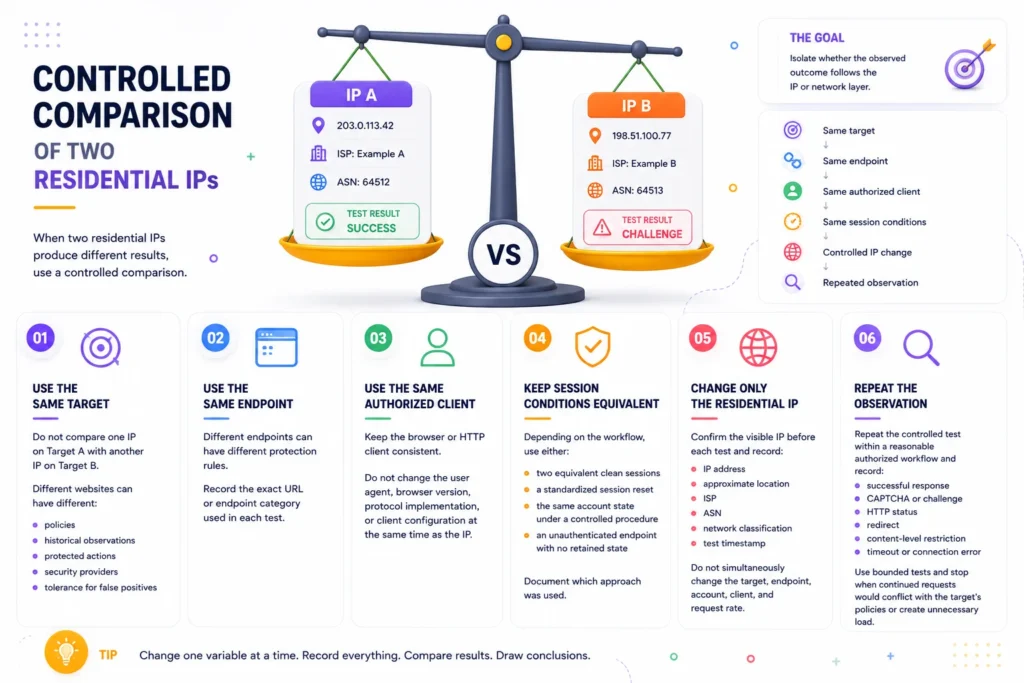
When two residential IPs produce different results, use a controlled comparison:
Same target → same endpoint → same authorized client → same session conditions → controlled IP change → repeated observation
The purpose is to isolate whether the observed outcome follows the IP or network layer.
Step 1: Use the Same Target
Do not compare one IP on Target A with another IP on Target B.
Different websites can have different:
- policies;
- historical observations;
- protected actions;
- security providers;
- tolerance for false positives.
Step 2: Use the Same Endpoint
A public content page, login form, search endpoint, checkout process, and API can have different protection rules.
Record the exact URL or endpoint category used in each test.
Step 3: Use the Same Authorized Client
Keep the browser or HTTP client consistent.
Do not change the user agent, browser version, protocol implementation, or client configuration at the same time as the IP.
Otherwise, the result cannot be attributed to one layer.
Step 4: Keep Session Conditions Equivalent
“Same session conditions” does not always mean reusing one live session after changing its IP.
A mid-session IP change can itself alter the result. Depending on the authorized workflow, use either:
- two equivalent clean sessions;
- a standardized session reset;
- the same account state under a controlled procedure;
- an unauthenticated endpoint with no retained state.
Document which approach was used.
Step 5: Change Only the Residential IP
Confirm the visible IP before each test and record:
- IP address;
- approximate location;
- ISP;
- ASN;
- network classification;
- test timestamp.
Do not simultaneously change the target, endpoint, account, client, and request rate.
Step 6: Repeat the Observation
One request is not sufficient to assign a lasting label.
Repeat the controlled test within a reasonable authorized workflow and record:
- successful response;
- CAPTCHA or challenge;
- HTTP status;
- redirect;
- content-level restriction;
- timeout or connection error.
Use bounded tests and stop when continued requests would conflict with the target’s policies or create unnecessary load.
What the Comparison Can Show
A controlled comparison can provide evidence that:
- the outcome consistently follows one IP;
- the outcome follows a wider network context;
- the result does not change when the IP changes;
- the result varies too much to support a conclusion;
- the difference is specific to one target or endpoint.
What the Comparison Cannot Show
It cannot directly reveal:
- the target’s private reputation score;
- the exact dataset used;
- the weight assigned to the IP;
- whether the decisive level was IP, prefix, ASN, or another rule;
- the precise internal reason for a challenge or block;
- whether the result will remain unchanged.
The test helps localize the IP/network layer. It does not expose the target website’s internal decision system.
Interpreting the Results
| Controlled result | Supported interpretation | Unsupported conclusion |
| IP A repeatedly succeeds and IP B repeatedly fails under matched conditions | The IP/network difference may be contributing to the outcome | IP B has universally bad reputation |
| Both IPs fail under matched conditions | The problem may not be limited to one IP | Both residential IPs are permanently untrusted |
| Both IPs succeed | Both worked under the tested conditions | Both will work for every target |
| Results change between repetitions | Evidence is insufficient or the decision is time-dependent | The test proves random blocking |
| IP A works on one target but not another | Trust is target-specific | The IP’s public reputation changed instantly |
| Changing the IP does not change the result | Another layer may be contributing | Residential proxies do not work |
| Outcome follows the account or session rather than the IP | Network reputation may not be the primary factor | The IP has no influence in any other workflow |
If the problem persists across several controlled IP changes, use the broader diagnostic process in Why Clean Proxies Still Get Blocked.
Common Comparison Mistakes
Treating One Request as a Reputation Test
A single result can reflect temporary conditions, endpoint policy, session state, or rate limiting. It is not enough to define the IP’s general reputation.
Comparing Different Targets
A residential IP can be accepted by one target and challenged by another. Combining these outcomes into one trust label hides the target-specific nature of the decision.
Changing Several Variables at Once
If the IP, browser, account, cookies, location, and timing all change, the result does not identify which difference mattered.
Treating a Public Database as the Target’s Database
A public service and a target may have completely different data and objectives.
Ranking Entire Countries, ISPs, or ASNs
A test involving a few addresses does not justify a universal ranking of a country, provider, or network.
Assuming Every Address Is Shared or Reassigned
CGNAT and dynamic allocation exist, but they do not describe every residential connection.
Production Tips for Repeatable IP Comparison
For authorized production diagnostics:
- Assign a test ID to every comparison.
- Record the exact target and endpoint.
- Store the visible IP, ISP, ASN, location, timestamp, and network classification.
- Keep client and session conditions documented.
- Change one controlled variable at a time.
- Separate connection failures, HTTP restrictions, challenges, and application-level responses.
- Use bounded retries.
- Do not automatically replace an IP after one failed request.
- Report results by target and endpoint, not as a universal IP quality score.
- Recheck conclusions when the target, IP assignment, network data, or workflow changes.
- Do not publish internal test results as product guarantees.
For measurement principles, see Proxy Success Rate Explained.
Practical Examples
Example 1: Two Residential IPs from the Same ASN Produce Different Results
Observed result: IP A succeeds repeatedly while IP B receives a challenge. Both are classified as residential and belong to the same ASN.
Controlled comparison: The target, endpoint, authorized client, session conditions, and request timing remain equivalent.
Possible interpretation: An individual IP-level observation may be contributing to the difference. Another possibility is a smaller prefix-level rule that does not affect the entire ASN.
What cannot be concluded: The result does not prove that IP B has universally bad reputation or that the ASN is untrusted.
Example 2: Two Public Databases Report Different Classifications
Observed result: One source labels an IP residential while another identifies it as an anonymous network or returns no classification.
Verification: Record the source, result, check time, ASN, ISP, and any available confidence or last-seen information.
Possible interpretation: The providers may use different datasets, definitions, coverage, or update schedules.
What cannot be concluded: One result does not automatically prove that the other provider is wrong or reveal which data the target uses.
Example 3: Both IPs Look Clean Publicly, but One Target Challenges IP B
Observed result: Neither IP has an obvious public listing, but the same target repeatedly challenges IP B under matched conditions.
Possible interpretation: The target may have first-party history, a private data source, or a network-level rule unavailable in the public checks.
What cannot be concluded: The challenge alone does not reveal the exact rule or prove permanent reputation damage.
Example 4: The Result Follows the Session, Not the IP
Observed result: An existing session remains challenged after changing from IP A to IP B. Two equivalent clean sessions succeed through both IPs.
Possible interpretation: The existing session or account context may be contributing more strongly than the network change.
What cannot be concluded: The test does not prove that both IPs have universally strong reputation.
Inspect the Network Metadata You Can Verify
Before describing one residential IP as more trusted than another, compare the network information that is actually available.
Check the IP with MangoProxy IP Lookup to view its reported location, ISP, ASN, and network type.
IP Lookup provides network and geolocation metadata. It does not reveal a target website’s private trust score, historical observations, or final access rules.
Glossary
Residential IP
An IP address associated with a residential or consumer network according to the relevant network data source.
Residential classification
A database or system’s current categorization of an IP as belonging to residential network infrastructure.
Residential IP trust variance
A working phrase used in this article for differences in target responses to residential IPs caused by address history, network context, target observations, and current request conditions. It is not an established universal industry term.
Individual IP history
Observations associated with one IP address over time by a specific data provider or target.
Prefix or subnet
A group of IP addresses represented and managed as part of a wider network range.
ASN
An Autonomous System Number identifying a network with its own routing policy.
Public reputation data
Risk indicators, classifications, or listings available through an external reputation or network intelligence service.
First-party target observations
Information collected from requests and events seen directly by a particular website or its security system.
Carrier-Grade NAT
A network architecture in which several subscribers can share a public IPv4 address.
Dynamic IP allocation
Assignment of an IP address for a limited period, after which the address may be reused.
Controlled comparison
A test that changes one selected variable while keeping other relevant conditions equivalent.
Final Thoughts
Two residential IPs can look similar in a basic lookup and still receive different responses from the same website. Residential classification describes network context, but it does not erase individual history, network-level information, data-source differences, or target-specific observations.
The useful question is not whether an IP is universally trusted. Such a universal verdict is generally unavailable. The practical question is whether the outcome consistently follows the IP or network layer under controlled, authorized conditions.
A controlled comparison can provide evidence about that relationship. It cannot expose a private rule, reputation score, or exact internal reason. Conclusions should therefore remain target-specific, time-specific, and limited to the conditions actually tested.
Sources Used
All sources were checked on 19 August 2026.
| Source | Purpose |
| Spamhaus – IP Reputation Data | Definition and scope of reputation data for an IP or range |
| MaxMind minFraud 2025 Release Notes | Historical IP risk snapshot versus responsive risk data |
| MaxMind minFraud 2026 Release Notes | Residential proxy classification confidence and last-seen fields |
| MaxMind minFraud API Responses | IP-level risk and documented risk reasons |
| RFC 6888 | Public IPv4 sharing through Carrier-Grade NAT |
| RFC 2131 | Dynamic allocation, limited leases, and reuse of IP addresses |
| Cloudflare IP Access Rules | Example of IP-, ASN-, and country-level target rules |
| Google reCAPTCHA Assessments | Example of request-level risk assessment interpreted by a target |
| MangoProxy IP Lookup page | Confirmed Tool capabilities |
Vendor documentation is used only to demonstrate specific supported architectures. It is not presented as a universal description of all websites.endor-specific behavior is identified as an example, not presented as universal implementation.
Frequently asked questions
Here we answered the most frequently asked questions.
Are all residential IPs equally trusted?
No. Residential IPs can differ in individual history, prefix or subnet context, ASN, classification across data sources, and previous observations held by a particular target.
Does residential classification guarantee good IP reputation?
No. It identifies a network category according to a particular data source. It does not certify the IP’s history or guarantee acceptance by a website.
Can two residential IPs from the same ASN receive different results?
Yes. A target may have different observations for the individual addresses or apply rules at a smaller network range. The current request conditions may also differ.
Can different websites treat the same residential IP differently?
Yes. Websites can use different data providers, first-party histories, rules, thresholds, and protected endpoints.
Does the absence of an IP from a public blacklist prove that it is trusted?
No. It only means that the IP was not found in that source under the conditions of the check. Private data, other public sources, or target-specific observations may differ.
Can a residential IP be reassigned to another user?
Some networks use dynamic allocation that permits addresses to be reused after a lease or assignment ends. This does not mean every residential address is dynamically reassigned.
Does one block prove that an IP has bad reputation?
No. A block is an observed outcome, not a complete diagnosis. The endpoint, target policy, session, account, request, and network context must be considered.
Does one successful request prove that an IP has good reputation?
No. It proves only that the request succeeded under the tested conditions.
How should two residential IPs be compared?
Use the same target, endpoint, authorized client, and equivalent session conditions. Change only the IP and repeat the observation. Record the network metadata and exact response.
Can a controlled comparison reveal why a website made its decision?
It can help determine whether the result follows the IP or network layer. It cannot reveal the target’s exact dataset, rule, threshold, or internal reason.