
IP Leasing Explained: How IPv4 Address Leasing Works
Quick Answer
IP leasing is a time-limited commercial arrangement that allows an organization to use public IP address space without permanently changing the organization recognized as the resource holder by the applicable Internet registry.
The lease can provide contractual usage rights, but those rights are only one part of the operational picture. The organization visible in registry records, the party authorized to use the addresses, the ASN authorized to originate the prefix, the network routing it, the company hosting the infrastructure, and the service using the addresses can all be different entities.
A useful conceptual model is:
Internet Number Resource → RIR-Recognized Holder / Authorized Party → Time-Limited Usage Relationship → Routing Authorization → Network Operation → Service Using the Address Space
This is a conceptual vendor-neutral model, not a universal sequence. Real arrangements vary by contract, resource status, Regional Internet Registry, routing model, and service provider.
Most importantly:
Registration ≠ Property Ownership ≠ Usage Rights ≠ Routing Authorization ≠ Routing ≠ Hosting ≠ Service Operation
Key Takeaways
- Commercial IP leasing and a DHCP lease are different concepts.
- IP leasing usually grants time-limited usage rights without an RIR-recognized transfer of the resource.
- Owner is often imprecise terminology for Internet number resources; registered holder or RIR-recognized holder is usually safer.
- Registry records do not independently reveal who physically hosts or operates a service.
- Leasing a prefix does not automatically change its origin ASN.
- BGP distributes reachability information, not commercial rights.
- An LOA can document authorization, but it does not transfer registration rights.
- A Route Origin Authorization identifies an ASN permitted to originate a prefix within RPKI; it does not prove that a lease exists.
- A new lease does not create a new IP history or guarantee good reputation.
- When a lease ends, routes, authorization records, DNS, databases, and services may need to be updated or renumbered.
Commercial IP Leasing Is Not a DHCP Lease
The word lease is used in two very different networking contexts.
| Term | What Is Temporarily Provided? | Relationship | Main Purpose |
| Commercial IP leasing | Contractual rights to use public address space, usually a prefix or block | Organization-to-organization commercial arrangement | Provide time-limited public address capacity |
| DHCP lease | An IP address and configuration parameters assigned to a device or network interface | DHCP server-to-client protocol process | Configure a device and manage address reuse inside a network |
Under DHCP, a server can assign an address to a client for a limited period and later reuse that address. RFC 2131 defines this as part of the Dynamic Host Configuration Protocol.
Commercial IP leasing operates at another layer. It concerns which organization may use public address space under an agreement and how that space can be registered, authorized, routed, and operated.
A company can commercially lease a public IPv4 prefix and then use DHCP inside its own network. These are separate relationships even if both involve the word lease.
What Is IP Leasing?
For this article:
IP leasing is a time-limited commercial arrangement that permits an organization to use public IP address space without necessarily changing the RIR-recognized holder of the underlying Internet number resource.
This is a working definition, not a globally standardized RIR policy term.
For example, ARIN explains that IPv4 leasing can provide access to addresses without giving the lessee permanent registration rights or automatically providing network autonomy. When the lease ends, the lessor may require the lessee to stop using and return the addresses. ARIN on IPv4 address leasing
The resource involved is usually an IP prefix: a contiguous address range written in CIDR notation, such as a /24. The commercial agreement concerns the right to use that address space under defined conditions. It does not turn the numerical addresses into physical equipment or automatically transfer every registry, routing, and operational relationship associated with them.
Is Leasing the Same as Owning IP Addresses?
Not precisely.
Commercial markets commonly use words such as buy, sell, and own as shorthand. Internet registry systems, however, describe relationships through terms such as:
- allocation;
- assignment;
- delegation;
- registration;
- recognized holder;
- transfer;
- contractual usage rights.
APNIC, for example, describes address space as being delegated to account holders through assignments or allocations. RIPE NCC’s RPKI terms state that using a resource certificate does not support a claim of ownership over Internet number resources. APNIC Internet Number Resource Policies, RIPE NCC Certification Terms
Legal characterization may also depend on jurisdiction, contract, resource status, and regional policy. For that reason, this article uses registered holder, RIR-recognized holder, registration rights, and right to use instead of treating IP addresses like ordinary physical property.
Why Organizations Lease IPv4 Address Space
Organizations may need public IPv4 capacity without seeking a permanent RIR-recognized transfer.
Possible reasons include:
- temporary infrastructure capacity;
- short- or medium-term projects;
- service migration;
- network expansion;
- hosting new systems;
- supporting customer services;
- deploying infrastructure in another network or region;
- obtaining additional addresses while longer-term plans are evaluated;
- avoiding a permanent resource commitment for a temporary requirement.
Public IPv4 capacity is limited, but IPv4 exhaustion should remain background context here. The history of IPv4 depletion, regional free-pool policies, transfer-market pricing, and the transition to IPv6 are separate topics.
Leasing is also not automatically the cheapest or fastest choice. Costs, prefix sizes, setup periods, documentation, renewal terms, and routing services are changing commercial data. They must be compared using current offers and the actual scope of each arrangement.
The Organizations Behind One Leased Prefix
The clearest way to understand IP leasing is to ask several separate questions.
| Role | Question | What It Does Not Automatically Prove |
| Registered To | Which organization is recognized in the applicable registry relationship? | Who physically hosts the service |
| Authorized For Use By | Which organization has contractual or delegated permission to use the address space? | Which ASN announces it |
| Authorized To Originate By | Which ASN is authorized through the relevant routing-authority mechanism to originate the prefix? | That a commercial lease exists |
| Routed By | Which network announces or carries reachability for the prefix? | Who holds registration rights |
| Hosted By | Which company provides the server, datacenter, or other physical infrastructure? | Which party controls the registry relationship |
| Used By | Which organization operates a service using the addresses? | That it can transfer or re-lease the resource |
These roles can belong to one organization, but they do not have to.
For example, one entity may remain the RIR-recognized holder, a second may receive contractual usage rights, a third may provide transit, and a fourth may host the service. A customer-facing brand may operate the final service without appearing as the original resource holder.
This does not make the arrangement improper by itself. It means that each source answers a different question.
Recommended future visual placement: after this section. Show RIR-Recognized Holder → Usage / Lease Relationship → Routing Authorization → Network / Hosting Operator → Service Using the IP Space, with the message: These can be different organizations.
Resource Holder, Lessor, and Lessee
These roles are related but not identical.
Resource Holder
The resource holder is the organization recognized through the applicable registry or contractual resource-management system as holding the address-space registration or delegation.
The precise term can vary depending on the RIR, resource type, and whether the address space is legacy, provider-independent, or received from an upstream organization.
Lessor
The lessor grants time-limited usage rights under the commercial agreement.
The lessor may be the RIR-recognized holder, an authorized supplier, or another party permitted to provide the service under the relevant relationship. The article should not assume that every marketplace, broker, or reseller is itself the registered holder.
Lessee
The lessee receives the right to use the address space for the agreed period and purposes.
The lessee may operate its own network, use an upstream provider, purchase a managed announcement, or receive the addresses as part of a hosting service. Receiving usage rights does not automatically grant authority to transfer the resource or modify every registry and routing record.
Allocation, Assignment, Transfer, and Lease
These terms must not be collapsed into a single idea.
| Term | General Meaning | Does the RIR-Recognized Holder Necessarily Change? |
| Allocation | A registry-policy delegation, often to an organization that can make further downstream delegations | Not applicable as a commercial lease comparison |
| Assignment | Address space provided for use by an organization or end site under a specific policy model | Not necessarily |
| Reallocation | A downstream delegation for further distribution, where the applicable RIR uses this term | Not necessarily |
| Reassignment | A downstream delegation to a customer or end user under a region-specific policy model | Not necessarily |
| Transfer | An RIR-recognized change in resource holdership or registration under applicable policy | Yes, when completed as a recognized transfer |
| Lease | A time-limited commercial permission to use address space | Usually not, but records can vary |
These are general distinctions, not globally interchangeable definitions.
ARIN’s current policy manual, for example, uses Allocation, Reallocation, and Reassignment, while noting that Assignment is no longer used to describe IP addresses issued directly by ARIN. APNIC continues to distinguish assignments for an organization’s own infrastructure from allocations intended for further customer delegation. ARIN Number Resource Policy Manual
This difference illustrates why one RIR’s terminology must not be presented as a universal Internet definition.
A Transfer Is Not a Type of Lease
A transfer changes the recognized resource relationship through an applicable RIR process. A lease gives another organization time-limited usage rights without necessarily making that change.
A commercial agreement described as an IPv4 purchase may still require an approved resource transfer before the receiving organization becomes the recognized holder. Payment between two parties alone does not update an RIR registry.
What Registry Records Can Show
There are five Regional Internet Registries. Together, they manage, distribute, and register IPv4 and IPv6 address space and Autonomous System Numbers within their respective service regions. ASO overview of the five RIRs
Registry data can help identify:
- the applicable address range;
- the organization associated with a registration or delegation;
- relevant contacts;
- allocation or assignment information;
- the responsible RIR;
- related routing or resource-management records, depending on the system.
But registry records do not independently prove:
- who physically hosts a server;
- which company currently uses every address;
- that a commercial lease exists;
- the complete contract chain;
- that the registered organization operates the origin ASN;
- that an IP has positive reputation;
- that a specific service is authorized by the contract.
The RIPE Database, for example, contains registration information for networks in the RIPE NCC service region and also publishes routing-policy data through its Internet Routing Registry. Those are related but distinct information classes. RIPE Database
Why Registry Outcomes Differ
The record visible during a lease can depend on:
- the RIR region;
- whether the resource is held directly or received from an upstream provider;
- whether the policy permits or requires a downstream record;
- the size and type of delegation;
- whether the arrangement includes a reassignment or sub-allocation;
- which party manages registry updates;
- whether the resource is legacy or governed by a current service agreement.
LACNIC’s policy manual, for example, describes provider-assigned address space as a temporary relationship connected to the customer’s service contract. The customer may need to return the addresses and renumber when that connectivity relationship ends. That is a LACNIC-specific policy context, not a universal definition of every commercial IP lease. LACNIC Policy Manual
The correct conclusion is therefore:
Registry visibility must be interpreted using the relevant region, resource status, record type, and operational arrangement.
Does Leasing Change the ASN?
Not automatically.
An IP prefix and an ASN are separate Internet number resources.
An Autonomous System is a network or group of networks operated under a defined routing policy. The origin ASN visible for a route identifies the AS originating that prefix in BGP. It does not automatically identify:
- the registered holder;
- the lessor;
- the lessee;
- the physical hosting provider;
- the customer-facing service;
- the complete authorization chain.
Depending on the arrangement, a leased prefix might continue to be originated by the lessor’s network, be originated by a hosting or transit provider, or be originated by an ASN used by the lessee under authorization.
Changing the organization that uses a prefix therefore does not inherently require changing its origin ASN. Conversely, changing the origin ASN does not by itself change the registered holder or establish a lease.
Routing Authorization, BGP, LOAs, and ROAs
Usage rights and routing authorization must align operationally, but they are not the same record.
BGP Distributes Reachability, Not Commercial Rights
BGP allows autonomous systems to exchange reachability information for IP prefixes and describe paths through the inter-domain routing system. RFC 4271
A visible BGP announcement shows that a route is being advertised. It does not independently establish:
- a valid commercial agreement;
- registration rights;
- property ownership;
- permission from the recognized holder;
- compliance with the applicable RIR policy.
A technically visible route can still be unauthorized, incorrectly configured, stale, or inconsistent with other records.
What an LOA Does
A Letter of Authorization can document that a resource holder has authorized another organization or network to use or route a prefix.
ARIN has described LOAs as assertions that an address holder authorized customer use of a block. It also notes that providers may need to verify the letter and that historical validation has involved manual checks across registration and routing records. ARIN on validating Letters of Authority
An LOA can support an authorization process, but it does not automatically:
- transfer registration rights;
- change the RIR-recognized holder;
- prove property ownership;
- replace the commercial contract;
- guarantee that the route will be accepted by every network;
- demonstrate that all related records are current.
The required wording, validation process, and supporting documentation can differ between providers and arrangements.
What RPKI and a ROA Do
Resource Public Key Infrastructure provides cryptographically verifiable information for routing authorization.
A Route Origin Authorization is a signed object specifying which ASN is permitted to originate a route for a particular prefix, subject to the prefix-length conditions in the ROA. APNIC RPKI documentation, RFC 6483
A ROA helps answer:
Is this origin ASN authorized within RPKI to originate this prefix?
It does not answer:
- Does a commercial lease exist?
- Who paid for the address use?
- Who hosts the service?
- Is the lease legally enforceable?
- Does the lessee have permission for a particular application?
- Does the IP have good reputation?
A ROA is therefore routing-authorization evidence, not a lease certificate.
Who Can Announce Leased Address Space?
Operationally, a network originates the prefix through an ASN, and other networks decide how to handle the resulting route.
In an authorized leasing arrangement, the origin might be:
- an ASN controlled by the recognized holder;
- an ASN used by the lessee;
- a hosting provider’s ASN;
- a transit provider’s ASN;
- another network operator providing managed routing.
Which model applies depends on the agreement, routing design, RIR and RPKI relationships, and the policies of the participating networks.
The presence of an LOA, ROA, registry record, or IRR object can support different parts of the authorization process. No single item should be described as universal proof of the entire commercial and operational relationship.
Common IP Leasing Models
There is no single industry-wide leasing model.
1. Direct Lease From a Recognized Holder
The RIR-recognized holder grants another organization time-limited usage rights.
The holder may remain visible in the primary registry relationship while the lessee operates the addresses. Routing may be managed by either party or by another authorized network.
The central limitation is that the lessee’s exact rights depend on the contract, resource status, and applicable regional policy.
2. Broker or Marketplace Arrangement
A broker or marketplace connects organizations with available address space to organizations seeking temporary capacity.
The intermediary may help with commercial onboarding, documentation, abuse handling, payment, or routing coordination. It does not follow that the marketplace is the registered holder of every listed prefix.
Example of one implementation – not an industry-wide rule. Individual marketplaces may package verification, routing, hosting, or support differently. Their use of terms such as owner, buyer, seller, or lease-ready describes that platform’s commercial model, not a universal RIR definition.
3. Lease Bundled With Hosting
The customer receives address use together with server or hosting infrastructure.
In this model, the customer may not control the route announcement or interact directly with the resource holder. The hosting provider or its upstream network can remain responsible for routing and infrastructure operation.
This can simplify service delivery, but it also means that address use may depend on the hosting relationship.
4. Lease Bundled With Transit or Managed Routing
The address arrangement includes network announcement or transit service.
The lessor, broker, hosting provider, or another network operator may manage the route. The lessee operates a service using the address space without independently controlling every routing component.
The main limitation is operational dependency: losing the routing service can make the address space unusable even if the commercial lease period has not yet ended.
5. Lessee-Origin Announcement Under Authorization
The lessee or its upstream provider originates the prefix under authorization from the recognized holder.
The relevant records may include an LOA, ROA, registry data, or other provider-required evidence. The exact combination is implementation-specific.
An authorized origin does not change the registered holder unless a separate RIR-recognized transfer occurs.
6. Downstream Reassignment or Sub-Allocation
Where the applicable resource type and regional policy permit it, an upstream organization may create a downstream reassignment or sub-allocation.
The registry may then show information about the downstream user in addition to the parent resource relationship.
This should not be presented as a universal leasing requirement. RIR terminology, record thresholds, rights, and obligations differ.
The IP Lease Lifecycle
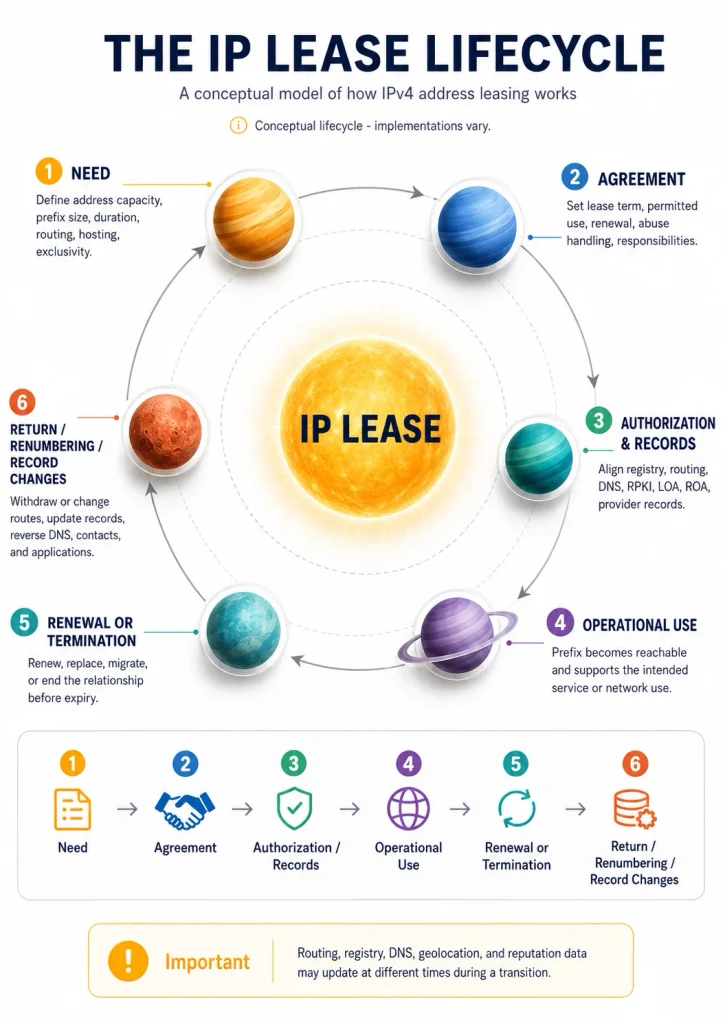
A useful conceptual lifecycle is:
Need → Agreement → Authorization / Records → Operational Use → Renewal or Termination → Return / Renumbering / Record and Routing Changes
This is not a mandatory universal process. Some stages can happen together, be handled by an intermediary, or be unnecessary under a particular model.
1. Need
The organization identifies a requirement for additional public address capacity.
It should define:
- the required IP version;
- approximate prefix size;
- intended duration;
- technical use;
- routing and hosting requirements;
- whether independent operational control is needed;
- whether the space must be exclusive;
- what happens if the service has to be renumbered.
This is planning context, not a guide to acquiring or announcing address space.
2. Agreement
The parties establish the commercial relationship.
Depending on the arrangement, the agreement may define:
- lease duration;
- permitted use;
- exclusivity;
- renewal;
- abuse handling;
- operational responsibilities;
- routing services;
- record-management responsibility;
- termination conditions;
- return and renumbering obligations.
These are possible contract topics, not universal legal requirements.
3. Authorization and Records
The organizations determine which registry, routing, RPKI, DNS, and provider records must reflect the arrangement.
A provider might request an LOA or other evidence. An appropriate party might create or update a ROA. A permitted customer or delegation record might be added. The exact steps depend on the resource and implementation.
4. Operational Use
The prefix becomes reachable through the agreed network and is used by the intended service.
Operational use can involve:
- a lessee-controlled network;
- managed transit;
- bundled hosting;
- cloud or datacenter infrastructure;
- a network service;
- proxy infrastructure;
- another Internet-facing application.
A route being visible does not establish that all contractual, registry, and security requirements have been satisfied.
5. Renewal or Termination
Before the lease ends, the parties may renew it, replace it, migrate the service, or terminate the relationship.
There is no universal renewal period or notice requirement. These depend on the agreement and provider.
6. Return, Renumbering, and Record Changes
When usage rights end, the lessee may need to stop using the addresses.
Depending on the model, this can also require:
- withdrawing or changing routes;
- updating a ROA or another authorization record;
- removing downstream registry data;
- updating reverse DNS;
- changing abuse contacts;
- updating geolocation or network-intelligence providers;
- migrating allowlists;
- replacing addresses in applications;
- renumbering hosts and services.
These systems do not necessarily update simultaneously. For a period, registry, routing, DNS, geolocation, and reputation data may describe different stages of the transition.
Operational Risks and Limitations
IP leasing can provide useful flexibility, but it separates several relationships that must remain coordinated.
| Risk | Why It Matters |
| Previous-use history | The prefix may have been used by another organization before the current lease |
| Registry mismatch | Public records may not describe every current operational role |
| Route-authorization mismatch | Route origin and authorization records may be inconsistent |
| RPKI invalid state | An origin or prefix-length mismatch can affect route handling by validating networks |
| Geolocation lag | Location databases may not immediately reflect a new operation |
| Reputation history | Blocklists and target systems may retain earlier observations |
| Abuse responsibility | Unclear contacts can delay investigation and remediation |
| Supplier dependency | The lessee may depend on the lessor, broker, host, or transit provider |
| Contract ambiguity | Permitted use, exclusivity, renewal, and return requirements may be unclear |
| Termination risk | The lessee can lose use of the addresses and need to renumber |
| Service migration | DNS, allowlists, APIs, certificates, and customer systems may reference old addresses |
| Regional-policy mismatch | An arrangement cannot be assumed to work identically across RIR regions |
These are operational considerations, not conclusions about the legality or quality of any specific provider.
Why a New Lease Does Not Reset IP Reputation
A new lease changes a usage relationship. It does not create a new IP address or erase earlier observations associated with it.
Safe conclusions include:
- previous-use history can predate the current lessee;
- changing the network operator does not automatically erase that history;
- changing the origin ASN does not create a new address identity;
- registry and commercial intelligence databases can update on different schedules;
- removing an address from one blocklist does not update every target system;
- lease status does not tell a website whether an IP should be trusted.
A target website may evaluate the individual IP, prefix, ASN, observed traffic, prior behavior, location consistency, and other private signals. It does not need to know whether the address is leased.
For the full distinction between ownership records, operational state, historical behavior, and target-specific treatment, see How IP Reputation Works.
How IP Leasing Relates to Hosting and Proxy Infrastructure
Leased or otherwise provisioned address space can support many network services.
A simplified bridge is:
Address-Space Usage Rights → Routing / Hosting → Network Service → Proxy Infrastructure
For example, authorized address space could be used in:
- hosting infrastructure;
- ISP-associated infrastructure;
- datacenter services;
- VPN services;
- static network endpoints;
- proxy services;
- other Internet-facing systems.
The use of leased addresses does not, by itself, determine whether a proxy is residential, ISP-associated, datacenter, static, rotating, dedicated, or shared. Those classifications depend on additional network, service, and allocation characteristics.
For the next layer – network association, hosting, proxy gateways, and customer-visible behavior – see how ISP-associated proxy infrastructure works.
This is a conceptual industry relationship. It is not a statement about Mango Proxy’s suppliers, address-space relationships, routing, or internal architecture.
Practical Examples
Example 1: Direct Lease With a Different Origin ASN
A resource holder grants Company B time-limited rights to use a prefix.
Company B operates a network with another ASN. Under the agreed authorization model, that ASN originates the prefix. The registered holder can remain Company A while Company B is the operational user and origin-network operator.
The correct conclusion is:
Registration, contractual use, and route origination involve different relationships.
The incorrect conclusion is:
The origin ASN proves that Company B owns the address space.
Example 2: Addresses Bundled With Hosting
A hosting provider supplies servers and public IPv4 addresses as one service.
The customer uses the addresses but does not manage BGP or communicate with the original resource holder. The hosting provider or its upstream network controls routing.
The customer has operational access to the hosted service, but that does not mean it has received independent registration rights or can move the addresses to another provider.
Example 3: A Lease Ends
A company uses a leased prefix for an Internet-facing service. The agreement is not renewed.
The company may need to migrate the service to another prefix, update DNS, replace allowlist entries, change monitoring configurations, and stop announcing or using the previous addresses. The relevant party may also need to update routing authorization and registry records.
Geolocation, reputation, and third-party databases may continue showing older information for some time. No universal update period can be assumed.
Continue From Address Space to Pool Management
IP leasing explains how an organization may obtain time-limited rights to use address space. It does not determine whether a proxy resource is healthy, eligible, available, or allocatable.
The next operational layer is explained in How Proxy Pools Are Built: how raw resources move through validation, metadata, segmentation, allocation, and continuous monitoring.
Final Thoughts
IP leasing is not simply the temporary “ownership” of a list of addresses. It is a time-limited usage relationship surrounded by separate registry, authorization, routing, hosting, and service-operation layers.
That is why one prefix can be:
- registered to one organization;
- authorized for use by another;
- originated by a third network;
- hosted in a fourth company’s infrastructure;
- used by a customer-facing service operated by someone else.
Understanding these roles prevents several common mistakes. Registry data does not prove physical hosting. A BGP route does not prove commercial rights. An LOA does not transfer registration. A ROA does not prove a lease. And a new lessee does not receive a new IP history.
The most useful question is therefore not only, “Who is using this prefix?” It is:
Who is registered, who is authorized, who is routing, who is hosting, and which rights end when the agreement expires?
Glossary
IP Address
A numerical identifier used for addressing through the Internet Protocol.
IP Prefix
A contiguous range of IP addresses represented with a prefix length, such as /24.
Internet Number Resource
Globally unique IPv4 or IPv6 address space or an Autonomous System Number administered through the Internet registry system.
RIR
A Regional Internet Registry responsible for managing, distributing, and registering Internet number resources in a defined service region.
Registered Holder
An organization recognized through the applicable registry or resource-management relationship as holding registration rights for a resource.
Lessor
A party granting another organization time-limited rights to use address space.
Lessee
A party receiving those contractual usage rights.
Allocation
A policy-defined delegation of address space, often to an organization that can make further downstream delegations. Definitions vary by RIR.
Assignment
A policy-defined delegation for use by an organization or end site. Definitions vary by RIR.
Reassignment / Reallocation
Region-specific terms for downstream address-space delegations.
Transfer
An RIR-recognized change in resource holdership or registration under the applicable policy.
Commercial IP Lease
A time-limited commercial arrangement for the use of public address space without necessarily changing the RIR-recognized holder.
DHCP Lease
A protocol-level assignment of an IP address and configuration information to a DHCP client for a defined period.
ASN
An identifier assigned to an Autonomous System participating in inter-domain routing.
BGP Announcement
An advertisement of reachability information for a prefix through the Border Gateway Protocol.
LOA
A Letter of Authorization asserting that a party has permission to use or route address space under defined circumstances.
RPKI
A public-key infrastructure for cryptographically verifiable statements about Internet number resources and routing authorization.
ROA
A Route Origin Authorization specifying which ASN may originate a prefix within RPKI.
Routing Authorization
Evidence or a cryptographic statement indicating that a network is permitted to originate a prefix.
Operational Control
Practical control over routing, hosting, or service use. It is not automatically the same as registration rights.
Renumbering
Replacing the IP addresses used by networks, hosts, applications, and related configurations.

Frequently asked questions
Here we answered the most frequently asked questions.
What is IP leasing?
IP leasing is a time-limited commercial arrangement that permits an organization to use public IP address space without necessarily changing the RIR-recognized holder of the resource.
Is commercial IP leasing the same as a DHCP lease?
No. Commercial leasing concerns organization-level rights to use public address space. A DHCP lease is a protocol process that temporarily assigns an address and configuration information to a device or interface.
Is leasing the same as buying IPv4 addresses?
No. Buying is common market shorthand. A recognized transfer changes the resource-holdership or registration relationship under an applicable RIR process. A lease normally provides temporary usage rights without that permanent change.
Who appears in registry records during an IP lease?
It depends on the RIR, resource status, delegation model, and record-management process. The recognized holder may remain visible, while some implementations can also publish downstream customer or assignment information.
Does leasing an IP prefix change its ASN?
Not automatically. The prefix and ASN are separate resources. The existing origin network might continue routing it, or another authorized ASN might originate it under the selected operational model.
Who can announce a leased prefix?
A network originates the prefix through an ASN under the applicable authorization and provider arrangement. The origin may be operated by the holder, lessee, hosting provider, transit provider, or another authorized network.
Does an LOA prove ownership of an IP block?
No. An LOA can assert that a holder authorized another party to use or route the block. It does not independently transfer registration rights or establish property ownership.
Does a ROA prove that an IP lease exists?
No. A ROA states which ASN is authorized within RPKI to originate a prefix. It does not contain or prove the underlying commercial agreement.
Can two companies use the same address block at the same time?
Do not assume that they can. A service can support multiple customers behind shared infrastructure, but that is different from granting overlapping independent control of the same public addresses. Exclusivity and operational scope must be defined by the relevant agreements and network design.
Can leased addresses be used for hosting or proxy services?
They can be used for different network services where the applicable agreement, resource status, and provider policies permit it. Leasing alone does not determine the resulting proxy or network classification.
Does leasing reset IP reputation?
No. Previous observations can predate the current lessee, and changing the user, host, or origin ASN does not automatically erase them.
What happens when an IP lease ends?
The lessee may need to stop using the addresses and renumber its services. Routes, authorization records, registry data, reverse DNS, geolocation information, allowlists, and operational configurations may also need to be changed. The exact process depends on the agreement and implementation.