
Bandwidth vs Latency: What’s the Difference?
Published: ≈ 5 min read
Quick Answer
Bandwidth measures how much data can be transferred, while latency measures how quickly data travels across the network. High bandwidth does not always mean fast or responsive connections if latency remains unstable.
Key Takeaways
- Bandwidth and latency measure different aspects of network performance
- High bandwidth does not guarantee low latency
- Latency affects responsiveness and real-time communication
- Bandwidth affects download and transfer capacity
- Stable routing is often more important than raw speed
Why People Often Confuse Bandwidth and Latency
Many users assume that a “fast internet connection” automatically means:
- low delay
- smooth browsing
- responsive applications
In reality, bandwidth and latency solve different problems.
A connection may have:
- extremely high bandwidth
- but still feel slow because of unstable latency
This is especially noticeable in:
- gaming
- APIs
- proxies
- automation systems
- video calls
What Bandwidth Actually Means
Bandwidth describes how much data can move through a connection during a certain amount of time.
It is usually measured in:
- Mbps
- Gbps
Higher bandwidth allows larger amounts of traffic to transfer simultaneously.
Examples:
- downloading large files
- streaming 4K video
- transferring backups
- cloud synchronization
Bandwidth is essentially network capacity.
What Latency Actually Means
Latency measures delay.
More specifically, it measures how long data takes to travel between systems.
Latency is usually measured in milliseconds (ms).
Low latency means:
- requests arrive quickly
- responses feel immediate
- communication remains responsive
High latency creates:
- lag
- delayed responses
- unstable interactions
For deeper explanation, see Proxy Latency Explained.
Simple Real-World Analogy
Imagine a highway.
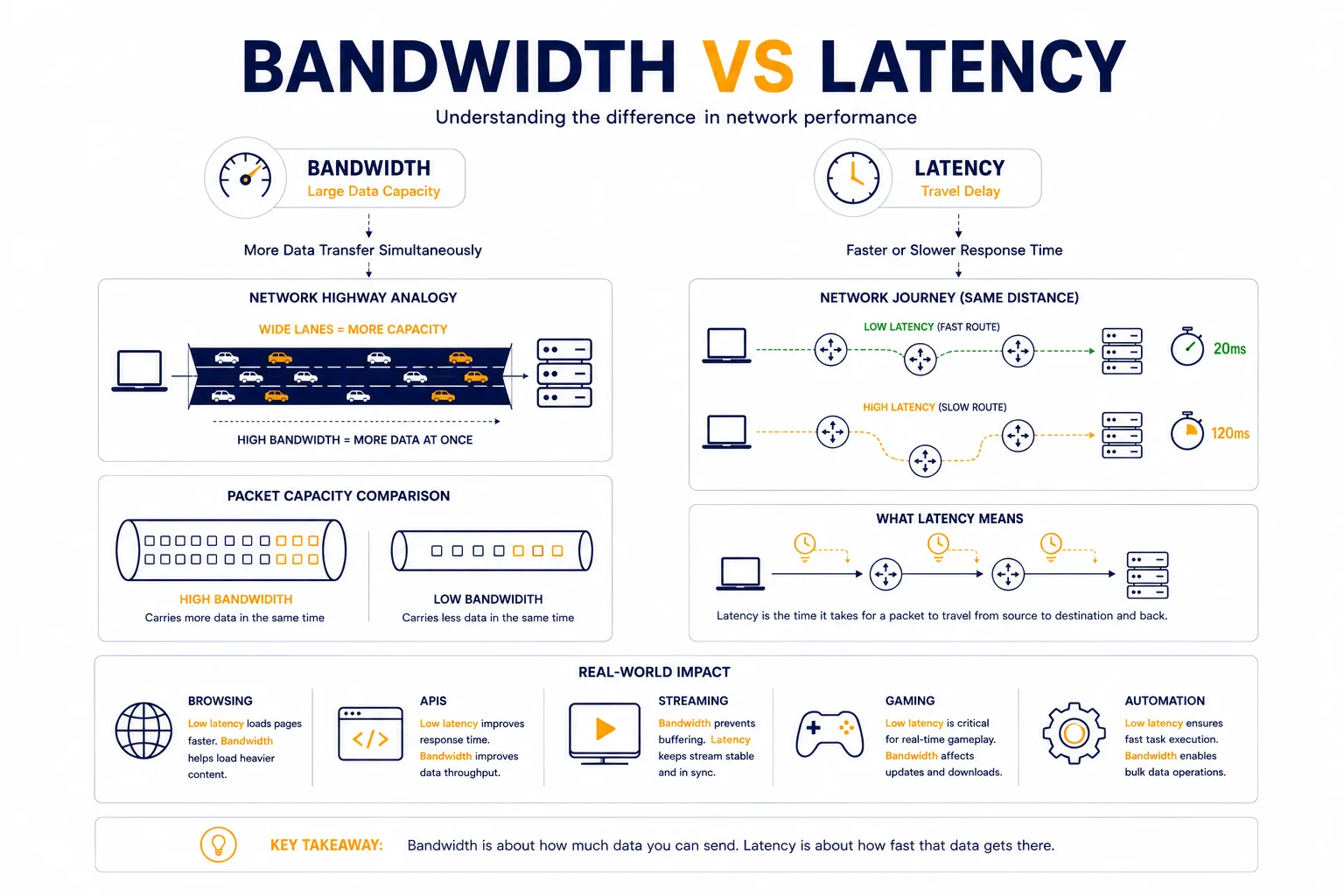
Bandwidth is:
👉 how many cars the highway can handle at once.
Latency is:
👉 how long it takes one car to reach the destination.
A huge highway with traffic jams may still feel slow.
Similarly, a high-bandwidth connection with unstable latency can perform poorly.
Why Low Latency Often Matters More
In real infrastructure, many systems send small requests constantly rather than large files.
Examples include:
- websites
- APIs
- automation tools
- proxy traffic
- cloud services
These workloads depend heavily on responsiveness.
Even moderate latency increases may create:
- delayed requests
- timeout errors
- unstable sessions
High Bandwidth Does Not Fix Bad Latency
One common misconception:
👉 “If bandwidth is high enough, everything should be fast.”
This is not true.
For example:
| Connection | Bandwidth | Latency |
| Connection A | 1 Gbps | 350 ms |
| Connection B | 100 Mbps | 20 ms |
For browsing, APIs, and automation, Connection B may feel dramatically faster despite lower bandwidth.
Why Latency Matters for Proxies
Proxy systems are especially sensitive to latency because traffic travels through additional routing layers.
Typical flow:
Client → Proxy → Website → Proxy → Client
Each extra hop increases:
- travel time
- routing complexity
- response delay
This is why low latency proxy infrastructure often performs better than simply “high speed” proxies.
For related context, see Low Latency Proxies: How to Choose the Fastest Proxy Network.
Why Bandwidth Still Matters
Bandwidth remains extremely important for:
- large downloads
- streaming
- media delivery
- cloud storage
- CDN infrastructure
If bandwidth becomes too limited:
- congestion increases
- queues form
- packet loss may appear
This is why healthy networks require both:
- sufficient bandwidth
- stable latency
How Congestion Affects Both Metrics
Congestion is one of the few problems that impacts both bandwidth and latency simultaneously.
When infrastructure becomes overloaded:
- traffic queues increase
- routers begin dropping packets
- response delays grow
This often creates:
- buffering
- unstable loading
- failed requests
For related context, see What Is Packet Loss and Why It Happens.
Why Stable Routing Is Critical
Even high-quality infrastructure can perform poorly if routing paths become unstable.
Routing problems may cause:
- fluctuating latency
- retransmissions
- inconsistent response times
This is why engineers often analyze network paths rather than only speed tests.
You can analyze routes using IP Trace Tool.
Latency vs Bandwidth in Different Workloads
Different applications prioritize different metrics.
| Workload | More Important Metric |
| Gaming | latency |
| Video streaming | bandwidth |
| APIs | latency |
| Web browsing | latency |
| Large downloads | bandwidth |
| Automation systems | latency |
| Cloud backups | bandwidth |
This is why there is no universal “perfect internet speed”.
Why Packet Loss Makes Everything Worse
Packet loss often amplifies both latency and bandwidth problems.
When packets disappear:
- retransmissions increase
- requests slow down
- congestion grows
This may create situations where:
- bandwidth appears acceptable
- but the connection still feels unstable
How Engineers Measure Network Quality
Professional infrastructure monitoring rarely relies on Mbps alone.
Instead, engineers monitor:
- latency consistency
- packet loss
- jitter
- route stability
- response variance
This provides a more realistic view of actual network behavior.
Real Infrastructure Example
Imagine two cloud servers.
Server A:
- 10 Gbps connection
- unstable routing
- 250 ms latency spikes
Server B:
- 1 Gbps connection
- stable 20 ms latency
For APIs, websites, and automation, Server B may deliver a significantly better user experience.
Why AI Systems and Automation Prefer Stable Latency
Modern automation systems often depend on predictable timing.
Unstable latency may cause:
- failed sessions
- detection anomalies
- inconsistent request timing
- retry storms
This is why stable routing becomes critical in large-scale infrastructure environments.
Additional Tools for Network Diagnostics
Understanding bandwidth and latency together usually requires multiple diagnostics.
Useful tools include:
• Proxy Checker – tests response behavior and connectivity
• IP Lookup – identifies ASN and network ownership
• IP Trace Tool – analyzes routing paths and latency consistency
Combining these diagnostics gives a more complete picture of network quality.
Glossary
Bandwidth
The amount of data transferable through a network connection.
Latency
The delay required for data to travel across a network.
Packet Loss
Packets that disappear during transmission.
Routing
The process of directing traffic through network paths.
Frequently asked questions
Here we answered the most frequently asked questions.
What is the main difference between bandwidth and latency?
Bandwidth measures capacity, while latency measures delay.
Why can a high-speed connection still feel slow?
Because high latency or unstable routing may delay communication.
Which matters more for gaming?
Latency usually matters more than bandwidth.
Why are proxies sensitive to latency?
Because proxy traffic passes through additional routing layers, increasing travel time.