
What Is a Good Proxy Speed? (Benchmarks and Real Numbers)
Published: ≈ 5 min read
Quick Answer
A good proxy speed depends on the use case, but for most tasks latency below 100-200 ms and stable response times are considered acceptable. Speed alone is not enough – consistency and success rate also matter.
Key Takeaways
- Low latency is often more important than raw bandwidth
- Different tasks require different proxy performance levels
- Stable response time matters more than peak speed
- Fast proxies can still fail if routing is unstable
- Residential, ISP, datacenter, and mobile proxies behave differently
What Proxy Speed Actually Means
Many people think proxy speed is simply about download bandwidth.
In reality, proxy performance includes several different factors:
- latency
- response stability
- packet routing
- connection consistency
- bandwidth throughput
This is why two proxies with identical Mbps speeds may behave completely differently in real usage.
For example:
- one proxy may feel responsive and stable
- another may experience delays despite higher bandwidth
The Difference Between Speed and Latency
One of the biggest misconceptions is confusing bandwidth with latency.
These are not the same thing.
| Metric | What It Measures |
| Bandwidth | how much data can be transferred |
| Latency | how quickly requests travel |
| Response Time | total request processing delay |
| Success Rate | reliability of completed requests |
In most proxy-related tasks, latency matters more than raw speed.
For deeper explanation, see Proxy Latency Explained.
What Is Considered Good Proxy Latency
The acceptable latency depends on the activity.
Different workloads tolerate different delays.
| Use Case | Good Latency |
| Web browsing | under 100 ms |
| Automation tools | 100-200 ms |
| Web scraping | 100-300 ms |
| Streaming | under 150 ms |
| Gaming | under 50 ms |
These numbers are general benchmarks rather than strict limits.
Stable performance is usually more important than occasional peak speed.
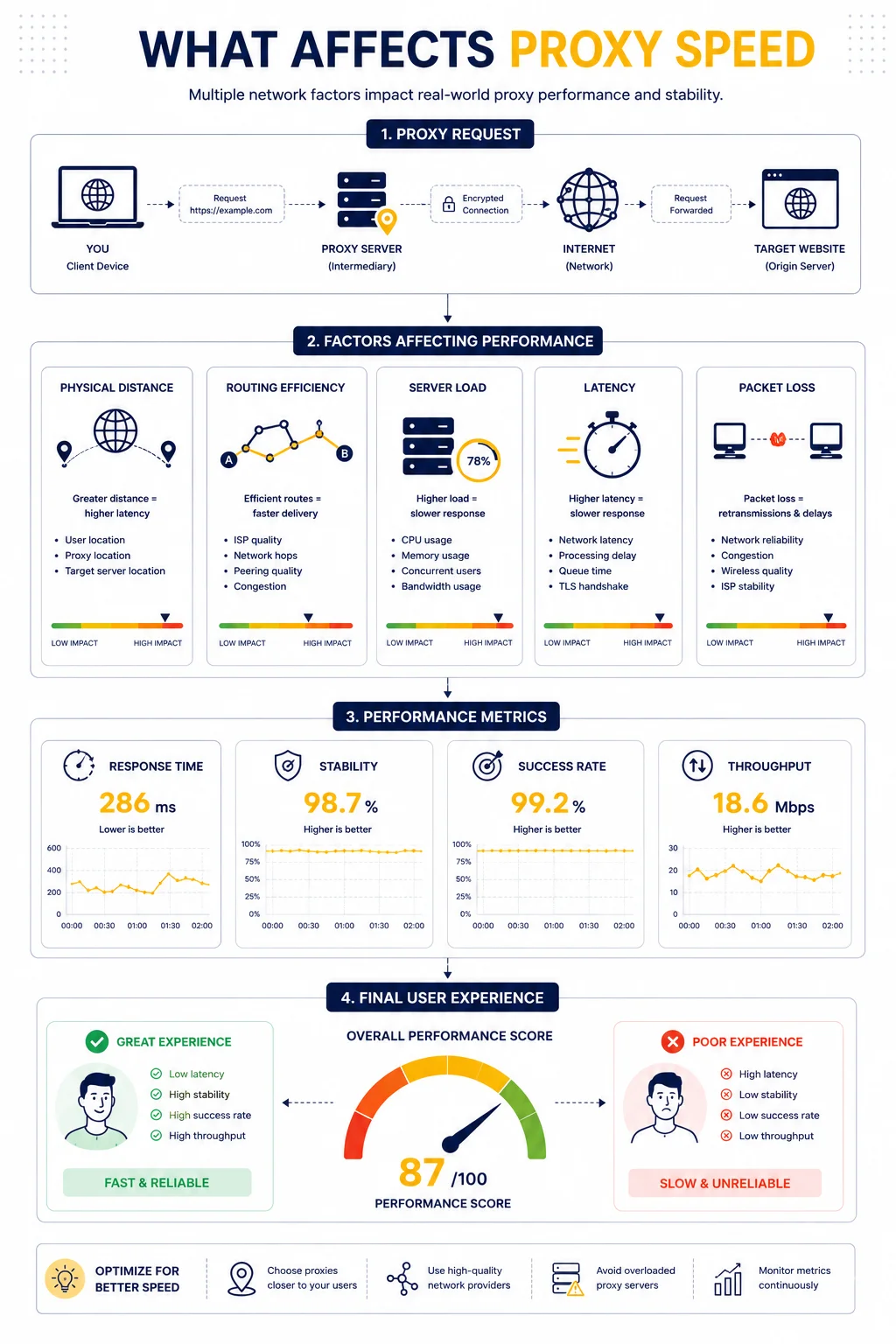
Why Stable Speed Matters More Than Maximum Speed
A proxy that occasionally reaches high bandwidth but constantly fluctuates may perform worse than a slower but stable connection.
This is especially important for:
- scraping systems
- automation workflows
- API integrations
- session-based traffic
Inconsistent latency often causes:
- failed requests
- timeouts
- unstable sessions
For deeper context, see Proxy Success Rate Explained.
Why Fast Proxies Can Still Feel Slow
Users often encounter situations where:
- bandwidth looks high
- but websites still load slowly
This usually happens because of:
- poor routing
- overloaded infrastructure
- unstable latency
- packet retransmissions
In practice, network quality matters more than isolated speed tests.
Typical Speed Differences Between Proxy Types
Different proxy categories naturally behave differently.
| Proxy Type | Typical Characteristics |
| Datacenter | fast but easier to detect |
| Residential | more natural but slightly slower |
| ISP | balance between speed and trust |
| Mobile | variable speed but high legitimacy |
Each type is optimized for different workloads.
For example:
- datacenter proxies often provide lower latency
- residential proxies blend better with normal traffic
- mobile proxies prioritize authenticity over raw speed
What Affects Proxy Performance
Several factors influence proxy speed.
Physical Distance
The farther traffic travels, the higher the latency.
Requests routed across continents naturally take longer than local connections.
Network Congestion
Overloaded infrastructure can increase response times even if bandwidth remains high.
This often happens during traffic spikes.
Routing Efficiency
Bad routing paths create unnecessary delays.
You can analyze network routes using IP Trace Tool.
Server Load
If too many users share the same infrastructure, performance becomes unstable.
This is one reason overloaded proxy pools often experience degraded speed.
Why Low Latency Matters for Automation
Automation systems frequently send many small requests rather than large downloads.
In these environments:
- latency matters more than bandwidth
- stable timing improves throughput
- consistent routing reduces failures
This is why low latency proxies are often preferred for:
- scraping
- automation
- monitoring systems
For deeper explanation, see Low Latency Proxies: How to Choose the Fastest Proxy Network.
Real-World Example
Imagine two proxy connections:
| Proxy | Bandwidth | Latency | Stability |
| Proxy A | 500 Mbps | 300 ms | unstable |
| Proxy B | 100 Mbps | 40 ms | stable |
Despite lower bandwidth, Proxy B may perform significantly better for browsing and automation tasks.
How to Test Proxy Speed Properly
Testing proxy performance requires more than a simple bandwidth check.
A proper evaluation usually includes:
- latency measurement
- response consistency
- request success rate
- routing analysis
- regional testing
Using only Mbps values rarely provides an accurate picture.
You can verify connectivity using Proxy Checker.
Why Speed Benchmarks Depend on the Use Case
Different tasks stress infrastructure differently.
Examples:
| Task | Most Important Metric |
| Streaming | bandwidth |
| Gaming | latency |
| Scraping | stability |
| Automation | response consistency |
| Large downloads | throughput |
This is why there is no universal “perfect speed”.
How Proxy Speed Relates to Detection
Performance and detection are often connected.
For example:
- overloaded proxies may generate unstable behavior
- inconsistent latency may appear suspicious
- aggressive routing changes can increase detection risk
This is why stable infrastructure matters beyond raw speed.
Additional Tools for Network Diagnostics
Understanding proxy performance often requires analyzing the network itself.
Useful tools include:
• Proxy Checker – tests connectivity and responsiveness
• IP Lookup – reveals network ownership and ASN data
• IP Trace Tool – analyzes routing paths and latency behavior
Combining these tools gives a more complete picture of infrastructure quality.
Glossary
Latency
The time required for data to travel between systems.
Bandwidth
The amount of data transferable per second.
Response Time
The total delay before receiving a response.
Packet Loss
Missing packets during network communication.
Frequently asked questions
Here we answered the most frequently asked questions.
What is considered a good proxy speed?
For most tasks, latency below 100-200 ms with stable response times is considered good.
Is bandwidth more important than latency?
Not always. For browsing, automation and scraping, latency often matters more.
Why do fast proxies sometimes perform poorly?
Because routing quality, stability, and congestion affect real-world performance.
Which proxy type is usually fastest?
Datacenter proxies are often the fastest, while residential and mobile proxies prioritize legitimacy and stability.
Solid baseline numbers. So many people expect residential IPs to match datacenter speeds and end up disappointed for no real reason