
What Are Server Proxies? The History, Evolution and Future of Server-Based Proxy Infrastructure
Quick Answer
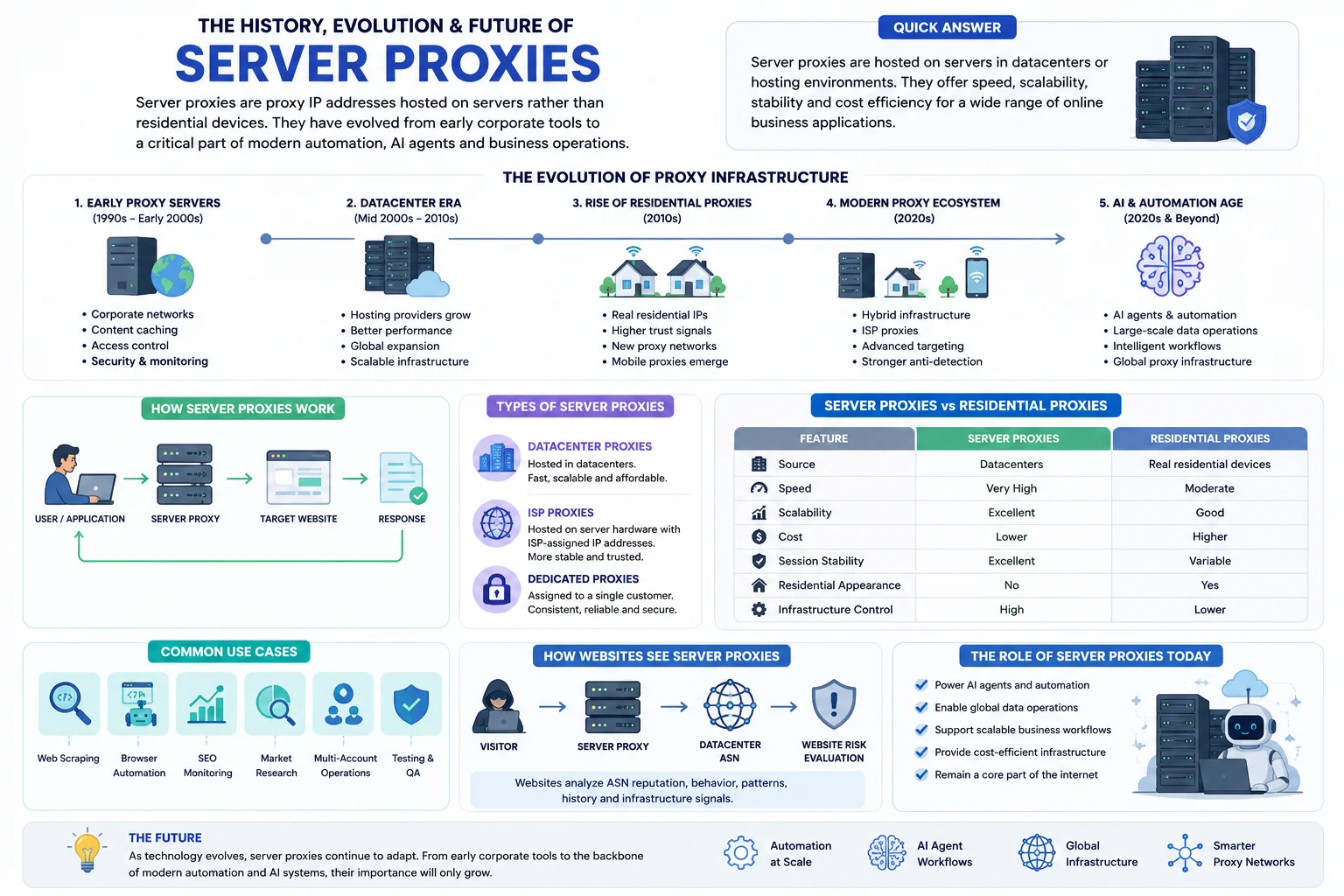
Server proxies are proxy IP addresses hosted on servers rather than residential devices. While the concept originated decades ago in corporate and datacenter networks, server proxies remain one of the most widely used infrastructure components for automation, web scraping, SEO monitoring, AI agents and large-scale internet operations.
Why Does the Term “Server Proxy” Even Exist?
The proxy industry has a terminology problem.
Some providers advertise:
- server proxies
- proxy servers
- datacenter proxies
- dedicated proxies
Others focus on:
To newcomers, these categories often sound like completely different technologies.
In reality, many of these terms describe infrastructure that shares the same roots.
The phrase “server proxy” became popular because the proxy IP addresses were hosted on servers rather than residential internet connections.
Before residential proxy networks existed, most proxy infrastructure on the internet was server-based.
Understanding that history makes modern proxy terminology much easier to understand.
The Early Days of Proxy Servers
The first proxy servers were not created for scraping, automation or account management.
They were created to solve network problems.
In the early internet era, organizations used proxy servers to:
- cache website content
- reduce bandwidth consumption
- control employee internet access
- improve security
- monitor network traffic
A simplified architecture looked like this:
Employee
↓
Corporate Proxy Server
↓
Internet
At the time, nobody talked about residential proxies or mobile proxies.
Proxy infrastructure was almost entirely server-based.
How Datacenters Changed the Industry
As hosting providers grew, companies gained access to large pools of server infrastructure.
Instead of running a proxy inside an office network, organizations could deploy proxy services from professional datacenters.
This created several advantages:
Better Performance
Datacenters offered faster internet connections.
Better Reliability
Professional infrastructure reduced downtime.
Better Scalability
Companies could deploy hundreds or thousands of proxy endpoints.
Global Expansion
Proxy servers could be deployed in multiple countries.
This period gave rise to what most people now call datacenter proxies.
Why Proxy Providers Use Different Names
One of the biggest sources of confusion is terminology.
Provider A may advertise:
- server proxies
Provider B may advertise:
- dedicated proxies
Provider C may advertise:
- datacenter proxies
In many cases, the underlying infrastructure is remarkably similar.
The naming often depends on:
- marketing strategy
- target audience
- product positioning
- historical terminology
This is one reason why searching for “server proxy” often leads to pages discussing datacenter infrastructure.
The Rise of Residential and Mobile Proxies
The proxy landscape changed dramatically when residential proxy networks became available.
Instead of routing traffic through servers, providers began routing traffic through real residential internet connections.
This created a new distinction.
Residential Infrastructure
User
↓
Residential Device
↓
Home ISP
↓
Website
Server Infrastructure
User
↓
Proxy Server
↓
Datacenter
↓
Website
From that point forward, the proxy industry became divided into two major categories:
- server-based infrastructure
- residential-based infrastructure
Most modern proxy products fit somewhere within those two groups.s.
How Server Proxies Fit Into Modern Proxy Networks
Today, proxy infrastructure looks much more complex than it did ten years ago.
A simplified view looks like this:
Proxy Infrastructure
↓
Server Proxies
↓
Datacenter Proxies
↓
Dedicated Proxies
↓
ISP Proxies
↓
Residential Proxies
↓
Mobile Proxies
Server proxies remain one of the foundational layers of this ecosystem.
Even many advanced proxy products ultimately rely on server infrastructure behind the scenes.
Why Businesses Still Prefer Server Proxies
Despite the growth of residential networks, server proxies remain extremely popular.
Lower Cost
Server infrastructure is generally more affordable.
Predictable Performance
Datacenters provide stable network conditions.
Easier Scaling
Organizations can scale traffic more easily.
Consistent Sessions
Long-running automation projects often benefit from stable connections.
Infrastructure Control
Businesses can manage server resources more directly.
For many organizations, these advantages outweigh the benefits of residential traffic.
How Websites See Server Proxies Today
Modern websites no longer evaluate traffic based solely on an IP address.
They often analyze:
- ASN reputation
- traffic behavior
- request patterns
- browser fingerprints
- historical activity
- infrastructure characteristics
A modern evaluation workflow might look like this:
Visitor
↓
Server Proxy
↓
Datacenter ASN
↓
Website Risk Evaluation
This is why proxy quality matters far more than simply choosing a specific proxy type.
Why AI Agents Are Driving New Demand for Server Proxies
One of the newest developments in the proxy industry is the rise of AI agents.
Modern AI systems increasingly perform tasks such as:
- website monitoring
- browser automation
- market research
- competitive analysis
- workflow automation
Many of these systems require reliable network infrastructure.
Server proxies are often preferred because they provide:
- predictable performance
- scalable traffic handling
- stable sessions
- cost efficiency
As AI automation expands, server-based infrastructure may become even more important.
Server Proxies vs Residential Proxies
The comparison is often oversimplified.
The real question is not which one is better.
The real question is which one is more suitable for a specific project.
| Feature | Server Proxies | Residential Proxies |
| Speed | High | Moderate |
| Scalability | Excellent | Good |
| Cost | Lower | Higher |
| Session Stability | Excellent | Variable |
| Residential Appearance | No | Yes |
| Infrastructure Control | High | Lower |
Different projects require different trade-offs.
The Future of Server Proxy Infrastructure
Server proxies have survived multiple generations of internet technology.
They existed before residential networks.
They survived the rise of mobile internet.
They adapted to modern anti-bot systems.
Today they support automation, monitoring, analytics and AI-driven workflows.
Rather than disappearing, server proxies continue to evolve alongside the internet itself.
The technologies surrounding them change, but the underlying need for scalable intermediary infrastructure remains.
Final Thoughts
Server proxies are much more than a technical product category.
They represent one of the oldest and most important layers of internet infrastructure.
From early corporate networks to modern AI-driven automation systems, server-based proxy infrastructure has continuously adapted to changing technologies and business needs.
Understanding where server proxies came from helps explain why they remain one of the most widely used proxy solutions today.

Frequently asked questions
Here we answered the most frequently asked questions.
Is a server proxy the same as a datacenter proxy?
Often, but not always. Datacenter proxies are the most common form of server proxy infrastructure.
Why do some providers call them server proxies?
The term originates from the fact that the IP addresses are hosted on servers rather than residential devices.
Are server proxies still relevant today?
Yes. They remain one of the most widely used proxy categories for automation, monitoring and business applications.
When should I choose residential proxies instead?
Residential proxies may be preferable when residential trust signals are particularly important.
Are AI agents increasing demand for server proxies?
Many modern AI workflows depend on scalable and reliable network infrastructure, making server proxies a common choice.