
TCP vs UDP: How Different Network Protocols Behave Under Real Internet Conditions
Quick Answer
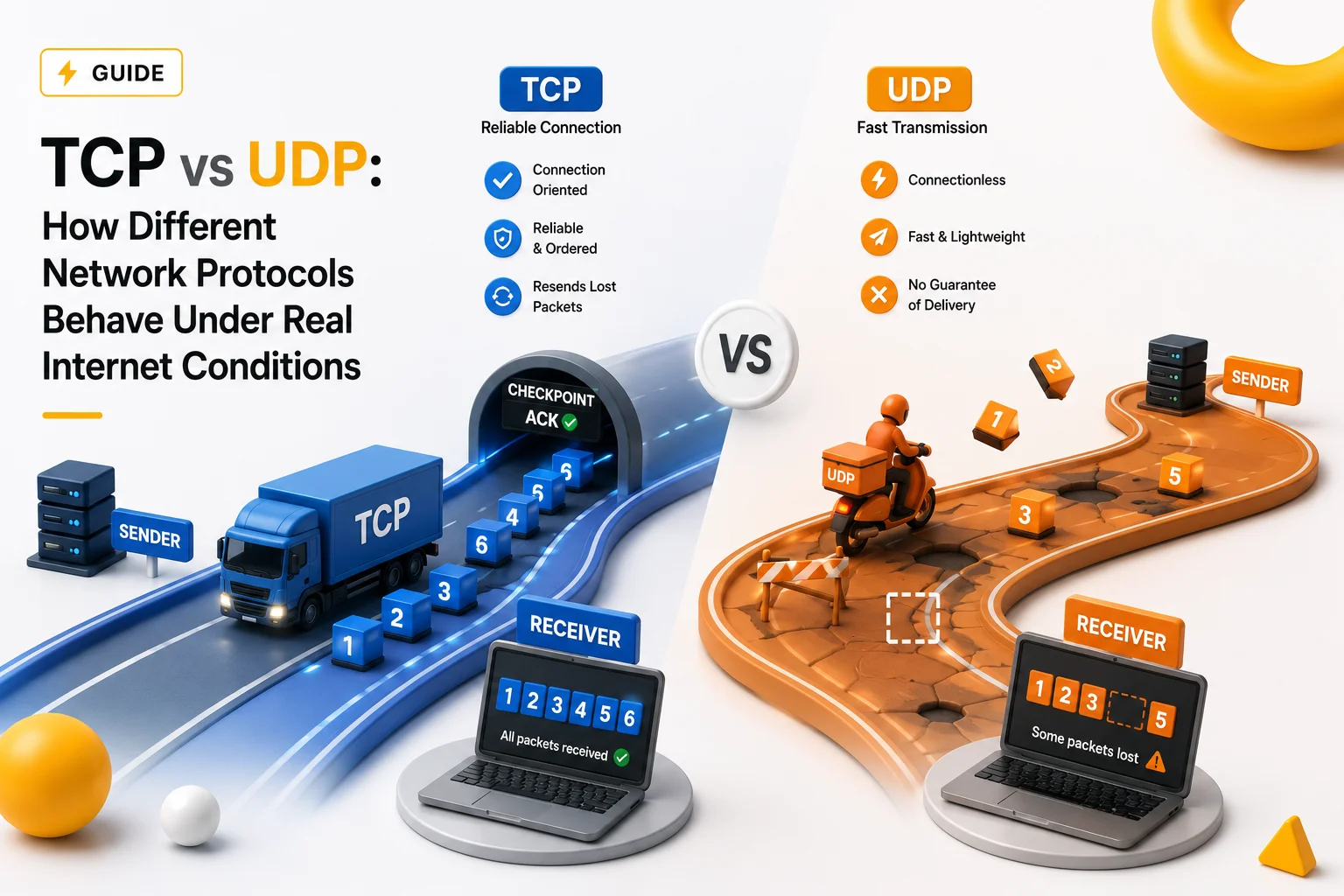
TCP and UDP behave very differently under congestion, latency spikes and packet loss. TCP prioritizes stable and verified delivery, while UDP prioritizes fast real-time transmission with minimal overhead.
Key Takeaways
- TCP focuses on reliable communication under unstable conditions
- UDP prioritizes low latency and fast transmission
- Packet loss affects UDP traffic much more aggressively
- TCP retransmissions improve stability but increase delay
- Real-time systems often prefer UDP despite occasional data loss
Why TCP and UDP Behave Differently
Modern internet traffic constantly encounters:
- congestion
- packet loss
- unstable routing
- latency fluctuations
TCP and UDP respond to these conditions in completely different ways.
TCP attempts to stabilize communication.
UDP attempts to preserve speed and timing.
This difference becomes especially visible during real infrastructure problems.
How TCP Handles Unstable Networks
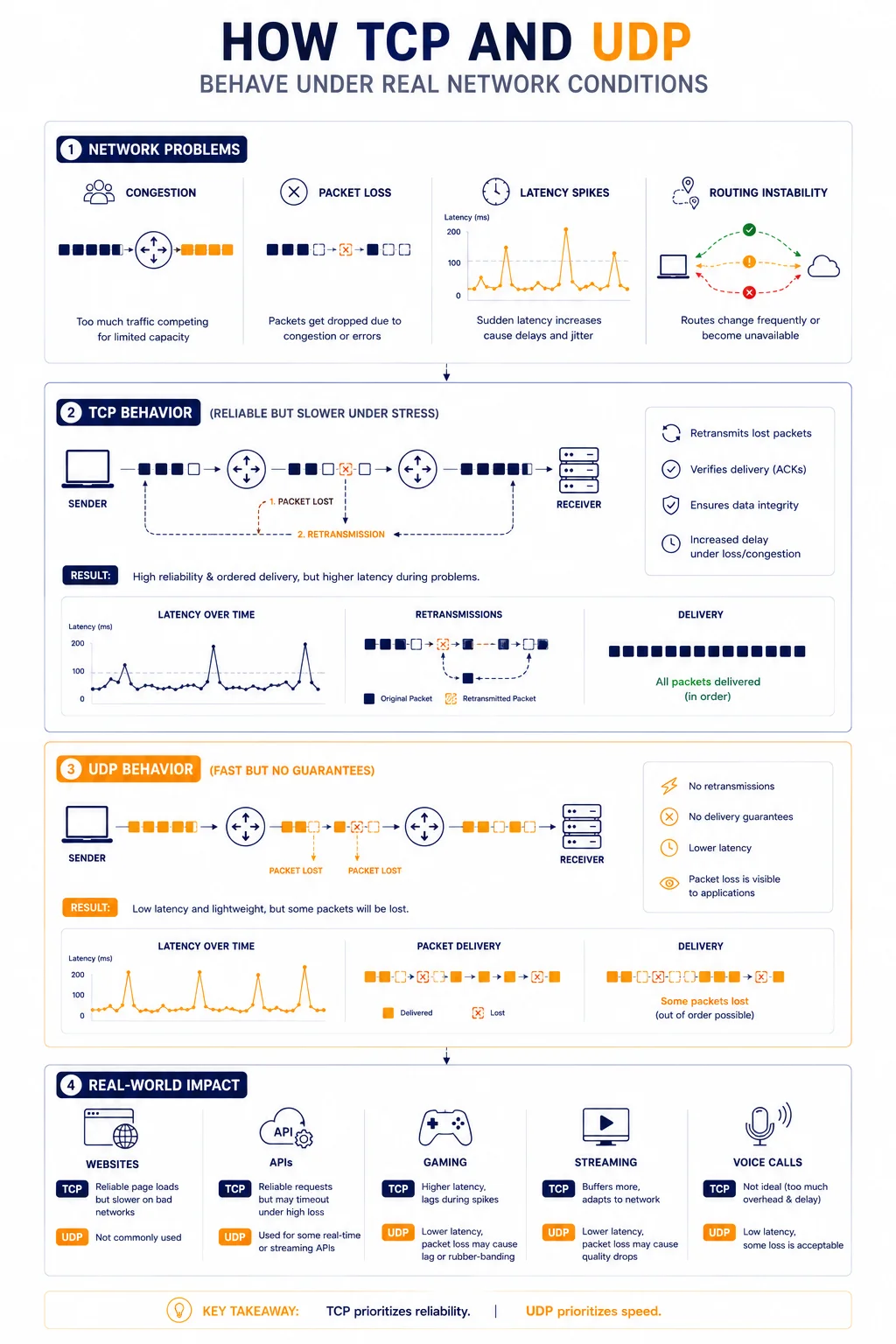
TCP continuously monitors communication quality.
If packets disappear or arrive incorrectly, TCP:
- retransmits missing packets
- reorders delayed traffic
- verifies delivery integrity
- slows transmission when congestion increases
This behavior makes TCP significantly more stable during difficult network conditions.
However, this stability comes with additional overhead.
Why TCP Sometimes Feels Slower
TCP prioritizes communication accuracy over immediate delivery speed.
During congestion or packet loss:
- retransmissions increase
- packet queues grow
- delivery delays become larger
As a result, TCP may feel:
- slower
- less responsive
- delayed during heavy traffic
But communication usually remains consistent.
How UDP Behaves During Network Problems
UDP removes most reliability mechanisms entirely.
UDP does not:
- retransmit lost packets
- verify delivery
- reorder delayed traffic
This dramatically reduces communication overhead.
However, it also means UDP exposes infrastructure instability much more directly.
Why UDP Feels Faster During Real-Time Communication
Real-time systems often prioritize timing over perfect delivery.
For example:
- online gaming
- voice calls
- live streaming
- telemetry systems
usually prefer immediate updates instead of delayed retransmissions.
In these environments:
- small packet loss may be acceptable
- excessive delay is not acceptable
This is why UDP dominates many real-time applications.
Why Packet Loss Impacts UDP More Aggressively
Because UDP does not recover lost packets automatically, packet loss becomes immediately visible.
Typical symptoms include:
- voice glitches
- frozen frames
- jitter
- desynchronized gameplay
- missing telemetry updates
TCP often hides moderate packet loss through retransmissions.
UDP usually exposes instability directly.
For related context, see What Is Packet Loss and Why It Happens.
Why TCP Performs Better During Congestion
Congestion creates overloaded queues inside routers and infrastructure devices.
TCP reacts dynamically by:
- reducing transmission rate
- slowing traffic temporarily
- retransmitting lost packets
This helps preserve communication stability.
UDP continues transmitting traffic regardless of congestion conditions.
As a result, UDP applications often degrade much faster during overloaded network events.
For related context, see What Is Network Congestion?.
Why APIs and Websites Usually Depend on TCP
Modern websites and APIs require accurate communication.
Examples include:
- authentication systems
- payment processing
- cloud dashboards
- databases
- HTTPS sessions
Losing even small amounts of data may break entire workflows.
TCP ensures:
- ordered delivery
- packet verification
- communication consistency
This reliability is critical for infrastructure systems.
Why Gaming and Streaming Prefer UDP
Real-time systems behave differently.
In gaming, delayed movement updates often feel worse than missing small packets.
In live voice communication:
- delayed audio creates conversation problems
- small packet loss is often less disruptive
UDP minimizes delay by avoiding retransmission overhead.
TCP Retransmissions and Latency Growth
TCP retransmissions improve reliability but increase total response time.
During unstable conditions:
- retransmissions accumulate
- queues become larger
- latency spikes appear
This is why unstable networks may still feel sluggish even when TCP communication technically succeeds.
For related context, see Bandwidth vs Latency: What’s the Difference?.
Why UDP Is Extremely Sensitive to Routing Stability
UDP depends heavily on:
- stable routing
- predictable latency
- low packet loss
Even moderate routing instability may create:
- jitter spikes
- inconsistent timing
- degraded real-time performance
This is why routing quality matters heavily for gaming and streaming infrastructure.
You can analyze routing behavior using IP Trace Tool.
Why TCP Hides Infrastructure Problems Better
TCP often masks moderate instability automatically.
Users may not immediately notice:
- retransmissions
- reordered packets
- congestion recovery
UDP-based systems expose these problems much more visibly.
This is why:
- gaming
- voice communication
- real-time telemetry
often reveal infrastructure problems earlier than normal web browsing.
Real Infrastructure Example
Imagine an overloaded regional network route.
During peak traffic:
- packet loss increases
- latency fluctuates heavily
- routing becomes inconsistent
A website using TCP may still remain usable because retransmissions stabilize communication.
Meanwhile:
- voice calls begin glitching
- gaming becomes unstable
- live streams freeze temporarily
The difference comes directly from protocol behavior.
Why Modern Infrastructure Uses Both Protocols
The internet does not choose between TCP or UDP globally.
Different systems optimize for different priorities.
| Infrastructure Goal | Preferred Protocol |
| Reliable delivery | TCP |
| Real-time communication | UDP |
| Session consistency | TCP |
| Low latency updates | UDP |
| Financial transactions | TCP |
| Voice communication | UDP |
Both protocols remain essential for modern networking.
How Engineers Diagnose TCP and UDP Problems
Infrastructure teams usually analyze:
- packet retransmissions
- latency consistency
- packet loss
- jitter
- routing behavior
Different protocols expose different network weaknesses.
Understanding protocol behavior helps diagnose instability much more accurately.
Additional Tools for Network Diagnostics
Understanding TCP and UDP behavior usually requires several diagnostics together.
Useful tools include:
• Port Scanner – identifies open services and infrastructure exposure
• My IP – quickly checks your current public IP address
• IP Lookup – identifies ASN and network ownership
• IP Trace Tool – analyzes routing paths and latency consistency
Combining these diagnostics helps reveal infrastructure instability more clearly.
Glossary
- TCP
A transport protocol focused on reliable and verified communication. - UDP
A lightweight transport protocol focused on low-latency transmission. - Retransmission
The process of resending lost packets. - Jitter
Fluctuating latency causing inconsistent timing.

Frequently asked questions
Here we answered the most frequently asked questions.
Why does TCP feel more stable?
Because TCP retransmits lost packets and verifies delivery integrity.
Why is UDP preferred for gaming?
Because real-time responsiveness matters more than perfect delivery accuracy.
Can congestion affect TCP and UDP differently?
Yes. TCP adapts dynamically while UDP continues transmitting traffic directly.
Why does packet loss impact UDP more visibly?
Because UDP usually does not retransmit missing packets automatically.
Perfect comparison. Really helps you understand which protocol to choose for speed versus stability.