
Best Proxy Providers Comparison Guide
Published: ≈ 5 min read
Choosing a proxy provider today means choosing an execution architecture, not just buying IP addresses.
Automation teams, data engineers and performance marketers rely on proxy infrastructure to manage identity distribution, request throughput and platform trust signals.
Different providers optimize for different priorities including enterprise compliance, flexible scaling, static routing stability or hybrid execution models.
This guide compares major proxy providers from a workload perspective to help teams understand how infrastructure design affects real-world performance.
Key Takeaways
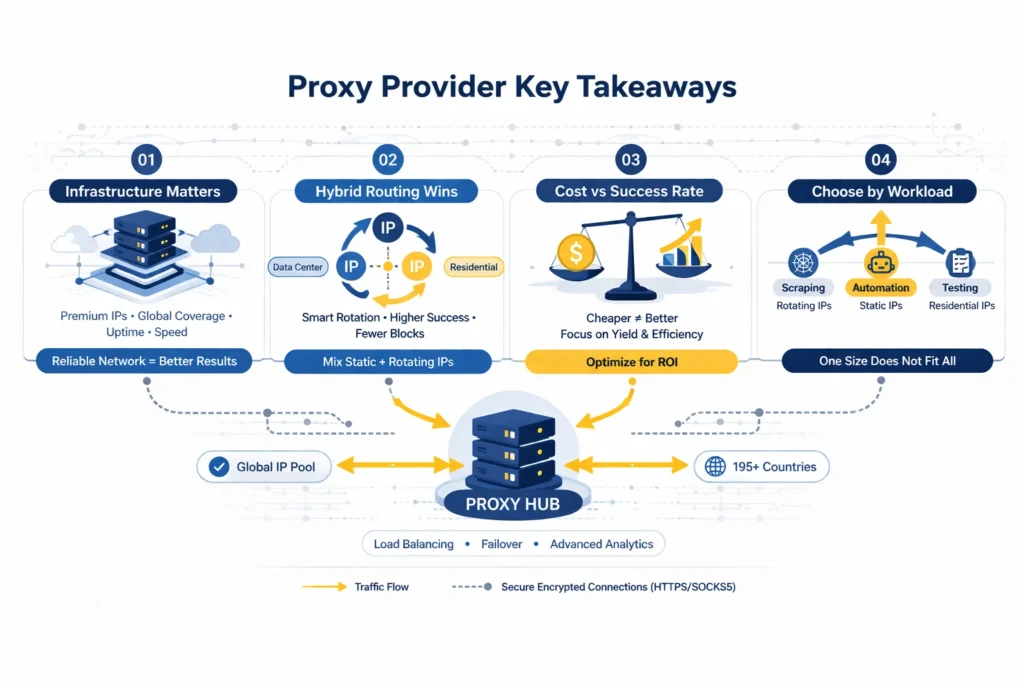
- proxy success rate depends on routing intelligence, not only IP pool size
- enterprise providers prioritize scale and governance tooling
- mid-market providers focus on usability and cost efficiency
- static proxy vendors specialize in identity persistence
- hybrid routing strategies increasingly outperform single-provider setups
Provider Comparison Overview
| Provider | Residential Scale | Mobile | ISP | Datacenter | Pricing Level | Best For |
| Bright Data | Extremely large | Yes | Yes | Yes | Very high | enterprise scraping |
| Oxylabs | Extremely large | Yes | Partial | Yes | High | structured data pipelines |
| IPRoyal | Medium | Limited | No | Yes | Low | freelancers |
| Geonix | Medium | Yes | Yes | Yes | Medium | growth automation teams |
| Proxy-Seller | Limited | No | Yes | Yes | Low | static workflows |
| MangoProxy | Medium | Yes | Yes | Yes | Competitive | hybrid execution |
| MobileProxy.Space | No | Yes | No | Yes | Low | Mobile automation, web scraping, multi-accounting, SEO monitoring |
How Proxy Infrastructure Impacts Automation
Automation reliability depends heavily on identity lifecycle management.
Large scraping pipelines must control:
- request concurrency
- geographic routing balance
- IP reuse patterns
- session persistence
Providers that invest in adaptive routing engines typically achieve more stable execution outcomes.
👉 Understand routing fundamentals in What Is a Proxy Server
Enterprise Proxy Providers
Bright Data
Bright Data operates one of the largest proxy ecosystems globally.
Its infrastructure is optimized for organizations requiring:
- massive request throughput
- compliance reporting
- advanced scraping orchestration
However, pricing complexity and integration overhead can slow experimentation cycles.
Oxylabs
Oxylabs focuses on structured data acquisition and enterprise reliability.
Its proxy networks often perform well in:
- ecommerce intelligence
- SERP data pipelines
- large-scale monitoring
Organizations with mature engineering teams benefit most from its ecosystem.
👉 Explore execution models in Proxy for Web Scraping
Flexible Mid-Market Providers
MobileProxy.Space
MobileProxy.Space provides mobile and datacenter proxy infrastructure for automation teams.
The platform offers broad mobile coverage across 50+ countries with flexible IP rotation, unlimited traffic, and carrier-level geographic targeting. It is particularly well suited for multi-account management, scraping, SEO monitoring, and social media automation.
IPRoyal
IPRoyal provides accessible proxy solutions designed for smaller teams.
Its strengths include:
- transparent pricing
- simplified setup
- suitable static proxy offerings
Performance consistency may vary under high concurrency loads.
Geonix
Geonix targets automation teams scaling beyond experimental workloads.
The provider offers rotating proxy pools and geographic flexibility.
Execution reliability is generally sufficient for medium-scale scraping pipelines.
Static Infrastructure Specialists
Proxy-Seller
Proxy-Seller is widely used for workflows requiring stable identity signals.
These include:
- account automation
- persistent login sessions
- controlled geographic routing
Dynamic scraping may require additional rotation strategies.
👉 See session engineering approaches in ISP Proxies Guide
Hybrid-Oriented Providers
MangoProxy
MangoProxy emphasizes combining multiple proxy identity layers within a single execution environment.
Typical deployments may include:
- residential routing for discovery
- datacenter nodes for throughput
- ISP proxies for session persistence
- mobile IP routing for sensitive interactions
This architecture supports teams experimenting with layered automation strategies.
👉 Learn layered execution logic in Static vs Rotating Proxies
Detection Resistance Comparison
| Provider | Residential Trust | Mobile Identity | Static Session Strength | High-Concurrency Stability |
| Bright Data | Very high | High | High | Very high |
| Oxylabs | Very high | Medium | High | Very high |
| Geonix | Medium | Medium | Medium | Medium |
| MangoProxy | Medium-high | Medium | High | High |
| Proxy-Seller | Low | None | Very high | Medium |
| IPRoyal | Medium | Low | Medium | Medium |
👉 Understand detection signals in Proxy Detection Guide
Pricing Model Comparison
| Model | Typical Providers | Pros | Cons |
| Traffic billing | Bright Data, Oxylabs | flexible scaling | unpredictable costs |
| Per-IP | Proxy-Seller | stable budgeting | limited dynamic routing |
| Hybrid | MangoProxy, Geonix | balanced control | requires planning |
Real Cost vs Listed Cost
A critical but often overlooked factor is cost per successful request.
High success rates can justify premium pricing, while cheaper proxies may require aggressive retries that increase effective spend.
Geo Routing – traffic localization
Automation teams should evaluate:
- retry frequency
- block rates
- latency impact
before selecting a provider.
Multi-Provider Strategy
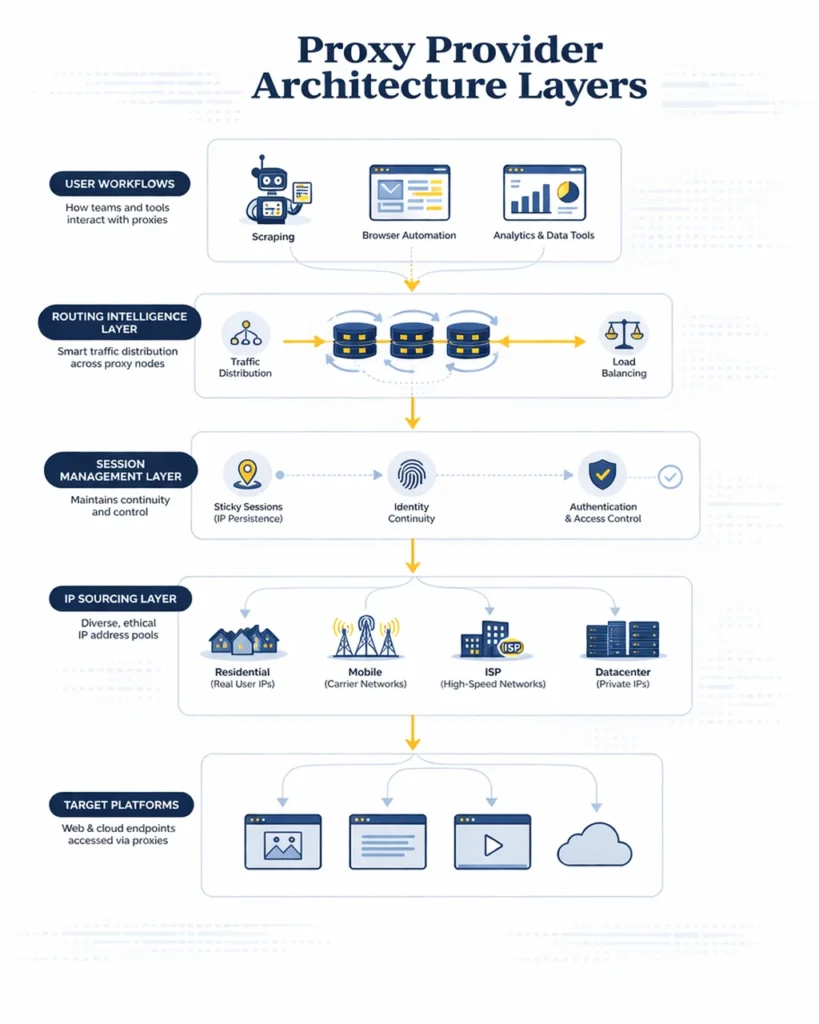
Increasingly, organizations deploy traffic across several proxy networks.
Benefits include:
- routing redundancy
- cost optimization
- improved detection resistance
Typical architecture:
- residential discovery
- datacenter scaling
- ISP persistence
👉 Explore real workloads in Proxy Use Cases Hub
Decision Framework
Choose enterprise providers if:
- scraping scale is massive
- compliance requirements exist
- engineering teams support integrations
Choose flexible providers if:
- experimentation speed matters
- cost transparency is critical
- workloads evolve rapidly
Choose static proxy vendors if:
- identity persistence is priority
- session continuity drives success
Final Thoughts
Proxy providers differ significantly in infrastructure philosophy, pricing logic and routing intelligence.
Organizations that design proxy strategies aligned with workload characteristics rather than brand perception typically achieve more predictable automation outcomes.
Frequently asked questions
Here we answered the most frequently asked questions.
What are proxies mainly used for?
They are used for scraping, automation, testing and routing flexibility.
Which proxy type is best for scraping?
Rotating residential proxies are commonly used for discovery tasks.
Are proxies useful for SEO monitoring?
Yes, they help simulate searches from different locations.
Can proxies improve automation stability?
Stable routing identity often reduces workflow disruption.
Easy API integration matters more than pool size